Some Seaside Fashion…

With the increasing interest in outdoor activities and in particular going to the beach, there was a corresponding increased interest in having the “right” fashion for such occasions. For beachgoing, yachting, or simply spending time at the seashore, designers were quick to respond and by the 1890s, there was a plethora of styles available to women.

Beach 1890s

Sometimes bathing costume was not available…

It could probably be argued that the first seaside fashions per se where those created for yachting, an activity that was decidedly limited to the upper classes. John Redfern was one of the first to popularize Yachting costume in the 1870s, being conveniently located on the Island of Cowes, the site of the Cowes Regatta which was one of the largest yachting events in Europe. Yachting costume pretty much followed regular day fashions with the only difference being an incorporation of nautical themes derived from naval uniforms, both officer and enlisted (i.e. sailors). Because of the nature of sailing, fabrics tended towards wool, cotton, and linen and trim and ornamentation tended towards the more minimal (although there were always exceptions).

Redfern Yachting Fashion Queen 1887

Some of Redfern’s “boating” or yachting fashions in the July 16, 1887 issue of The Queen.

Here is one example of yachting dress that’s possibly attributed to Redfern (according to the auction website) from c. 1895:

Yachting Dress c. 1895

Yachting Dress, c. 1895 (originally made in 1890, sleeves have been modified); Kerry Taylor Auctions Website.

Yachting Dress c. 1895

Full Front View

Yachting Dress c. 1895

Another Close-Up Of Bodice

Yachting Dress c. 1895

Close-Up Of Bodice

Yachting Dress c. 1895

Side Profile

Yachting Dress c. 1895

Rear View

This dress is constructed from a cream-color wool with matching upper sleeves made from a silk “grosgrain”- we suspect that it might be a silk bengaline or faille but the picture quality is not good so it’s hard to determine. It would be interesting to know how it looked in its original configuration before the leg-of-mutton sleeves were installed but we can only assume that the sleeves would have been fairly close to the shoulders with perhaps a small “kick-out” at the top.

Here’s another example from 1897 constructed of a cream-colored linen:

Yachting Fashion c. 1897

Yachting Dress, c. 1897; Preservation Society of Newport County

This yachting dress was part of the wedding trousseau for Mrs. John Nicholas Brown (née Natalie Bayard Dresser) who had the dress embroidered with the insignia of the New York Yacht Club in 1897.

And as an aside, we have always wondered just how women managed to get on or off of a yacht, given the somewhat confining nature of late 19th Century fashion… 🙂

e6c8016d72f56b74bef014d6a546d733

But it wasn’t all about yachting dress, the nautical theme was carried over into dresses intended simply to be worn at the seashore, whether on the beach or close by:

Day Dress 1900 Linen Nautical Theme

Day Dress, American, c. 1900; Metropolitan Museum of Art (1980.171.3a–c)

Day Dress 1900 Linen Nautical Theme

Close-Up Of Front

Day Dress 1900 Linen Nautical Theme

Front Three-Quarter Profile

Day Dress 1900 Linen Nautical Theme

Rear View

This dress is made of a mocha or dark khaki-colored linen and was made around 1900; based on the full blouse silhouette (suggestive of the pigeon-breast style), we believe it dates from the early 1900s. With its free-flowing lines, this dress allowed freedom of movement and the linen material was the perfect choice for wear in warm weather.

Taking the nautical theme further, here’s a similar dress from c. 1895:

Day Dress 1895 Linen Nautical Theme

Day Dress, c. 1895; Metropolitan Museum of Art (1986.150a–e)

Day Dress 1895 Linen Nautical Theme

Side Profile

Day Dress 1895 Linen Nautical Theme

Rear View

Like the first dress, this one is also constructed of linen, also in a shade of khaki. This dress is a little more fitted than the first with a slightly longer, narrow skirt and a more fitted blouse but is still practical for wear on the beach on hot summer days. 🙂

Finally, here’s another dress from 1895 that employs a different color combination:

Day Dress 1895

Day Dress, American, c. 1895; The Museum at the Fashion Institute of Technology, New York ( P84.25.2)

The above dress is made from a white cotton pique with salmon-colored cotton trim that’s utilized on the hem, cuffs, belt, and collar. In contrast with the first two dresses, this one is a more structured and definitely has a typical 1890s silhouette (of course, the difference between the dresses may be simply be a matter of staging).

Beach 1890s

And sometimes one had to improvise at the beach…

Whether or not people had the “right” fashion, the seashore never failed to attract people and especially on a hot summer day. Enjoy your summer! 🙂


Summertime At Atlantic City…

Atlantic City 1873

William Trost Richards, “Seascape With Distant LIghthouse, Atlantic City, New Jersey” (1873)

With the latest theme of summertime fashions for the seashore, we decided to take this opportunity to put up a few views of Atlantic City in the early 1900s:

Atlantic City Boardwalk c. 1900

Atlantic City Boardwalk c. 1900

Atlantic City Boardwalk c. 1900s

Atlantic City, c. early 1900s

Atlantic City 1900s

Atlantic City Boardwalk, c. early 1900s

California Girls – 1890s Style

For most people, the celebration of the California beach girl is a relatively new thing, starting with such songs as “California Girls” by the Beach Boys and the surge of surf and beach party movies that came out during the 1960s.

However, while the Beach Boys might seemingly have been instrumental in securing the image of the California beach girl in the the popular mind, they were not the first. 🙂

As noted in yesterday’s post, interest in sports and outdoor life by both men and women led to the development of specialized clothing to include bathing costume. The attractions of going to the beach as a relief to the hot summer weather was attractive to the point where the 1880s and 1890s, there was a rapid growth of seaside resorts such as Atlantic City and Coney Island. California also had its seaside resorts such as Coronado and Santa Monica. Below is a poem with illustrations from the June 21, 1896 edition of the San Francisco Call:

bathingsuits_sfcall_jun21_1896

From the June 21, 1896 edition of the San Francisco Call.

And here’s the poem from the above illustration:

Dance, old sea, for your charmer neareth!
There! She is wrapped in your lace of foam!
Never your summery smile she feareth!
Ha! She is down near the sea pears home!

Rare as the pearl her pink foot presses-
Rare as the pink of the pearls, her charms!
Wave that enfolds her, what fortune blesses-
What bliss- as she sways in the wild wave’s arms.

Happy sea, by our west shore golden;
Seas of the east- do they chafe and reel,
There where naught can the maids embolden
More than their sandal shoons to wet?

Perhaps the verse is not the best but it’s certainly enthusiastic and celebrates the superiority of the California coast. 🙂 In the end, whether it’s fashion, music, or popular culture in general, nothing is really ever “new.” We hope you’ve enjoyed this little excursion back to 1896.

Hotel Del Coronado, c. 1890


1890s Bathing Costume

My recent trip up north to Angel Island got me thinking about how Victorians experienced the seashore during the 1890s and thus this post was born. It’s a little off our usual beaten path but we think that you’ll like it. 🙂


During the Victorian Era. During the late 19th Century, various forms of specialized dress rapidly developed and especially when it came to sporting activities. This was an especially revolutionary development for women in that it signaled that the status of women in society was changing. Where once Women were expected to remain focused solely on domestic activities, they were now increasingly leading public lives and often independent of men (granted, this was an uneven process that continues up to the present).

One of the most dramatic developments was the development of “bathing costume” which allowed women to go swimming at a lake, river, or seashore while maintaining decorum and modesty. However, this was not a smooth process and there was resistance from the more conservative elements to the point where the wearing of bathing costume was either completely illegal or subject to stringent regulation to the point where women could be arrested for indecent exposure if their bathing costume failed to meet local standards.

Le Monitor 1893

Le Moniteur de la mode, c. 1893

Specific bathing costume can be traced back at least the 1850s but it wasn’t until the 1890s that bathing costume emerged as a major trend, spurred by the idea that going to the beach was considered to be a healthful social activity.

Too often we think of people in the Victorian era as being bored or even morose. These photos humanize an era by capturing those elusive smiling Victorian faces.:

And the market responded… 🙂 The catalog advertisement below is only one of the wide variety of ads that were out there during the 1890s:

Jordan, Marsh & Co., Women's Bathing Suits Spring and Summer, 1897 Mohair plus water plus a hot summer day, what could be more comfortable than that?:

Page From An 1897 Jordan Marsh Catalog

Bathing costume during the 1890s usually consisted of a top, blouse, short bloomers or knickers and a skirt. Stockings and special “bathing boots” made of canvas and cork soles were also worn, all with the idea of the woman not showing too much skin. The fabrics used for making bathing costume were usually wool flannel, wool jersey, mohair, linen, cotton, or some combination thereof. Needless to say, these were not intended for serious swimming (that would come later) but rather wading or simply lounging on the beach. Style-wise, bathing costumes had a nautical theme with sailor collars and the predominant use of blues and blacks.

Victorian Bathing Suits

Posed Picture, c. 1902; Library of Congress

Below are some examples of bathing costume. First, here is one from c. 1878 – 1880 where we see the basic silhouette and style that was to predominate in the 1890s starting to become established:

CI50.77.1a–c_F

Bathing Costume, c. 1878 – 1880; Metropolitan Museum of Art (C.I.50.77.1a–c)

CI50.77.1ac_B

Rear View Of The Top

CI50.77.1ac_F

Front View Of The Top

CI50.77.1b_F

The Bottom

Here’s a later version from the 1890s:

M992.115.2-P1

Bathing Costume, c. 1890s; McCord Museum (M992.115.2)

As can be seen from the above, bathing wear had a nautical style reminiscent of naval uniforms of the period, a theme that was to continue on into the early 1900s.

However, even back in the 1890s, there could be dramatic exceptions to the norm when it came to fashion and that was especially evident with this “startling bathing costume” pictured in the August 22, 1897 edition of the San Francisco Call:

fashion1_sfcall_aug22_1897

The above outfit is certainly a departure from the typical dark-colored nautical-theme in that the base color is white, constructed of horizontal layers of white wool serge. The model is wearing only the knickers and a one-piece bodice/shirt. She appears to be perhaps holding a skirt or cape of sorts. What is interesting is that the front and back of the top match the horizontal layers of the knickers and it appears to almost be a one-piece outfit. This is definitely fashion-forward beach wear of the time. 🙂

Finally, we leave you with this picture below of some frolicking beach-goers, all dressed in variations of the standard 1890s bathing costume style:

Santa Monica 1898

“Out for a Time,” Long Beach, c. 1898; California State Library

We hope you have enjoyed this little summer excursion to the beach. 🙂


Angel Island Recap

wp-1470449172924.jpg

Looking Out Towards The Golden Gate Bridge

After a relaxing but busy weekend at Angel Island, I have returned to the hustle and bustle of Los Angeles- it was all too short a time but it was a pleasant relief from the heat and near-constant brush fires. So how was it? Excellent! The weather was perfect for wearing wool uniforms and the cooling breezes off the ocean kept everything on an even keel. 🙂

Officer Row4

Camp Reynolds looking West, out into San Francisco Bay.

wp-1470677786068.jpg

Camp Reynolds, Looking East

Colors3

Lowering The Colors

Angel Island has been a favorite with me because of its rich history going back to 1863 when a permanent military presence was first established. As previously noted, this year we stayed on at Camp Reynolds on the West side of the island where a small group of us presented a living history timeline display focusing on the year 1917.

Supervising1

Supervising…Sort Of…

Inspection1

Awaiting Inspection

The main living history day, at least for our contingent, was on Saturday and we set up a display of uniforms and equipment as they would be laid out for inspection, per the regulations. Behind us is a row of Civil War Era tents left over from another event that happened a few weeks before. One of the best parts of the event was being able to interact with the public and tell them about the history of the island and the US Army in the First World War.

Visitors1

Visitors…

At the other end of Camp Reynolds was the officers’ quarters…

Camp Reynolds4

Another View Of Camp Reynolds, Looking East

wp-1470698533719.jpg

Restored Officer’s Quarters

Camp Reynolds1

Looking Towards The Golden Gate

Here are a couple more views:

wp-1470677786797.jpg

wp-1470677785545.jpg

We took up residence in the Quartermaster Building and cooked part of meals there:

Group1

Yes, as an officer I would sample the enlisted men’s meals. 🙂

And there was time for a road march:

Group6

Road March

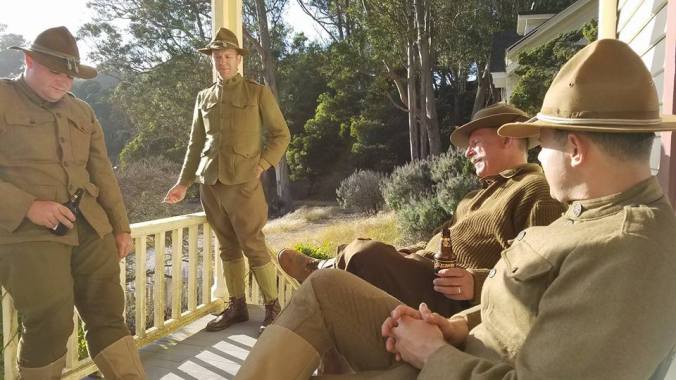
And here we are relaxing up at the officer’s quarters by special invitation… 🙂 Group2

And in the parlor…

Group3

I also took the opportunity to model my new 1906 pattern officer’s uniform, complete with the proper campaign ribbons:

wp-1470677784706.jpg

And Here’s Me…

wp-1470678036029.jpg

Discussing my last campaign…

wp-1470678086167.jpg

And One In Sepia…

Well, as with all good things, the event came to an end and it was time to go home. I will definitely be returning next year! 🙂
Leaving1.jpg