Mid To Late 1880s Daytime Fashion

When it comes to mid to late 1880s style, it’s easy for one to conjure up visions of dresses with severely sculpted lines that were largely defined by an extremely angular “shelf bustle.” Naturally, as with all fashions, they manifested themselves in both extreme and moderate versions but it was the more extreme versions that caught the attention of the press and assorted satirists. One of the most oft-repeated quips was “one could set a tea service on top of the bustle.”

Here’s just one example from an 1883 German humor magazine in which the women is likened to a Centaur:

bustle-satire-fliegende-bltter-magazine-1880s

From Fliegende Blätter; Band LXXVIII (1883), p. 147.

Interestingly enough, the above cartoon was made in 1883 when the bustle was re-emerging- perhaps they were ahead of the fashion curve? 😉

All joking aside, to a great degree, 1880s style was defined by the “shelf bustle” as shown in the picture below:

Evening Dress c. 1884 -1886

Evening Dress, American or European, c. 1884 – 1886, silk; The Metropolitan Museum of Art (C.I.63.23.3a, b)

Structure was everything in Victorian fashion and below are some examples on how the distinctive 1880s silhouette was created:

Bustle_c._1885

Bustle, c. 1885; Los Angeles County Museum of Art (M.2007.211.399)

Bustle 1884

Bustle, Steel Frame, c. 1884; Victoria & Albert Museum (T.131C-1919).

Bustle 1880s

Bustle, 1880s

Within the parameters created by the basic silhouette, there was a wide variety of possible styles. As a rule, day dresses were defined by an under and overskirt, one draped over the other, and these could either in complementary or contrasting colors and/or a solid color combined with a pattern or even two different patterns. As for bodices, this could either be  one solid unit or a combination jacket and waistcoat. The waistcoat could either be a separate garment or a faux waistcoat that has been integrated into the jacket to create a single bodice. Below are just some examples:

Godeys_Jan 1887

Godey’s Ladysbook, January 1887

In the above plate, on the left one can see a combination jacket/waistcoat styled bodice combined with with a solid colored overskirt covering a patterned underskirt. Interestingly enough, the waistcoat fabric matches the pattern on the underskirt. On the right, one can see a solid bodice trimmed with an embroidered panel that matches the pattern of the underskirt. At the same time, the pattern on the overskirt matches the basic fabric of the bodice. While there may be contrasts in fabric patterns, the do harmonize in the way that they’re both used on the skirts and the bodices. At the same time, the colors also harmonize even when they’re contrast colors.

As a rule, day dresses were defined by an under and overskirt, one draped over the other, and these could either in complementary or contrasting colors and/or a solid color combined with a pattern or even two different patterns. As for bodices, this could either be  one solid unit or a combination jacket and waistcoat. The waistcoat could either be a separate garment or a faux waistcoat that has been integrated into the jacket to create a single bodice.

Magazine Des Demoiselles_1887_2

In the above plate, we see the use of different shades of the same color that are used to harmonize. The dress on the left simply combines a lighter brown with dark brown trim on the bodice lapels and are continued down the dress front (the dress appears to be a princess line but it’s hard to tell from the plate). The dress on the right is a bit more sophisticated in that not only do we see a dark and light shades of green combined, but we also see the use of a striped overskirt combined with a striped and patterned bodice. Interestingly enough, in both dresses, the dark color is only used on the trim and patterns, the light color makes up the majority of both dresses.

Below is another example of how colors and patterns could be combined:

Magazine Des Demoiselles_1887_3

Magazine des Demoiselles, 1887

On the left, we see the use of contrasting colors, in this case rose-colored vertical stripes combined with a light gray. The stripes are distributed around the skirt and on the sleeves and front of the bodice. There appears to be only one skirt. On the right, we see a solid dark gray/blue overskirt and bodice combined with a black floral pattern with a rose background for the underskirt, cuffs, collar, and bodice front. It also appears that the bodice cuts away to reveal a waistcoat of the same patterned fabric- to us, the patterned fabric conjures up visions of cut velvet.

The following fashion plates from 1886 and 1887 further illustrate some other possible combinations:

Peterson's_Nov 1886

Peterson’s Magazine, November 1886

Petersons_Feb 1887

Peterson’s Magazine, February 1887

Petersons_June 1888

Peterson’s Magazine, June 1888

Fashion plates are are well and good but what about actual dresses? Well, in answer, here are some extant examples::-)

Day Dress c. 1885

Day Dress, French, c. 1885; Silk plain weave (taffeta) and silk plain weave with warp-float patterning and supplementary weft, and silk knotted tassel; Los Angeles County Museum of Art (M.2007.211.34a-b)

1887 - 1891 Day Dress1

Day Dress, c. 1887 – 1891; Metropolitan Museum of Art (C.I.55.40.1a, b, e)

Pingat 1 1888

Pingat, Promenade Dress, 1888; Metropolitan Museum of Art (2009.300.7758a, b)

Day Dress 1887 - 1889 1

Day Dress, c. 1887 – 1889; Metropolitan Museum of Art (C.I.53.68.2a–c)

Day Dress 1888 1

Worth, Day Dress, 1888; Metropolitan Museum of Art (2009.300.665a, b)

1888 Day Dress

Madame Arnaud, Paris, Morning Dress, c. 1888; The Museum at the Fashion Institute of Technology (2008.46.1)

For many, the typical 1880s silhouette is off-putting and in our experience, we have found that for most people looking to recreate the styles of the 1880s, they tend to gravitate towards either towards the beginning of the decade with the Mid-Bustle Era styles or towards the end of the decade where the bustle was diminishing and we start to see a more cylindrical, upright profile that was to carry on into the 1890s.

However, while there’s no denying that the late 1880s fashion silhouette was defined by an often extreme, angular bustle, this was not always the case and there are many instances where women toned it down- just looking at the variety of bustle appliances and pads that were available for sale is testament to that. As with all fashion, there were those who went to extremes and others who tended to be more conservative and especially for those of more modest means.

Just as important, if not more so, the 1880s offers a variety of styles to suit every aesthetic and a lot of room for developing a unique “signature” style that’s unique to the individual. So, why not give it a try? 🙂

Gone To No. 11…

Etihad 777 flight

It’s been a long week here in LA but now it’s time for me to head out to Tombstone but it will not involve a long car ride, just a long wait at the airport. However, it’s all worth it and soon I’ll be at No. 11 and working on some new design ideas (like we don’t have enough design ideas already!).

So what sorts of design ideas, you might ask? We’ll that’s a bit under wraps for now but trust me, it’s definitely something stylish. 🙂

And just because I can’t resist, one of my favorite movie characters, Johnny Behan in Tombstone:

johnbehansherrif1

See you down the trail!

Dressing The Lawman

Recently someone asked me the question: “What did lawmen wear in the Old West?” The easy answer is: “the same clothes that everyone else wore.” OK, I’ll admit that that answer is a bit snarky and it is a legitimate question. Our perceptions of what lawmen wore have been to a great degree shaped by what we’ve seen in film and television with all its inherent inaccuracies.

Tombstone-Val-Kilmer-Sam-Elliott-Bill-Paxton-Kurt-Russell

Wyatt Earp Movie1

When considering the question of fashion and lawman, one’s head is filled with images from such iconic movies as Tombstone or from television shows such as Gunsmoke. In reality, “lawmen” in the American West during the late 19th Century took several forms to include town and county sheriffs/marshals, state rangers such as the Texas or Arizona Rangers, and federal marshals. Also, there could be a variety of semi-private “lawmen” such as Pinkerton detectives (who often functioned as a law unto themselves).

TEXAS RANGERS — (Standing from left) Jim King, Bass Outlaw, Riley Boston, Charley Fusselman, Tink Durbin, Ernest Rogers, Charles Barton and Walter Jones. (Seated, from left) Bob Bell, Cal Aten, Captain Frank Jones, J. Walter Durbin, Jim Robinson and Frank L. Schmid. – Courtesy Texas Ranger Research Center; Texas Ranger Hall of Fame & Museum —:

Texas Rangers, c. 1888

This photograph was made in about 1880, and shows three agents from the Pinkerton Detective Agency. The man in the middle is William Pinkerton, son of the group's founder, Allan Pinkerton. Allan Pinkerton was a personal friend of Abraham Lincoln, and provided protection for the president while he was in office.:

Pinkerton Detectives c. 1880. The man sitting in the middle is purported to be Allan Pinkerton, the company’s founder.

Also, it must be noted that for many jurisdictions throughout the American West, the position of “Sheriff” at the country or municipal level was typically an elected one with all its inherent flaws and they had a variety of job duties of which apprehending criminals was only a part. Other duties could include serving warrants and summonses, supervising executions, jailing prisoners, investigating crimes, collecting stray dogs, and collecting taxes. Collecting taxes was one of the most important parts of the job since it was taxes that paid for the sheriff’s deputies and the costs of running the government.

While the popular conception of the Old West lawman is that one of a steely-eyed gunfighter staring down one or several desperados, all intent on murder and mayhem. The reality was that it more about dealing with drunks and generally keeping public order, specially in the newly-formed cow towns such as Wichita and Dodge City.

That said, let’s move to the clothes- here are just a few pictures of real Western lawmen:

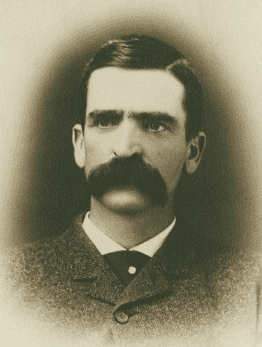
John Slaughter, Sheriff of Cochise County, Arizona 1887 – 1890

Bass Reeves Lawman the Original Lone Ranger ✔️:

Bass Reeves, Deputy US Marshal, 1876 – 1907

Old West lawman | old-west-lawman_edward-johnson.jpg:

Henry Andrew "Heck" Thomas born January 3, 1850 was an lawman on the American frontier most notably Oklahoma. He was appointed US Deputy Marshal out of Fort Smith, Arkansas working under Judge Isaac Parker.:

Looking at the above pictures, it’s easy to discern that their clothing pretty much mirrored what was generally worn. For the most part, it mostly consisted of trousers, shirt, vest, and a sack coat. In warmer weather, a jacket was not worn and sometimes just the shirt was worn. Allowing for the “dressing up for the camera” effect, it’s still obvious from the more informal portraits that it wasn’t an affected style. In many instances, there was little difference between what a lawman wore and what others wore except for the badge and perhaps more guns.

Lawmen as seen on film.

For anyone desiring to recreate the look of a Western lawman, probably one of the best places to start is with either a sack suit or for something more “out on the trail,” a pair of trousers, shirt, and vest but that’s only a suggestion. There are a lot of original pictures that one can use to base their research on and they can adjust their look depending on what sort of an impression. One thing I do want to note is that except during times when lawmen were in active pursuit of a criminal or otherwise expecting trouble, they were not walking arsenals with multiple pistols and a rifle or shotgun. In town, lawmen frequently simply carried a small caliber pistol in a trouser or coat pocket (often reinforced because of the weapon’s weight).

And another…

Finally, it should be noted that as an elected public official, a county or town sheriff or marshal was expected to project an image of respectability (although the definition of “respectable” could be somewhat elastic) and as such, they tended to dress the part. For many, the position was viewed as more of a means to a political career than anything else and they acted accordingly. One good example of this was with Johnny Behan, the Sheriff of Cochise County. For the most part, he was more concerned with collecting taxes and keeping up appearances; for the actual work of enforcing the law, deputies were hired. Pictures of Behan show him dressed in a sack suit, looking like any middle class small town businessman (which he basically was). Like today, image and respectability were important during the Victorian Era and dressing correctly played a key role.

Johnny Behan, c. 1871

Reality is often pretty dull when compared to what is portrayed in film and television and that especially applied to the lawman of the American West and we hope that you have found this post to be informative. 🙂  


Lily Absinthe & That Old West Magic

It’s going to be a busy week here at No. 11. This is where we make the real old west magic. So many projects, my head is spinning! 🙂

wp-1467071947136.jpg

wp-1467071932877.jpg

And Now Back To Paris…

Gray is a color that works for a variety of fashions and especially when it comes to daywear. Here is just example that every effectively combines complementary shades of gray (we kind of cringe using that phrase… 🙂 ), made by a one Amedée Françoise (unfortunately, we were unable to find anything in English about this Couturiere):

Day Dress 1880

Day Dress, c. 1880; Metropolitan Museum of Art (43.72.2a–c)

Day Dress 1880

Side Profile

Day Dress 1880 - Rear

Left Three Quarter Rear View

Day Dress 1880

Rear View

As can be seen from the above pictures, this dress combines a solid dark gray silk underskirt with an embroidered patterned silk bodice and train. The patterned bodice fabric has a darker gray background and while this would simply serve to darken the entire dress, this fabric actually has the opposite effect partly because of the fabric’s luster and the white and lavender embroidered pattern.

Except for the the band of tassels running along the hem, the skirt is unadorned with a smooth back and three rows of knife pleating on the front. Interestingly enough, the train appears to be composed of two different shades of gray silk fabric; the darker gray makes up the majority of skirt while the lighter shade is seen peeking out at the bottom where the skirt and train begin. Although it’s hard to tell from the available pictures, we would be inclined to say that this appears to be a minimal underskirt. Also, this light gray matches the trim. Finally, the bodice is also relatively unadorned except for fringe and tassels running along the edges.

Style-wise, this dress is firmly in the Mid-Bustle Era, 1880 to be precise, and as such it’s characterized by having a cylindrical profile, low demi-train, and defined balayeuse. Moreover, the bodice is reminiscent of an 18th Century coat with cutaway lapels.

To better appreciate the contrasts in the two base fabrics, close-up views are available here:

This dress utilizes a masterful combination of grays to achieve an effect that is both understated and elegant at the same time. With this dress, the fabrics and cut do all the talking. 🙂