By 1907, a seismic shift was happening in the fashion world that saw a repudiation of the tightly controlled architectural styles defined by tight corseting to styles that were seemingly unstructured and free-flowing (although undergarments still played a key role, albeit more subdued) a more freer. One manifestation of this new fashion trend was a return to the Directoire and Neo-Classical styles of the early 1800s, styles that were incorporated by Paul Poiret in his couture collections such as with his iconic “Josephine” evening dress that he created in 1907:

Poiret, Evening Dress (aka “Josephine Dress”), c. 1907; Musee de les Arts Décoratifs (UF 70-38-10)
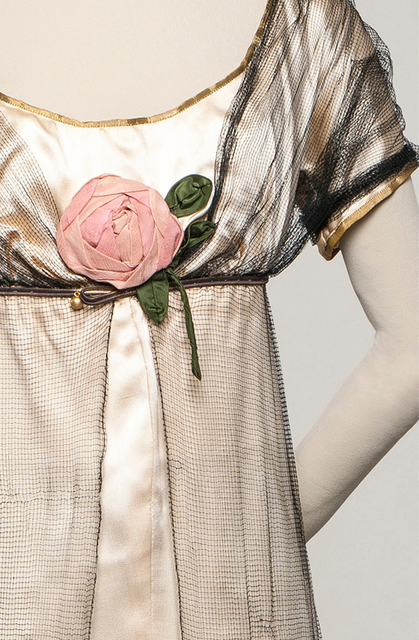
This dress was constructed from an ivory silk satin and cut in an empress silhouette, a silhouette characterized by a fitted bodice with a high waist that ended just below the bust line combined with a loosely fitted skirt that flowed over the body. The dress is trimmed with a fitted black net shawl, trimmed in gold braid along the edges and hem. Finally, on the bodice front is a large silk fabric rose that draws the eye. Here’s another view:

Here’s a comparison between the dress and concept illustration that was published in 1908:

And here’s a close-up of the dress front. Note the black net covering:
This dress definitely looks back to an earlier time and it could be argued that the style completely repudiates the tightly structured styles that had dominated fashion for over half a century. To draw a further parallel, the Directoire and Neo-Classical fashions of the late 18th Century and early 19th Century was also a repudiation of the earlier tightly structured styles that were characteristic of most of the 18th Century up until the 1790s. Just for comparison, here’s just two examples from the early 1800s that are very similar to Poiret’s design:

Merry-Joseph Blondel, Felicite-Louise-Julie-Constance de_Durfort, 1808

And here’s the concept illustration that appeared in Les Robes de Paul Poiret which was a design album illustrated by Paul Iribe that served to promote his fashion conceptsLes Robes de Paul Poiret was a limited edition book- only some 250 copies were printed and almost impossible to find on the used book market. But you can download an electronic version for free from https://archive.org/details/lesrobesdepaulpo00irib[/mfn]:

Poiret’s Josephine dress is a perfect illustration of the basic fashion cycle of action and reaction and it pointed the way forward for fashion into the 20th Century.


