And For A Little Street Style…1881 Style

P

ictures of street style for the 19th Century are rare but here’s one I found while looking for material for another project (it always seems to to happen that way).

Yankton1 1881 Day Wear Streeet

Yankton, South Dakota, 3d street looking west from Walnut. 1881

What details that can be made out in the picture are interesting in that even though the picture was taken in the middle of Yankton, South Dakota, it’s clear that these two ladies put some effort into their outerwear and the styles match those found with in more opulent locations such as London and Paris. While perhaps not as opulent as this mantle made by the House of Worth, the silhouette is still similar:

Worth 1885

It’s a pity that the women in the picture are far from the camera and that there’s not a lot of detail that can be discerned but it’s still fascinating because the women are well dressed even in 1881 South Dakota.

More From The FIDM Museum…

W

e at Lily Absinthe make a point of often visiting the FIDM Museum. The exhibits are updated often and there’s always something that exquisite to see and rarely do we go away not being inspired. 🙂 As a follow-up to yesterday’s post, here’s a little more about what we saw there. First, we have a mantle, c. 1885, designed by Charles Worth:

Worth 1885

Worth 1885

This coat is constructed a silk velvet/brocade trimmed with sable. Although it’s not easy to make out, the brocade design is that of a pineapple (one could argue that the choice of pineapple was apt since it was considered an expensive luxury). Definitely intended for a cold climate (with temperatures running abound 103, the Californian in us shudders), the mantle was intended to provide total coverage and is shaped to accommodate the underlying bustled dress.

Next up, is this c. 1908 afternoon dress designed by Liberty & Company, Ltd.:

FIDM Liberty of London 1908

FIDM Liberty of London 1908

The dress silhouette is characteristic of the later 1900s and while it was no doubt work with an s-bend corset underneath, it’s fairly muted (although that can simply be the staging). The bodice and skirt are made from a gray silk/silk chiffon, trimmed with embroidered silk flowers along the lapels of the bodice, sleeves, and waist. The bodice is designed with a front opening to simulate a jacket with a lace/gauze waist underneath.

FIDM Liberty of London 1908

FIDM Liberty of London 1908

Close-up of the embroidery detail. Liberty of London was a high-end department store in London specializing in importing fabrics from the Orient and especially Japan.

In terms of style, this represents the more conventional path when compared to a designer like Paul Poiret who, at the same time, was pushing Nouveau Directoire:

Paul Iribe 1908 Poiret Noveau Directoire

Noveau Directoire 1908 Poiret Josephine Dress

Paul Poiret, Day Dress, 1908; Les Arts Décoratifs

 It’s quite a contrast…

Well, that concludes our most recent trip to the FIDM Museum. Stay tuned for more posts in the future about this most remarkable place. 🙂

Charles Frederick Worth & Early Haute Couture

Atelier11

Costume College was busy for me this year. Besides delving into the world of Paul Poiret, I also delved into the world of haute couture during the later 19th and early 20th Centuries, an ambitious topic to say the least- one could easily go on for days and barely scratch the surface. 🙂 Fashion  history has always been fascinating and even more so when one makes little discoveries that link the world of the past with today and the research process never fails to disclose tiny nuggets of useful information.

Image result for louis xiv

In many respects, the world of haute couture, as we know it today, got it’s start in Paris largely through the efforts of one man- Charles Frederick Worth. Moreover, he was able to capitalize on a series of trends that had been developing for quite some time. Specifically, going back to reign of Louis XIV, royal patronage driven by the consolidation of the monarchy as the supreme ruling power in France combined with France’s growth as an economic, military, and cultural power served as a catalyst for the development of the textile industry and the needle trades. All the right elements were in place and over the next 300 years a thriving garment began to develop, spurred by patronage both by the Crown and nobility (as they sought to remain in good graces with the King).

charles-frederick-worth-english-fashion-designer-active-in-paris

By the mid-19th Century, industrialization served to further spur the growth of the textile and needle trades (can you say sewing machine?) and the ground was fertile for a man like Charles Worth. Worth transformed a relatively decentralized industry composed of many individual dressmakers working in small establishments into a large-scale industry employing hundreds, if not thousands. Worth consolidated fabric procurement with production (before this, it was customary for clients to bring their own fabrics to the dressmaker). Also, for marketing, he employed the technique of having his clients choose from a series of sample models, modeled by an army of pretty young women; the client would make a selection and a custom garment would be created. The model was intended to give the client an idea of the final product- often, the fabrics and trim would vary to the individual client.
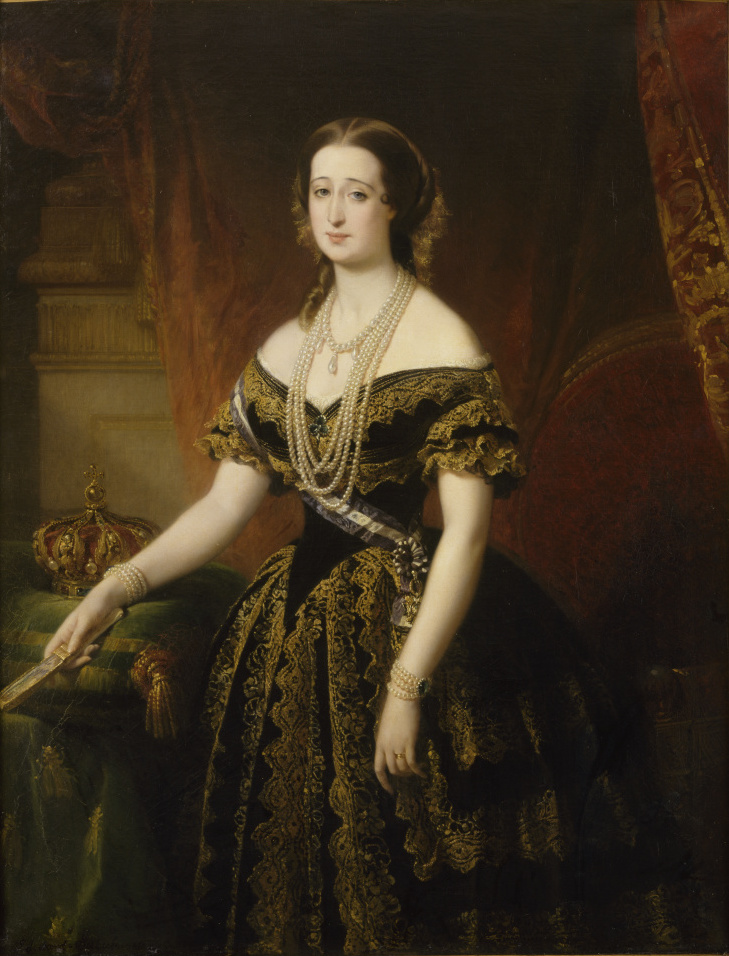
Image result for empress eugenie

What also makes Worth unique is that in 1860 he was able to secure the patronage of the Empress Eugénie and this cemented his reputation; as the center of the French court, the Empress set the styles and naturally everyone of importance wanted to emulate her.

With the demise of the Napoleon III and the Second Empire, Worth was forced to seek expanded markets- no longer did he have a guaranteed client base founded on royal patronage- so he was forced to seek a wider client base. Worth was ultimately successful in this endeavor and by the time he died in 1895, he had clients on all seven continents.

In many ways, the demise of the Empress’s patronage was the best thing for both Worth and haute couture in general in that it pushed couture out to a wider audience and stimulated greater design/style creativity- styles were not determined by the whim of a few people but rather transferred the power to the designers (and ultimately their clients). It also helped couture to reach a wider audience and facilitate the diffusion of fashion.

Worth Ballgown 1898

House of Worth, Ballgown,, 1898; Metropolitan Museum of Art (2009.300.1324a, b)


Of course, Worth wasn’t the only couturier- there were many others. Some of Worth’s leading contemporaries were Jacques Doucet, Emile Pingat, John Redfern, and Jeanne Paquin- all fascinating as designers. Unfortunately, there’s not a lot of information out there on many of these designers and they’ve become almost forgotten.

Doucet1

Jacques Doucet

John Redfern

John Redfern

Emile Pingat

An early portrait of Emile Pingat; Courtesy of Jacques Noel

Paquin1

Jeanne Paquin

The above is only a very broad sketch of the topics that I covered in my presentation and I felt that it went pretty well. For the future, I may narrow my focus a bit but nevertheless, it wasn’t bad for a first outing. Stay tuned for more… 🙂


Almost Ready For Costume College…

Isincerely apologize for things being quiet here but I have been in hibernation for the past few weeks furiously working on a series of presentations that I will be giving at Costume College. Why the last minute rush? Well, unfortunately life has a habit of getting in the way and with our relocation and all, time has been at a premium. Costume College is an annual three-day costuming arts convention sponsored by the Costumer’s Guild West and it covers all periods and genres.

Adam 1918

Last year, I gave a presentation on American military uniforms entitled “US Army Uniforms, 1915 – 1918” and I had such a fun time with it that I decided to give an expanded version this year and this is scheduled for Friday July 28. But wait, there’s more…

Picture1

On Saturday July 29, I will also be giving presentations on Paul Poiret, entitled “The King of Fashion: The World of Paul Poiret” which will give an overview of his early career. Also, I will be presenting “Haute Couture: The Early Years” where I give an overview on the rise of haute couture during the late 19th and early 20th Centuries (1870 through roughly 1905) both in terms of designers and the various styles.

Stay tuned for more!

Black & Mourning Wear

Mourning wear was a major element of Victorian clothing, governed by elaborate protocols that dictated style, color, and material. Naturally, the use of the color black was central in mourning wardrobes and early on, the color was for the most part co-opted for this express purpose. However, by the end of the 19th Century, we see some relaxation of the “rules” and the color black started to make it’s appearance in more everyday wear and especially with evening wear. Below is just one example that was created by the House of Worth sometime in the 1897 to 1899 time frame:

Worth Evening Gown c. 1897-99

Worth, Evening Gown, c. 1897 – 1899; Galleria del Costume di Palazzo Pitti, Florence, Italy (00000113)

Worth Evening Gown c. 1897-99

Three-Quarter Rear View

The use of the term “evening gown” is a bit misleading in that this dress would have worked either as an evening dress (any event that was not a ball) or a ballgown. The sleeves are relatively restrained, lacking the gigot silhouette. The bodice has a deep wasp-waist and the skirt has a minimal train. Although it’s hard to see with the lighting, the skirt front is decorated in two patterns of jet beading using a vine motif. For the skirt back,  we see beading on an overlayer of net. The bodice front is also decorated with floral bead patterns that extent to the neck line. Along the front neckline, the black fabric has been cut out so as to create the appearance of leaves rising up on their own combined with a lighter silk/net inset. To complete the look, there’s a strip of ivory/cream lace running along the rear neckline.  Overall, the beaded black fashion fabric combined with artful cutting has created a very dramatic effect using a minimum of color- this dress definitely depended on the ambient light to create its effect.

As with many of the examples we find online, there always seems to be a lack of information and close-up pictures. We would have been very interested in seeing the details of the beadwork and the bodice inset panels. So, there it is- black can be used in ways that are by no means limited to mourning so why not give it a try? 🙂