At The Sea Shore…

We’re almost in August and we thought we’d post some pictures of people at the seashore in the 1880s…
Beach

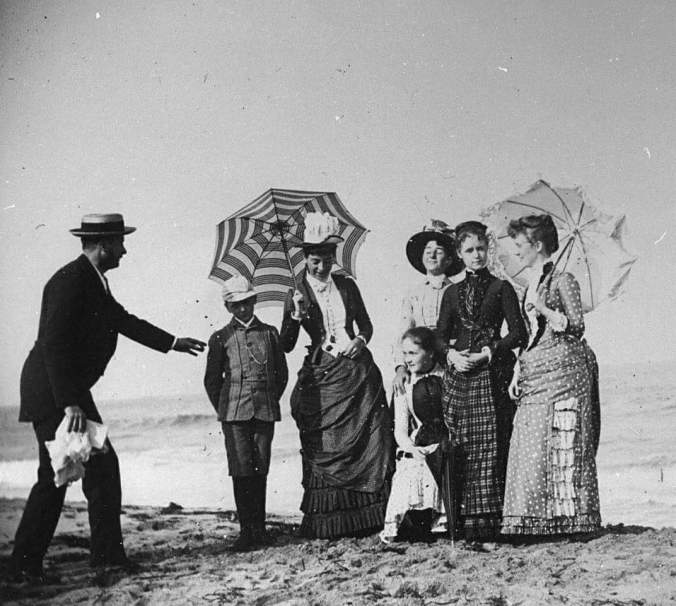
The Montgomery family, all dressed up and preparing to pose by the shoreline of beach at Stokemus, near Sea Bright, August 8, 1886

The above picture is interesting in that here you see a variety of common styles to include vest/faux, open bodice with faux waist, and closed bodice.. For skirts, all follow the bustle silhouette of the later 1880s but not in an extreme manner and each features some variation on the over/under-skirt configuration. The skirt on the woman in the middle with the parasol is the same color (seemingly from the picture) for both skirts and the under-skirt appears to the be ruffled in rows. The woman standing to the immediate rear of the little girl has a contrasting solid color over-skirt with a plaid check underskirt while the woman at the far right has a skirt and bodice made of the same material with no obvious under-skirt. It’s a very useful portrait for determining some common daytime styles that can be readily utilized for recreation purposes.

Coney Island 1885

Collecting Shells, Manhattan Beach, Coney Island, 1885 (New York Historical Society & Museum)

These two women are not deterred by the wet sand or water and have simply taken the expedient of hiking up their skirts. They’re a bit more plainly dressed than the group in the first picture with bodice and skirt of the same color. The woman on the left also appears to be wearing a short coat or jacket that has been designed to fit around the bustled skirt.

And just for contrast, something a bit more upmarket, staged in the photographer’s studio…

Portrait_Seaside c. 1885

The above picture portrays a more elaborate style although it still keeps to the convention of the bustled over/under-skirt combination typical of the later 1880s. In this instance, the bodice appears to drape over the hips and is gathered towards the rear and has a floral print design. Of course, with the woman’s elbow obscuring the waist, it’s hard to tell exactly but judging from the swags of net trimmed in fabric running along the skirt, it appears that the net is the over-skirt with a solid-colored fabric under-skirt. The effect is airy and very appropriate for summer by the beach. We hope you’ve enjoyed this little glimpse of 1880s style at the sea shore. 🙂


Some More From Pingat…

Lately, it seems that Emile Pingat has become the subject of interest for us here at Lily Absinthe and combined with our love for 1890s fashions in general, we’ve been finding all manner of Pingat’s designs. For today’s consideration is this circa 1894 ball gown:

Pingat, Ball Gown, c. 1894; Museum of Fine Arts Boston (56.816)

Rear View

As ball gowns go, this is a relatively simple design with a minimum of trim (mostly beading on the front bodice), relying instead on combinations of lace, and silk satin to achieve its effect.  With roses strategically placed on the skirt front, collar and shoulder, there are pops of color that offset the blush pink/ivory silk satin. The gigot sleeves combined with gored skirt definitely place this dress safely in the mid-1890s and create the classic hourglass style that was typical of the period. Overall, as with many of Pingat’s designs, this is elegant and clean and would definitely make an excellent bridal gown. Although best known for his outerwear, Pingat also produced many elegant dress designs- ball gowns, evening/reception dresses and day dresses and this is just one excellent example.


In The Works…

Thinking a season ahead…two 1890s capes currently in the works. The purple one is awaiting its collar.  🙂

And here’s a couple of close-ups of the collar on the red cape:


An 1890s Wedding Dress

Today we take a look at an 1890 wedding dress from the V&A Museum that not only has extensive provenance, but it even has a picture of the original owner, a one Cara Leland Huttleston Rogers, wearing the dress on her wedding day on November 17, 1890. This is a rare treat indeed. To begin, here’s some pictures:

Francis O’Neill/Stern Brothers. Wedding Dress, c. 1890; Victoria & Albert Museum (T.276,A-F-1972)

This dress has the simple, clean lines characteristic of 1890s styles with the addition of a train. The dress is constructed of a cream-colored corded silk for both skirt and bodice. The skirt is relatively simple and unadorned except for some artfully arranged swagging along the hem, punctuated by rosettes. However, the bodice is a completely different matter- built on the same cream-colored corded silk, the bodice is framed in the front by a embroidered gold/mustard brown-colored floral appliques jeweled with pearls running along the middle of the bodice and continuing up to follow an open neckline. Below is a picture of the bride:

Cara Leland Huttleston Rogers, wearing the dress on her wedding day on November 17, 1890.

The neckline is further accented by a row of ruffled silk chiffon leading up to the shoulders. The shoulders are decorated with upright panels that further continue the decorative trim design and are heavily jeweled with pearls. The upper sleeves are ruched and while there’s fullness towards the top, it lacks of the extensive gigot sleeves so characteristic of the mid-1890s. Naturally, the cuffs are also finished with more silk chiffon. Finally, the peplums on the bodice are also accented by the jeweled embroidered applique strips that harmonize with the rest of the bodice’s decorative trim. Below are some close-ups of the bodice:

The decorative appliques are even more extensive on the bodice back:

The decorative design on the bodice is very unique and it definitely attracts the eye to the upper dress and puts focus on the bride. The relatively neutral cream skirt and bodice provide a blank canvas for the decorative design. This dress design is definitely unique and is an interesting take on bridal dress designs of the period.


Pingat & Tea Gowns

No sooner did we say that tea gowns didn’t seem to be a thing with Emile Pingat than this amazing circa 1892 example from the National Gallery of Australia came along:  🙂

Emile Pingat, Tea Gown, c. 1892; National Gallery of Australia (NGA 92.1129.A-B)

This design takes the while idea of a “tea gown” and takes the style to the extreme, elevating it to an extremely fashionable garment. Utilizing complementary colors of acid yellow and dark brown, the gown combines a silk satin skirt and bodice and velvet sleeves with a Medici collar. The effect is further enhanced by the same brown velvet running along the skirt hem. Finally, a large belt with a jeweled design and decorative panel running down the gown front completes the gown’s dramatic effect. With the belt, it’s difficult to tell if it’s a princess line or not but in either case, the silhouette is a typical 1890s style. With the Medici collar and jeweled velvet sleeves, this gown reads Renaissance with a nod to aesthetic dress. And here’s the rear view:

Fashion has always been a play between extremes and this tea gown is no exception in that Pingat’s design pushes the boundaries of what a tea gown was intended to be- what was once meant as a casual garment for wear at home has now been transformed far beyond that definition to the point where it bears little difference between it and full-on formal wear. Of course, one could argue that perhaps it’s more a matter of the dress being mislabeled by the museum and we acknowledge that it’s quite possible too although the neo-Renaissance style seems to belie that a bit. In either case, without further documentation, all we can do is speculate but one can’t deny the dramatic style effect either way.