At The Sea Shore…

We’re almost in August and we thought we’d post some pictures of people at the seashore in the 1880s…
Beach

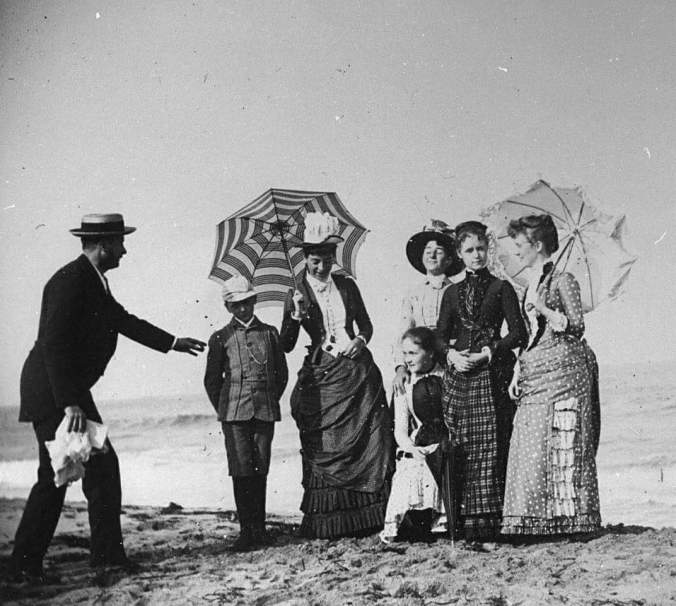
The Montgomery family, all dressed up and preparing to pose by the shoreline of beach at Stokemus, near Sea Bright, August 8, 1886

The above picture is interesting in that here you see a variety of common styles to include vest/faux, open bodice with faux waist, and closed bodice.. For skirts, all follow the bustle silhouette of the later 1880s but not in an extreme manner and each features some variation on the over/under-skirt configuration. The skirt on the woman in the middle with the parasol is the same color (seemingly from the picture) for both skirts and the under-skirt appears to the be ruffled in rows. The woman standing to the immediate rear of the little girl has a contrasting solid color over-skirt with a plaid check underskirt while the woman at the far right has a skirt and bodice made of the same material with no obvious under-skirt. It’s a very useful portrait for determining some common daytime styles that can be readily utilized for recreation purposes.

Coney Island 1885

Collecting Shells, Manhattan Beach, Coney Island, 1885 (New York Historical Society & Museum)

These two women are not deterred by the wet sand or water and have simply taken the expedient of hiking up their skirts. They’re a bit more plainly dressed than the group in the first picture with bodice and skirt of the same color. The woman on the left also appears to be wearing a short coat or jacket that has been designed to fit around the bustled skirt.

And just for contrast, something a bit more upmarket, staged in the photographer’s studio…

Portrait_Seaside c. 1885

The above picture portrays a more elaborate style although it still keeps to the convention of the bustled over/under-skirt combination typical of the later 1880s. In this instance, the bodice appears to drape over the hips and is gathered towards the rear and has a floral print design. Of course, with the woman’s elbow obscuring the waist, it’s hard to tell exactly but judging from the swags of net trimmed in fabric running along the skirt, it appears that the net is the over-skirt with a solid-colored fabric under-skirt. The effect is airy and very appropriate for summer by the beach. We hope you’ve enjoyed this little glimpse of 1880s style at the sea shore. 🙂


And Now For An 1890s Velvet Walking Suit…

Velvet was a go-to fabric for many late 19th Century designs and sometimes it could be taken to extremes as with this circa 1897-1900 walking suit:

Walking Suit, c. 1897-1900; Galliera Musée de la Mode

This is an interesting outfit on several levels. First, it would appear that this is a walking suit of sorts with a long fitted jacket that’s more characteristic of the 1908-1912 time frame while at the same time, the upper sleeves read more late 1890s. From a silhouette perspective, we see the nipped waist characteristic of the 1890s combined with a multi-gored skirt. Unfortunately, we don’t have a frontal view of this garment so we can only guess at what’s going on but based on other examples, it’s most likely that there would have been some sort of real or faux waistcoat/waist combination. Finally, to complete the style, the cuffs are also decorated with a scaled down version of the flame pattern

This most notable feature of this suit is the use of magenta-colored silk velvet on a major scale- both the skirt and bodice/jacket use it on lavishly to the point where it appears that the suit is almost entirely velvet with accents of a lighter shade of magenta-colored fabric- perhaps wool or a silk faille. Even more compelling is that the entire lower part of the skirt is covered in velvet, tapering off in a series of flame or tentacle-like tips in the middle. The overall effect is dramatic, especially since the decorative scheme on the jacket/bodice is similar but reversed with the flames/tentacles going downwards and made from the lighter fabric. Finally, a word about color- this is one of the better examples of the use of saturated jewel tone colors, in this case two shades of magenta and effect is just stunning.

Unfortunately, on a practical level, we also realize that the fabrics and colors read “winter” and as a practical matter, replicating a walking suit similar to this wouldn’t work for us here in the American Southwest. But it would be perfect for a trip to the British Isles… 🙂


Some Late 1880s Daytime Style…

As seen in a recent post, velvet was often used as an accent both in terms of the fabric itself and the rich colors it could hold. Today we take this theme a bit further with this late 1880s day dress:

Day Dress, c. 1880; Metropolitan Museum of Art (C.I.40.181a, b)

This dress is constructed from a medium brown silk faille with dark brown velvet panels on the front and sides of the skirt as well as panels on the bodice front. Also, one can see with the bodice that it’s been constructed to give the appearance of having an open v-neck with a faux velvet waist (it’s all actually a one-piece construction). Further decorating the bodice front, shoulders and cuffs in metallic gold filigree.

For dating the dress, although this has been labeled as being from circa 1880, we believe it was constructed during sometime in the 1888 to 1890 time frame based on the silhouette. In contrast with earlier 1880s dresses, this one’s silhouette is more moderate suggesting that the large bustle trend was beginning to taper off. Of course, it could also be the museum staging but we seriously doubt it.

Compared to the front, the back is plain and unadorned, suggesting that this was more of a mid-range dress than haute couture. This dress is interesting in that darker velvet combines nicely with the lighter brown silk faille. Darker colored velvet tend to absorb light but the gold filigree neatly counters this, thus creating a backdrop that only enhances the luster of the gold filigree decoration. One of the things that makes Victorian Era fashions so interesting is the seemingly endless unique design variations that one finds and it’s a constant source of inspiration to us.


Some More 1890s Style…

Saturated colors and jewel tones have always been a favorite with us but they’re something that we have to use somewhat judiciously here in Southern California. Here’s an interesting circa 1894-1895 day dress that definitely embodies the idea of saturated jewel tones, enhanced by the use of silk velvet:

Visiting Dress, c. 1894-1895; August Auctions

The bodice is designed to mimic an open jacket with an inset waist, a style that was very popular during the 1890s and would be carried forward into the early 1900s.

With it’s narrow waist, multi-gored skirt, and gigot sleeves, this has the silhouette characteristic of mid-1890s dress styles. The lines are clean and there’s a minimum of trim except for ivory-colored lace on the bodice front and sleeve cuffs. What is striking about this design is that it combines jewel tone wine/burgundy-colored velvet sleeves and bodice front with a lighter jewel tone wine-colored silk taffeta (at least that’s what it looks like from the picture). Further enhancing the bodice is the use of tapered velvet stripes on the bodice back. The overall effect is rich but not overwhelming. Here’s some close-ups:

Details of the rear upper bodice. Note the use of guipure lace trim.

Upper bodice front trimmed in guipure lace and net.

Here’s an excellent close-up of the silk velvet juxtaposed to the silk taffeta. Overall, this is an interesting dress in that it nicely combines a number of style elements that neatly define mid-1890s style in an aesthetically pleasing way.


Something New…

Renaissance Revival style of bodice in our collection, circa 1880, with a hand smocked center front inset, silk covered tasseled wrist lacing cords and a surprise scarlet lining for the rear tails with heavy lead weights. She’s a beauty, should we lift a pattern?  🙂

Interior view- the seam finishing is a fascinating study in itself.