Un Portrait de Emile Pingat

A few years ago, one of Emile Pingat’s descendants was kind enough to send us a picture of a younger Emile Pingat. It was a touching moment and it’s one of our most treasured memories. Recently we came across this post so we thought that we’d give it a little volume. Enjoy! 🙂


We have been blessed by an early portrait of Emile Pingat that was kindly sent to us by one of our readers, M. Jacques Noel, who is a descendant of M. Pingat. M. Noel gave us permission to post the picture here and we are very grateful, anything pertaining to one of the foremost couturiers during the late 19th Century.

Emile Pingat

An early portrait of Emile Pingat; Courtesy of Jacques Noel, jacnoel21@gmail.com

Pingat was famous for the sheer luxury of his designs, utilizing the best fabrics to create styles that, in our opinion, surpass those of Worth. Although we have discussed M. Pingat in prior posts, here’s just a sample of his work:

From day dresses…

Pingat1 1885

Reception Dress, Emile Pingat, c. 1885; Shelburne Museum (2010-75)

Pingat1 1885

Emile Pingat, Dinner Dress, c. 1883 – 1885; Smith College Historic Clothing Collection (1989.1.3ab)

To outerwear…

Pingat 1

Pingat, Evening Jacket, 1893; Metropolitan Museum of Art (2009.300.139)

Pingat Opera Cape1

Opera Cape, Emile Pingat, c. 1882; Metropolitan Museum of Art (C.I.60.42.13)

To something more formal…

Pingat7

Pingat4

The above is just a small sampling of Pingat’s work and we salute him.  🙂


Late 80s Style- A Look At Sportswear

Yachting1

During the 1880s, sportswear became increasingly prevalent in women’s wardrobes as women increasingly spent more time outside the house and participated in various sporting activities. Cycling, tennis, and yachting were some of the more popular outdoor pastimes and while these started with women from affluent backgrounds, they gradually began to trickle down to the middle class.

As mentioned in an earlier post on John Redfern/Redfern & Sons, one of Redfern’s specialties was designing sports clothes and in particular, yachting dresses. Below is a plate from the July 31, 1887 issue of Harper’s Bazar:

Yachting and Tennis Dresses from Harper_s_Bazaar_1887

Moving from left to right, each dress is described:

Fig. 1- This youthful gown has a red serge Eton jacket, a white cloth waistcoat with gilt cord and buttons, and navy blue serge skirt with white cloth panels and a short apron. Gilt anchors of cord are on the white cuffs of the red jacket and anchors trim the skirt on the hips and at the foot. The red straw sailor hat has a white ribbon band and bow.

Fig. 2- This pretty dress for either tennis or yachting is of blue and white stripped serge or flannel, with a blouse-waist of dark blue India silk or of surah. The jacket is of simple sacque shape, quite short behind, pointed in front, open from the collar down. The lower skirt has wide pleats, and the apron is deep and pointed. White cloth sailor hat with blue ribbon band.

Fig. 3- This costume has a blue jacket, skirt, and cap, decorated with red anchors. The draped bodice is of white washing silk or of white wool, with a gilt belt and gilt buttons. The jacket is short and adjusted behind, but falls open in front in square tabs; it is lined throughout with red silk, which shows at the top when turned back.

Fig. 4- This gown is of white wool, with surplice belted waist and plastron, belt, sash, and borders of blue and white striped wool or of washing silk. It can also be made of navy blue with jersey webbing of blue and white stripes. Quite dressy toilettes of white nuns’ veiling or of challi are made by this simple design and trimmed with Pompadour-stripped silks, or those with Roman stripes or metallic stripes, or else with the silk tennis scarfs that have tennis bats, stripes, etc. wrought in them.

The first three dresses feature a jacket over a shirtwaist (or “blouse-waist”), a look that was characteristic of the 1880s and 1890s. The fourth dress is somewhat more formal and features a plastron bodice. Combined with masculine hats such as boaters or flat cap, the first three dresses give an air of casualness and ease of movement that is tempered somewhat by the bustled skirts. The fourth dress stands in contrast to the first three.
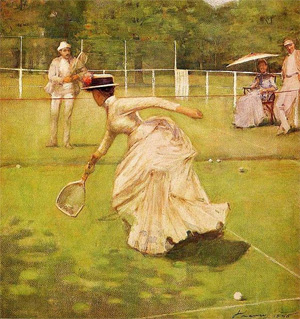
women-in-victorian-dress-playing-tennis-1880s

Of all the sporting activities women participated in, tennis was probably one of the most strenuous, requiring freedom of movement. Naturally, dress styles followed and here is just one example:

60.38.7a-b_front_CP4

Sports Dress, c. 1885 – 1888 ; Metropolitan Museum of Art (2009.300.2477a, b)

60.38.7a-b_back 0002

Back View

60.38.7a-b_side 0004

Side Profile

60.38.7_front bw

While the above dress gives an air of vigor and free movement, it is still anchored to the 1880s in that the bustle still remains, thought to be an aid to stabilizing the frail female body. At the same time however, we do see a shortening of the skirt to ease movement and a minimum of trim.

Below is a tennis dress that is believed to date from 1880 through 1890:

4f2f02f53c4fc66e1a07aaa69fd3e4bd

Tennis Dress, c. 1880 – 1890; Powerhouse Museum (1880 – 1890)

tennis2The 1880s version of sportswear was not the most practical by today’s standards but it was a start and it represented a major departure for women in the way they lived their lives. No longer did life center around the home but it now included other spheres of life. During the 1890s, sportswear was to evolve even further and especially with the growth of cycling and this trend would ultimately combine with other trends that propelled women into playing a greater role in public life, thus giving rise to the “New Woman.”

This post only gives a taste of what was to come later in the 1890s but it’s interesting to see how it got its start. What is especially jarring to modern eyes is how the bustle still remained a style element even though it hindered the body’s free movement. But nevertheless, the die was cast and there were going to be changes in the role of women, changes that are still playing out to this day.


Fashion Inspiration- The Tissot Shipboard Dress

Enjoying the cool sea breezes at the Getty Villa during our recent excursion definitely energized me and it too me back to one of my major sources of inspiration, James Tissot and his especially his nautical-themed paintings and it takes me back to an earlier post… 🙂


Karin Tissot

Lately, James Tissot has been a major source of inspiration for some of my designs. Check out the brunette. Pretty curves, cotton batiste gown is weighed down with a hem of pleats, ruffles, ruches, and two huge silk sash bows in the back. When I realized I had an original bonnet like hers…well, you get the picture. 🙂 Below are a few pictures of my take on the Tissot shipboard dress:

Karin

Bonnet is original, complete with cobalt silk ribbons and silver medallions

Karin

Gown is completely hand finished, except for construction seams. It’s weightless, my corset is heavier than the gown!

Karin

So I forgot to prune…

Karin

Enter a caption


La Robe De Soir

The Kyoto Costume Institute has some amazing items in their collection including this circa 1902 evening dress/ball gown (where one ends and the other begins can sometimes be a bit ambiguous). Unfortunately, we don’t know much about this except to say that it’s definitely reflects early 1900s style and uses an artfully arranged combination of lace and fashion fabric (no doubt a silk satin). The pink-colored silk satin fashion fabric has a series of vertical stripes along with two vine-like lines that appear to be beaded/jeweled.

Evening Dress, c. 1902; Kyoto Costume Institute

But what’s more striking is how the fashion fabric’s hem has been cut so as to mimic a leaf, longer in the front (and presumably the back) and shortening on the sides. Framing this is a layer of ivory lace that forms a complete underskirt (and no doubt backed with a lining). The bodice also has a layer of the same lave draped across the front. This is a brilliant style and we only wish that were more pictures available. We hope you’ve enjoyed this little pop of fashion history. 🙂


Florals For Spring And Summer

Floral design motifs were a major element in dress styles throughout the late Nineteenth Century and especially during the 1880s and 1890s and came in many forms and were utilized both in the fashion fabric and trim to varying degrees. Here’s one interesting example from circa 1889 that was made by Maison Felix:

Day Dress c. 1889 Felix

Felix, Day Dress, c. 1889; Albany Museum of History and Art (u1973.69ab)

Day Dress c. 1889 Felix

Side Profile

The sheer expanse of the side panels utilizing the pattern is amazing and it definitely stands out.

Day Dress c. 1889 Felix

Close-up of  the fashion fabric.

Looking closely at the pictures, it appears that the fabric was most likely a silk brocade.

Style-wise, this dress is simple, sharply defined lines characteristic of the late 1880s and employs a pale green background fabric for the bodice back and sleeves as well as the front and back skirt that offsets the areas with the floral brocade with its various shades of green. The pleating and folds are used to create the effect of an overdress/robe but if you look closer, it’s actually one unit; the bodice and skirt appear to be joined at the waist but whether this is simply hooks and eyes or stitching, it’s hard to tell without a closer examination in person (Hmm..maybe a trip to Albany, New York is in order…). Finally, the total effect is enhanced by the lack of any extraneous trim- the fabric speaks for itself.

Below are a few fashion that show different uses of florals:

 Just for comparison, here’s another dress from the same year thereabouts:

Visiting Dress c. 1889

James McCreary & Co., Visiting Dress, c. 1889; Metropolitan Museum of Art

Visiting Dress c. 1889

Side Profile

Visiting Dress c. 1889

Detail of Cuff

This dress has a more elaborate construction in that we see the use of a rich silk brocade executed in several different colors set against a dark brown brown shades of velvet and silk, creating a multi-tonal color pattern. Also, the luster qualities vary between the fabrics with the silks having far more luster from reflected light versus the silk velvet which tends to absorb light. The above examples give only a small glimpse of the variety of design possibilities and we hope that they might provide some inspiration for people recreating historic fashions.