A Brief Look At Men’s Hats – The Bowler/Derby

Hats have always been fascinating to us here at Lily Absinthe and millinery/hat-making is an artform all its own. In contrast to today, hats were an essential part of men and women’s wardrobes and they helped to shape and define an individual’s appearance and how the presented themselves to the world. In this post and others to follow in the future, we’ll be taking a look at hats as a means to educating and especially in connection with recreating styles from the late 19th Century. With that, let’s begin…

Mens_hat_Advertisment


For men, hats were an essential part of their wardrobe, ranging from the purely practical for protecting oneself from the elements to the purely decorative for fancy dress. For the most part, the situation/social function determined what clothing was proper to wear and this in turn also affected hat selection.

For everyday wear from 1870 through 1900, probably the two most popular style was the derby or bowler (frontier regions such as the American West had their own peculiar hat styles and we’ll leave those aside for the moment.).  The terms “derby” and “bowler” have been used interchangeably with bowler predominating in Great Britain and derby in the United States.

Derby

Derby, American, Wool, c. 1880; Metropolitan Museum of Art (C.I.49.49.18)

The bowler/derby was characterized by a curved brim and a rounded low crown and was made of stiffened wool felt, reinforced by the addition of shellac to the manufacturing process.  The hat was said to have been invented by a London hatmaker in 1849 as an alternative to the top hat for riding due to the top hat’s tendency to catch branches and get knocked off (although there are some other conflicting stories as to its origins). No matter the case, the bowler/derby’s popularity grew as the 19th Century progressed and was popular with both the working classes as well as the more prosperous middle classes and it was ideal as both practical and semi-formal headwear.

Below are just a few examples:

5ba54f437224da957e78b0ba6cec8e84

3638374990_1859083d1d

a13b7d177e1a3d09bd360a47c6539def

c933fdf3e3543bf612d064adad5b6cd9

The bowler/derby was widely worn, even in the West, and it has even been claimed to have been “the hat that won the West.” Below are just a few notables that sported a bowler/derby hat (at least for the camera):

Bat_Masterson_1879

Bat Masterson, 1879

butch-cassidy

Butch Cassidy

4c3a326f4c191a7cd5d5de20b0dedd92

The Wild Bunch

As can be seen from the various pictures above, the bowler/derby was usually worn with the sack suit although it could also be seen with morning suits and even occasionally with a frock coat.  Just to show how ubiquitous this style was, here’s one interpretation that was made in Japan in the 1890s:

Kimono_001

Bowler Hat, Japanese, c. 1880 – 1897, constructed of rattan and bamboo with cloth bands; Metropolitan Museum of Art

For those desiring  to recreate men’s styles of the later 19th Century, the bowler/derby hat combined with a sack suit is a very good place to start- it provides an outfit that will work for most sorts of daytime events and even a few evening ones. In fact, we would argue that the sack suit and bowler/derby combination is probably the most versatile style for men, more so that the usual pseudo “gunfighter style” that seems to be prevalent these days.  But that’s just our opinion. 😉

Stay tuned for more posts in the future on men’s hats….

A Brief View Of Men’s Clothing – The Morning Coat

During the 1880s and on into the the early 20th Century, the morning coat increasingly supplanted the frock coat as the standard for men’s formal daywear. The morning coat (or cutaway) evolved out of the earlier dress coat (aka tail coat) and frock coat styles and was a single-breasted coat characterized by having a cutaway front with the front edges of the coat sloping away towards the rear:

Morning Suit_1

Morning coats got their name from being worn in “the morning” (which in reality could extend into the early afternoon) for men conducting business and making formal calls- this was considered the proper dress for presenting oneself to the world (although as previously noted in a previous post, the sack suit could also fulfill this function). Also, according to some sources, the morning suit was envisioned as being a proper outfit for a gentleman taking their morning horseback ride but we somewhat question the assertion- I leave that up to you to decide. 🙂

Morning Suit2

629fedb1980475b50f024fe63df6ae8e

Morning Suit, c. 1900

As with frock coats, morning coats came in a variety of materials and weights either as separates or as part of a three-piece suit with matching trousers and waistcoat (aka vest) and below are a few examples:

Morning Suit

Morning Coat Ensemble, British, c. 1890 – 1900; Metropolitan Museum of Art (1983.423a, b)

Morning Suit2

Rear View

Morning Suit3

The matching vest.

Morning Suit 1

Morning Suit, British, c. 1894; Metropolitan Museum of Art (2009.300.548a–c)

Morning Suit 2

Rear View

As seen in the two above examples, the morning coat/suit did not just come in dark, somber grays and blacks but could also be found in various lighter colored plaids. Morning suits also came in darker colors, principally black and various shades of gray:

Morning Suit

Morning Suit, 1885; Philadelphia Museum of Art (1933-13-1a–c)

Morning Suit

Morning Suit, c. 1880s; Los Angeles County Museum of Art (M.2010.33.15a-b)

Morning Suit3

Morning Suit, c. 1875; The FIne Arts Museums of San Francisco (1985.40.34a-d)

Morning Coat_1880s_1

Morning Suit, c. 1880s

As can readily be seen from the above, black was a popular color and often various details such as taped edges, cuff details, and contrasting fabrics (principally black silk on the lapels) were used to add some variety to what would otherwise be a monotonous expanse of black. Finally, note that the coat front could have a variable amount of buttons, usually ranging from two to five, and the coat could be worn buttons or unbuttoned. Interestingly enough, morning coats made today typically have less buttons and are meant to be worn up.  Often times, the morning was worn buttoned only at the top, a popular convention for wearing coats during the late 19th Century:

Morning Suit_1880s_1

Morning Suit, c. 1880s; Los Encinos State Park

Here are a few more pictures of morning coats/suits being worn:

346b85b4e10dc0866265f47ee113c180

f9db7b09388dac497f15adf2dc60ab07

The above is just a sampling of what was out there but we do believe that it gives a pretty good idea of how they were worn. Although they were typically worn with top hats, that was not always the case and sometimes one can see derby or homburg hats being worn. In contrast to the earlier frock coat style of the 1840s – 1860s, the morning coat tended to have a more narrow, fitted silhouette and was not meant to be worn loose- this is especially evident when one examines the shoulder and back seams on extant garments.

Unfortunately, time has not been kind to the morning suit- for the most part, it lives on today as ill-fitting garments usually worn at weddings (and perhaps at a few speciality formal occasions). As with fashion in general, men’s fashion has become dominated by more informal styles of dress and the morning suit has become a casualty. However, from a recreationist perspective, it is very much alive and a well-tailored morning coat is a truly treat to behold. 🙂

We hope you’ve enjoyed this brief glimpse at what is often an overlooked staple of 19th and 20th Century men’s wear and stay tuned for more in the near future.


More Frock Coats…

The frock coat were one of the most commonly worn items of men’s daywear in the Western World during the 19th Century. Even in locations as vastly separated as Great Britain and New Zealand (or Russia and the United States, for that matter), the frock coat reigned supreme and even after it began to be supplanted by the morning coat and the sack suit, it still maintained a strong position in men’s wardrobing.

As we noted in a previous post, the frock coat started out as a longer, full garment that somewhat resembled a great coat. As the 19th Century progressed, the frock coat gradually evolved to a shorter, more tailored garment:

Frock Coats4

Frock Coat, c. 1820 – 1830; Victoria & Albert Museum (T.294-1910)

Frock Coats5

Frock Coat, c. 1876; Kent State University Museum (1983.1.2392)

Frock Coats6

Frock Coat, c. 1870s; Metropolitan Museum of Art

7d40d01bc320364b8f335778649507d9

Frock Coat, American, c. 1870s; Kansas State University Museum (1984.21.1 ab)

M973.49.7

Frock Coat, c. 1880 – 1890; McCord Museum (M973.49.7)

So, just for fun, how does this translate when it comes to film and TV and especially with that Gunfight at the OK Corral? 🙂  Well, let’s start with the iconic movie Tombstone:

tombstone11

Well, all said and done, not as bad as as one would think…except for Wyatt Earp. So what’s Wyatt wearing? Well, the best we can figure out is that it’s an elongated frock coat or a black-colored duster, your choice (I lean towards elongated frock coat myself 🙂 ).

Here’s one from Tombstone’s major competitor, Wyatt Earp:

wyatt-earp-doing-the-walk

Interesting, we see at least two in frock coats (it’s hard to make out what the second guy on the left is wearing) although Doc Holliday’s coat seems to border on being a light great coat.

And now we go back a little to Hour of the Gun:

 hour-of-the-gun

Again, not too bad…in this movie, only Doc Holiday is wearing a frock coat. Finally, here’s one from Gunfight at the OK Corral:

gunfight-at-the-corral-doing-the-walk1

And in this one, nobody is wearing a frock coat. 🙂

Now, let’s look at some Spaghetti Westerns… first we have A Fistfull of Dollars: 🙂

Lee Van Cleef1

And the classic The Good, The Bad, And The Ugly:

Lee Van Cleef2

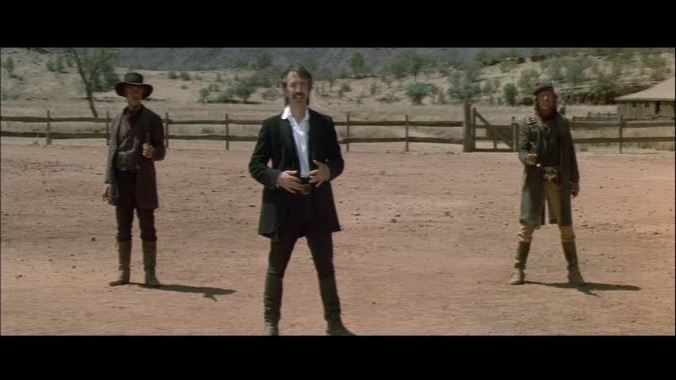
And finally, there’s Quigley Down Under:

Quigley-Down-Under-Screencap-alan-rickman

From the small sampling above, we would be inclined to believe that the frock coat is alive and well in the movies. 🙂 What’s also interesting is that often in Westerns in film and TV, the villain is often well-dressed and the frock coat is perfect for this.

For the recreationist, reproduction frock coats are available from a variety of sources at all sorts of prices. The cheaper ones are often simply patterned off of a modern men’s suit coat that’s been lengthened. The better ones are based off period patterns with the proper sleeve and shoulder styles. Also, the frock coat was a tailored garment with padded shoulders and chest that were constructed so that the coat keeps it shape even when taken off; a proper frock coat’s construction should reflect this.

We hope you’ve enjoyed this little side-trip and be on the lookout for more posts on men’s clothing in the future. 🙂

A Brief View Of Men’s Clothing- The Frock Coat

Frock Coats3

In a previous post, we gave an overview of the sack coat and sack suit during the late 19th Century from 1870 through 1900. While the sack suit was probably one of the most commonly worn outfit for men, there were other styles that bear mention, principly the frock and morning coats.

The frock coat got its start in the early 19th Century as an informal alternative to the dress coat (also referred to as the tailcoat or claw-hammer coat) and as such, was a coat with full skirts that extended to the knee and had a distinct waist seam that gave it a tailored appearance. In contrast to dress coats, the skirts on the frock coat was constructed of distinct upper and lower pieces rather than being cut as one piece.

In the examples below, the difference between the types of coats is readily apparent and especially in the skirt:

Dress Coat1

Note the distinct, fuller skirt pieces on the frock coat. Also, frock coats could be single or double-breasted:

lm109b

d-16231-163

Frock coats were primarily made from wool although other materials such as linen were also used. In terms of color, frocks coats came in a variety of colors with darker colors predominating. Also, frock coats were made in both single and double-breasted styles; the double-breasted style was considered to be more formal than the single-breasted version. Finally, the frock coat could be worn open or closed.

edwardian_men_style_frock_coat

Here’s an example of a frock coat made from linen:

0386

Frock Coat, c. 1860 – 1870; Augusta Auctions

Below is an early version of the frock coat. As the 19th Century progressed, the skirts gradually became less exaggerated:

Man's_silk_and_wool_twill_frock_coat_c._1820

Frock Coat, French c. 1816 – 1820, constructed of wool/silk twill; Los Angeles County Museum of Art (M.2010.33.7).

And now some from the 1870s:

f49afb73661056c03a482d67bfe4d901

From Gazette of Fashion, and Cutting-room Companion, 1870

7d40d01bc320364b8f335778649507d9

Frock Coat, American, c. 1870s; Kansas State University Museum (1984.21.1 ab)

And the 1880s:

M973.49.7

Frock Coat, c. 1880 – 1890; McCord Museum (M973.49.7)

And finally, the 1890s:

Frock Coat1

Frock Coat, c. 1890; Victoria Albert Museum T.624-1996)

54e34a7f76f224fff8fff4ef47b8d52b

As a general rule, frock coats became shorter and more tailored with a slimmer silhouette and were often worn with a pair of lighter-colored trousers as shown in some of the pictures above. Also, it’s interesting to note that during the 1880s and 90s, we increasingly see frock coats being worn open with wide lapels.

Frock Coats1

Frock Coats2

For people desiring to recreate period fashions of the late 19th Century, the frock coat offers one possibility for those desiring a more formal, conservative look. However, it must be noted that the frock coat is more representative of the period prior to the 1870s and as such, it was being supplanted by the morning coat for formal wear. In a future installment, we will be covering the morning coat so stay tuned! 🙂

(To Be Continued)


How The West Was Worn…Dressing Up

Lawmen2

In a previous post, we presented a brief overview of the sack coat/sack suit during the late 19th Century. In the course of writing that post, it prompted us to think about men’s clothing in the American West and especially how the reality often differs from the image that’s been created through film and television. It has been often noted that the 19th Century was a much more formal time than today and one’s clothing choices reflected one’s status and how one was regarded by their peers. While occupations such as laborers, cowboys, miners, farmers, and the like required rugged practical clothing, this did not mean that these individuals wanted to project a rough image to project to the world and when possible, more formal clothing was preferred. The idea of “keeping it real” was an alien one and would have made little sense to the average 19th Century man.

Here are several interpretations of the same events/people:

Tombstone-Val-Kilmer-Sam-Elliott-Bill-Paxton-Kurt-Russell

Gunfight-at-the-OK-Corral-2

Clanton Gang

As a bit of a corrective, below are some pictures of “real people” of the American West. While it’s obvious that many of these people sitting for these pictures had dressed themselves up for the camera, the fact that they DID speaks volumes. Clearly, social convention and a desire to portray oneself to the best advantage played a major role here.

To begin, here are some pictures of some famous people, as they really looked:  🙂

Earp1

Wyatt Earp

Bat_Masterson_1879

Bat Masterson, 1879

Lawmen Dodge City

Original photograph of the ‘Dodge City Peace Commission’ in June 1883. Front, l-r; Chas. E. Bassett, Wyatt S. Earp, Frank McLain, and Neil Brown. Back, l-r; W. H. Harris, Luke Short, W. B. Bat Masterson, and W. F. Petillon. This is the version with Petillon beside Masterson. Ford County Historical Society, Dodge City, Kansas

IkeClanton4125

Ike Clanton

Pat Garrett

Pat Garrett

Curley Bill Brocious

Curley Bill Brocious- One of the only known portraits.

Lawmen1

But lawmen and outlaws are only one aspect, there were also others:

xt7.jpg

Cowboys, John Slaughter Ranch

Cowboys_1880

Cowboys, c. 1880

This is only a small sampling but we think it conveys the basic idea that there’s definitely a bit of a difference between what actually existed and what we THINK existed. Of course, this has been an issue ever since the first Western was ever filmed but it still bears consideration in that in order to gain a better historical understanding, we need to keep the two separate.

We hope you’ve enjoyed this little side-trip into the West and we want to make it perfectly clear that we’re not denigrating the costuming found in movies versus reality- we know that they can be be vastly different with different goals- rather, we’re only pointing out that all too often, people tend to use film and television as a substitute for solid historical evidence. Each has its place but let’s not confuse the two. At least, that’s out take on it. 🙂