More From The Atelier: Fall Fashions Continued

Since we got a good reception in the last post on Fall designs, we decided to take this a little further. When we think of “Fall Colors”, we tend to think in terms of browns, golds, orange, cinnamon which all are suggestive of the leave falling. At the same time, there are other colors outside of this range that will also work to a lesser degree such as dark green, blue-grey, plum, and lavender. Now we grant that this is somewhat of a subjective interpretation on our part but what is key that the tones should not be muted or dull, but rather should be bright hues. We even favor jewel tones if used judiciously. The essential point is that as Fall progresses, the days grow shorter and the sun’s intensity diminishes as it shifts (at least in places other than Southern California), thus the garments’ colors need compensate. Unlike today’s fashion, Victorians exploited the possibilities provided by the advent of synthetic dyes and this was reflected in their use of bright colors. Often one or several colors were used in combinations that sometimes seem jarring to modern aesthetic sensibilities.

Victorian Era Colors- These were intended for house paint but the colors were were used in fabric dyes and often came in bright hues.

By way of example, below is a Parisian fashion plate from September 1885:

Le Moniteur de la Mode, September 1885

Le Moniteur de la Mode, September 1885

Having the right colors for the Fall is critical but it’s only the beginning. In order for those colors to have the most impact, it is essential that they be integrated into a design that delivers the maximum impact. Whether the dress is a day dress, evening dress, or ballgown, the same rule applies. One example of this can be found with the following evening dress:

26ee600440c54bd89e96da751ddcaaed

Evening Dress, American, c. 1884 – 1886; Metropolitan Museum of Art (C.I.63.23.3a, b)

CI63.23.3a_label

Maker’s Label

This dress dates from the mid 1880s or Late Bustle Era, characterized by the return of the bustle in all its glory for a second run. However, unlike the Early Bustle Era of the early 1870s, the silhouette created by the bustle and train is more extreme with the bustle shelf perpendicular to the rest of the dress (there were those who joked that one could set an entire tea service on the “shelf” created by the bustle). It’s a pity that there are no available pictures of the front and rear of this dress.

But more importantly for our purposes, with the bustle and its attendant train, we now have a larger “canvas” to display style elements and in the above example, the designer took full advantage of this, utilizing long long vertical knife pleating and large velvet chevrons. To complement the train, the designer also incorporated three rows of knife pleating along the hem in complementary colors. The design itself is relatively simple, utilizing sharp clean lines that are not obscured by any trim. As for the colors, they are a dark cinnamon-red and a light peach/salmon with a hint of orange. The luster of the silk fashion fabric make the colors lively and it was no doubt deliberately designed so as to make the dress stand out in a candle or gas light room (in terms of lighting, this dress would not work that well for daytime wear). Here, the colors are allowed to speak for themselves.

Below is some examples of day dresses that also use this idea in varying forms:

2fd7d5757da340af4825be0a051d6495

76409adcf360cc8b92e9588d92226d6e

The above day dress is from circa 1876 and is made from a silk taffeta and unfortunately the photography doesn’t do justice to the dress. This is a relatively simple design with a clean lines which creates a very simple silhouette. Once again, there is a minimum of trim which is somewhat atypical for mid 1870s dresses. In some ways it could be argued that this is a transitional piece, incorporating elements from both Early and Mid Bustle Eras. One can make out the presence of a train and bustle but it’s not as extreme as what was prevalent during the early 1870s. At the same time, the silhouette is not completely vertical. Ultimately, there’s room for interpretation on these points.

But even more compelling is the use of two complementary colors, an orange rust and a dark cinnamon. One can see contrasting stripes consisting of both large bold ones on the bodice and much smaller ones along the hemline. The use of contrasting colors is taken even further with the use of a darker colored overskirt and train. This dress may not seem as bold as the first one but bear in mind that the photography of the two examples greatly differ and we are dealing with garments that are over a 100 years old. More importantly, the second example is a day dress which tended to be more muted color-wise than evening dresses or ball gowns.

We’ve saved the best for last, the ballgown… 🙂

Ballgown, Worth, c. 1890; Preservation Society of Newport County

silk-brocade-evening-gown-1890

Closeup of the fashion fabric.

Closeup of the fashion fabric.

This ballgown was made for a Mrs. Ella Rives King of Kingscote, a large mansion in Newport, Rhode Island. During the mid to late 19th Century, Newport was a popular summer residence for the rich and over the years a number of mansions were built there of which Kingscote was only one. These mansions are preserved to this day by the Preservation Society of Newport County and are open for visiting on a seasonal basis.

Ella Rives King1

Now to the gown itself. As stated above, it’s constructed from a silk brocade and while it’s not explicitly stated in what little information that was available, it’s safe to say that the design was woven into the fabric given Worth’s ties with the silk weaving industry in Lyon, France. Draped along the neck line the left side of the bodice is a gold colored tulle. From the pictures it’s hard to tell what exactly has been placed to give the tulle a metallic sparkle effect. The centerpiece of the gown, however, is the fabric itself consisting of a gold colored floral pattern against a darker orange background. From a distance, the effect is suggestive of falling leaves but we’re probably reaching a bit here. 🙂

This ballgown is a relatively simple (of course, nothing is “simple” when it comes to the haute couture of the period) design both in silhouette and style- with the exception of the tulle on the left neckline, there’s nothing else to distract from the fashion fabric itself. This is in contrast to Worth’s usual designs which tended towards an elaborate laying of fabrics and trim. Moreover, it stands in contrast to Doucet who tended to favor a more softer (some say “fluffy”) look. Finally, one could even argue that the floral design and color combination give it an almost impressionist look although at the same time it could be considered too “busy”. Whatever one’s position it, it’s still eye catching.

In the above examples, we’ve attempted to give some or our “design philosophy” which, simply put, consists of combining color, fabrics and construction to create garments that are not only historically appropriate but ones that deliver the greatest aesthetic impact.

Magnificent 7 Convention – October 24, 2015

Costume Sketch by Walter Plunkett for the movie How The West Was Won

Costume Sketch by Walter Plunkett for the movie How The West Was Won (1962).

We have pleased to announce that we will be giving a presentation on Victorian fashion and the West entitled: The Victorian West: How The West Was Worn at the Magnificent 7 Convention (M7Con) at 3 PM on Saturday, October 24, 2015 at the Los Angeles Convention Center. This will be the second time that we have presented at the M7Con, the first time was in 2013 and we had a good time then so we’ve decided to do it again with an expanded program. Also, as part of our presentation, we will have on display some select items from our collection and we will be available to answer questions. Finally, just to let you all know, while the M7 Convention originally started as a convention centered around all things Magnificent Seven from either the movies or television series, it’s been expanded out to more of a general Western theme. Be sure to mark your calendars- we look forward to seeing you there!

Debbie Reynolds in How The West Was Won (1962)

Recreating The Victorian Life

“Do you live in a Victorian House?”

Over the years, we have often we are asked this question by clients, friends, and even complete strangers. Although it seems like a simple question, it really is not . What they are really asking is “do you live a Victorian lifestyle with all that it entails?”

Tombstone House_Snow1

The short answer is: no. The longer answer is that no matter how interesting we find the Victorian Era (which for us really means the period from about 1870 through 1903 or so), we are still rooted in the 21st Century and more specifically, 2015. Trust me, there is no end to our fascination with various aspects of Victorian fashion, culture, society, politics, et al., there is also much that is negative such as grinding poverty, inequality, and racism. While it is easy to sink into an depressingly endless cycle of compare and contrast between today and then, it’s ultimately pointless. We, as human beings, are in part a product of our environments and there is simply no getting away from that fact no matter how we try. At least that is how we see it.

While we actively take part in all manner of Victorian-themed events, we are also aware that they can only give us a small taste, at best, of life back then. At the same time however, we can enhance our experiences through various forms of research such as reviewing first-person accounts. Thus, it is possible to get a good idea of the social and cultural milieu or environment of the time.

Adam_Mac2

And for something a bit more refined, complete with dog- the Tombstone House, September 2015. Once again, a somewhat selective portrayal but it works. Three days later, I was back in the 21st Century. 🙂

So why a sudden desire to impart the “Lily Absinthe Philosophy of Recreating History?” 🙂 The first reason is that it’s a natural question people ask of us and it deserves an answer. We have spent somewhere in the neighborhood of 30 years involved in various aspects of historical recreation (living history or reenactment, if you will) and while there have been some frustrating moments, it’s overall be very rewarding and it’s added to our everyday modern lives.

The second reason is in response to a recent flurry of commentary, both positive and negative, in regard to a one Sara A. Chrisman who has attempted to re-fashion her lifestyle around one characteristic of the 1880s and 1890s. Residing in a house built in 1888 located in Port Townsend, Washington, Ms. Chrisman (we should probably address her as Mrs. Chrisman) has gone to great lengths to recreate period equivalents for the modern activities of daily life and she notes these both in her blog and in an upcoming book entitled This Victorian Life: Modern Adventures in Nineteenth-Century Culture, Cooking, Fashion, and TechnologyIt is evident that Ms. Chrisman has taken historical recreation to extent that is far beyond what most enthusiasts are able and/or willing to go and it’s to be admired. It is not something that we readily could, or even desire, to attempt and we freely admit this.

Before we go any further, we can gain a little insight into Ms. Chrisman’s experience though this blog post:

This is not an easy life. People seldom understand lives which are different from their own, and often do not accept them. I’ve received everything from hate mail, to taunts from children whose parents were actually egging them on and encouraging them to behave still more badly.

People are constantly demanding that I first explain and then justify my entire existence. Complete strangers attempt to grope my waist, and then have the gall to expect an apology when I don’t let them. (I’ve even had the experience of a customer in a café – a woman whom I had never seen before in my life  – demanding the owner that I be thrown out, simply because I wouldn’t let her fondle me!)

And yet I refuse to let the ignorance and misbehavior of others prevent me from living as I truly am in my heart, from following my honest ideals.

This is not the critics’ life, it is mine: the one I have always wanted, and feel I was destined for.

It’s clear that Ms. Chrisman has chosen a path that most of us would not be inclined to follow, a path that takes a great leap of faith. However, at the same time, it could also be argued that Ms. Chrisman is creating a very select part of the late 19th Century life and it omits many realities. Even in terms of her book (her third), you are no doubt thinking “well, she probably used a computer to prepare that manuscript for that book” and you may be right. So here, we see a demonstration of the idea that we really cannot completely escape the time we live in. But more importantly, it also demonstrates the tendency to sentimentalize or idealize history, only selecting the better parts and ignoring the more unpleasant aspects. Idealization is a something that is often discussed among Anthropologists when they study a particular culture and there has been an extensive literature built around this.

Pulling away from our digression into Anthropology 101, we are seeing the various flaws in Ms. Christman’s approach and it’s nothing that has not already been pointed out ad nauseum. It is not Ms. Chrisman’s attempt to recreate a Victorian lifestyle that bothers us, but rather the high degree of negative feedback that she has received. Perhaps readers may find the tone of some Ms. Chrisman’s comments somewhat condescending (we have never met her in person and electronic media is a poor medium for communicating emotions) but at the same time also appreciate what she is trying to accomplish as well as her frustration with others who do not understand or treat her as some animal in a zoo or an exhibit at Disneyland (we have often experienced similar situations in Tombstone when we go into town dressed in period attire).

Ultimately, Ms. Chrisman has harmed no one and the harsh criticism she has received is completely unwarranted. Over the years, we have found that each person has a different take in how they interpret history and each is valid in its own way. No one has a lock on the truth and before we criticize, we need to look at ourselves.

Just In Time For Fall…

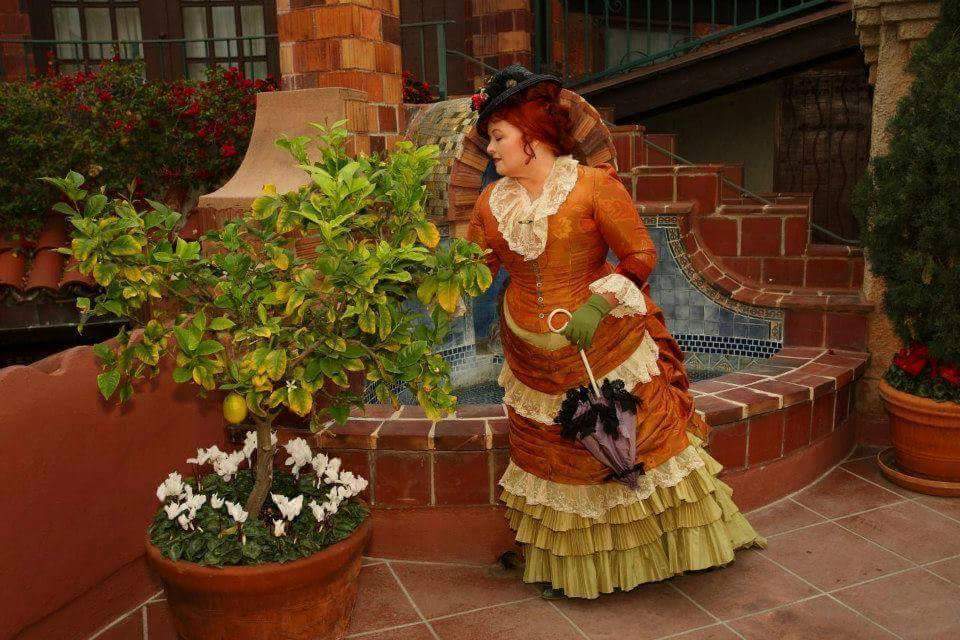
Living in Southern California, it’s easy to forget that there are actually seasons like the rest of country. While most of California may lack the dramatic seasonal changes found in other parts of the United States, there are definitely changes in the seasons but they are more subtle. One of the more obvious signs is that the days are growing shorter and the position of the sun is beginning to shift (although the temperatures show little sign of change so far).

Karin_Fall

Karin in Fall colors at the Mission Inn Hotel in Riverside, California; Photo by Bill Terrell.

We have decided that Fall is here even if Mother Nature is not completely on board and towards this end, we have been working on a few new designs for the Fall.

Below are a few examples of our inspiration:

Karin5

The above outfit is based on an extant circa 1900 ranch woman’s outfit. With its clean lines and brown/copper colored with leather fringe along the hem, it suggests the coming of fall and a sense of freedom. The changing of the seasons is no reason to scale back on enjoying life. 🙂

Karin1

Now for something a bit more formal. This is an afternoon/visiting dress, c. 1880. The colors are a light gold, celadon, and ecru and while the colors are not in the usual fall color palette, they complement one another and suggest a turning of the seasons.

Here’s another view of Karin modeling the dress along with me modeling some “cowboy” clothes:

Adam_Karin1

Planning Thanksgiving…

 Below are two views of a demi-polonaise dress that we made for a client:

Rebecca2

Rebecca1

The dress color is peach (a very light orange) and while one could argue that this is suggestive of spring, it also works for the fall. However, fall colors are not restricted to just shades of orange and brown. Below are some other designs:

Karin6

Is it rain? Is it snow? Who knows, it’s Arizona!

Karin7

Adventures in China Town…

Here we have an afternoon dress in a plum antique silk with dark plum silk velvet trim, a black lace collar with antique cut steel and antique lace accents. The shades of plum are completely complementary and they help give an enhanced three-dimensional depth to the dress.

The last set of pictures take the Fall even further and now it’s getting ready to snow any day. Winter is definitely coming…

Karin2

The above day dress is made of an coral-cinnamon silk trimmed with vintage silk soutache from the 1880s and black fringe. The coral-cinnamon suggests that colder days have arrived.

Karin3

Now for something a little more neutral, we have day dress made of a plaid trimmed with rust-colored velvet. Complementing the grey/black plaid are bands of copper-colored velvet on the cuffs and shoulders. A vintage 1880s muff and antique lace-on-wire chapeau completes the package.

12042096_10152966932597693_900167204_n

Above is another day dress we made for a film production that utilizes shades of plum, burgundy and grey in a harmonious package that works as a day dress even in the most harsh daylight. Note that the fabrics have been carefully selected so that there is no shine; we let the textures of the fabrics along with the knife pleating and trim to create a three-dimensional effect that will read well on camera. Not all colors work well in harsh daylight but these do. This is perfect even on a cold, crisp sunny Fall day.

By now, it’s become obvious that plum, burgundy, lilac and lavender are excellent colors to work with and especially when it comes to outfits for the Fall. Below is a late 1870s day dress we made for a client that’s designed for the bodice to have a style reminiscent of an 18th Century waistcoat. The neckline is relative simple with the soutache taking center stage. Often times in design, it’s best to focus on one or two major style elements and keep everything else as a simple backdrop.

Bodice and skirt.

Karin4

Close up of trim and cuffs.

As it can be seen here, one has many choices of color and fabrics in selecting a suitable Fall dress. The above pictures are only a small sample of what we are currently working on and we are constantly trying new fabric/color/trim combinations. Let us design a Fall dress just for you! 🙂

Colors2

Reenactorisms, Fantasy and Historic Costume

Adam41

One of the most frustrating aspects of working with historic costume is when we encounter garments, hats, or other costume items whose creators adamantly insist that they are historically correct when clearly that is not the case. In these situations, one’s social skills are put to the test and while we want to scream “you are clearly wrong!”, our polite response is “That’s nice,” “Wow, that really shows some effort,” or “You look really pretty today.” Kindness wins.

While we naturally applaud those who go to the time and effort to create fantastical designs such as those found in Steampunk, we also take an exception to those who create “historical” fashions but have clearly done little or no research on their own. We could go on for days finding numerous examples on the internet and then ravaging them for their lapses in historical accuracy but ultimately it’s cruel and counterproductive.

Counterproductive? But shouldn’t one constantly be on guard against the historically inaccurate? Yes and no. For us, the bigger issue is: “are we on the clock?” For example, if we are working on a film where we are being paid to provide historically accurate wardrobe (or as historically accurate as the production designer, director and budget will allow), of course we will act in a swift and sure manner to preserve the integrity of the production.

Being “on the clock” also applies to our historical designs. If there are deviations from what is historically accurate, we are up-front about them. In some instances, we have had to make concessions to modernity due to availability of materials, client preferences, etc. Unfortunately, modern realities are part of recreating historical fashion and in some instances they can not be avoided. In the end, we are not paid to be the “costume police” and it’s a role we would prefer not having and we are not in the business of publicly calling people out. If you ask us privately what we think about a costume, we will be honest and supportive.

Adam_Town2

Adam contemplates the meaning of historical accuracy…

With that said, let’s look at some of the more common reasons why costumes fall short of the mark for historical accuracy. First, there are “reenactorisms”. Loosely defined, reenactorisms are those practices (for our purposes, as applied to costume) which have their basis in what reenactors or self-styled “living historians” do rather than what was historically done. Perhaps it the particular practice began as someone’s imperfect interpretation of something historical or simply someone making something up because they either didn’t know any better or were too lazy to properly research it. Some examples of reenactorisms often seen at late 19th historical events are ball gowns and evening dresses worn during the day, “saloon girls”, and men wearing far too many weapons.

During my gunfighter days…yes, I’m guilty!

Next, closely related to reenactorisms are those practices that can arise from various sources and are now preserved by “groupthink”. Roughly defined, Groupthink is:

…a psychological that occurs within a group of people, in which the desire for harmony or conformity in the group results in an irrational or dysfunctional outcome. Group members try to minimize conflict and reach a consensus decision without consideration of alternative viewpoints, by actively suppressing dissenting viewpoints, and by isolating themselves from outside influences or groups

While this phenomena is similar to reenactorisms, its scope is more limited to specific groups who, simply stated, “do things a certain way because that’s just the way it’s done” with no regard to whether or not the practice is historically justified. Any attempt to introduce new information that might compel change is extremely unwelcome.

Period hairstyles? Go to the source… 🙂

One example of this that we have witnessed when a small women’s group decided that the only way to portray historically correct hairstyles of the 1870s and 1880s was for everyone to wear wigs. Not only were the wig hair styles historically questionable, but the wigs themselves did not look like any known hairpieces of the era. Unfortunately for the larger organization, this small group’s unfortunate fashion choice then became the de facto standard for a much larger group in which they belonged to. At no point were the use of wigs questioned; people in the larger group simply uncritically adopted the style thinking that it somehow “must be right”. Finally, yes we were asked at several points what our opinion of this practice was and we answered honestly and provided historical documentation but it was largely disregarded. C’est la vie.

Another phenomenon is what I call the “cool factor.” Essentially is a matter of people superimposing their modern sensibilities onto historic portrayals (“Look, I’m a walking arsenal just like in the movie xxx!”). One example of this is when it comes to firearms and especially for those recreating the Old West. Often times, men (and some women) will arm themselves to the teeth (literally in some cases) with multiple pistols, knives, and maybe a shotgun or rifle. Hey, I get it, it’s fun and you get to look larger than life. I too have been guilty of this: when I first started coming to Tombstone, I used to strap on my pistols and a knife or two and walk up and down Allen Street like something out of the movie Tombstone. However, in reality even the most dangerous gunfighter/desperado types rarely carried as much weaponry as modern reenactors even when they were expecting a fight.

Other reasons for costumes lacking historical accuracy can range from lack of research to attempting to take shortcuts in materials and/or construction. While taking shortcuts can be somewhat forgivable, lack of research is not. Now granted, the word “research” sounds somewhat intimidating but it really isn’t- it simply means reading up on the subject (aka “doing your homework”). While information resources were more limited before the advent of the internet, this is no longer the case today and there is a wealth of resources, both online and hardcopy, on 19th Century clothing that are readily accessible. Understanding 19th Century clothing is not difficult but it does require some thought to translate it into recreating garments of the period.

As for shortcuts, it’s understandable that people would want to take shortcuts wherever possible and we do it ourselves. However, the thing to remember is that the garment still has to have the correct period lines and details (i.e., the look) and this requires an attention to detail. In terms of materials, this can be more tricky but bear in mind that 19th Century fabrics had very specific uses and that it’s not always possible to get good results with fabrics made from manufactured or synthetic fibers, with a few exceptions, of course ( Blog post for another day!).

pnp365603 (2)

We have identified some of the sources behind why historic costume can miss the mark in terms of accuracy and while by no means is this survey exhaustive, it does offer a cautionary tale for anyone with a sincere desire to recreate historic fashions of the 19th Century (or any other period for that matter). Essentially, to have the right look, one must not only inform themselves about the subject, but they must also be willing to alter their beliefs as to what is correct in light of new information. We can never achieve total accuracy for the simple reason that we are not living in the all-encompassing world of the late 19th Century; a world that is impossible to completely recreate for a variety of reasons. To one degree or another, how we approach historical costume is affected by our modern beliefs and the best that we can do is to work around them. In short, we’re all a work in progress.

Adam1

We always aim to be on target… 🙂