How The West Was Worn…Dressing Up

Lawmen2

In a previous post, we presented a brief overview of the sack coat/sack suit during the late 19th Century. In the course of writing that post, it prompted us to think about men’s clothing in the American West and especially how the reality often differs from the image that’s been created through film and television. It has been often noted that the 19th Century was a much more formal time than today and one’s clothing choices reflected one’s status and how one was regarded by their peers. While occupations such as laborers, cowboys, miners, farmers, and the like required rugged practical clothing, this did not mean that these individuals wanted to project a rough image to project to the world and when possible, more formal clothing was preferred. The idea of “keeping it real” was an alien one and would have made little sense to the average 19th Century man.

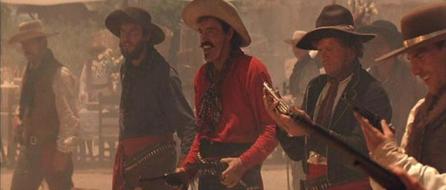
Here are several interpretations of the same events/people:

Tombstone-Val-Kilmer-Sam-Elliott-Bill-Paxton-Kurt-Russell

Gunfight-at-the-OK-Corral-2

Clanton Gang

As a bit of a corrective, below are some pictures of “real people” of the American West. While it’s obvious that many of these people sitting for these pictures had dressed themselves up for the camera, the fact that they DID speaks volumes. Clearly, social convention and a desire to portray oneself to the best advantage played a major role here.

To begin, here are some pictures of some famous people, as they really looked:  🙂

Earp1

Wyatt Earp

Bat_Masterson_1879

Bat Masterson, 1879

Lawmen Dodge City

Original photograph of the ‘Dodge City Peace Commission’ in June 1883. Front, l-r; Chas. E. Bassett, Wyatt S. Earp, Frank McLain, and Neil Brown. Back, l-r; W. H. Harris, Luke Short, W. B. Bat Masterson, and W. F. Petillon. This is the version with Petillon beside Masterson. Ford County Historical Society, Dodge City, Kansas

IkeClanton4125

Ike Clanton

Pat Garrett

Pat Garrett

Curley Bill Brocious

Curley Bill Brocious- One of the only known portraits.

Lawmen1

But lawmen and outlaws are only one aspect, there were also others:

xt7.jpg

Cowboys, John Slaughter Ranch

Cowboys_1880

Cowboys, c. 1880

This is only a small sampling but we think it conveys the basic idea that there’s definitely a bit of a difference between what actually existed and what we THINK existed. Of course, this has been an issue ever since the first Western was ever filmed but it still bears consideration in that in order to gain a better historical understanding, we need to keep the two separate.

We hope you’ve enjoyed this little side-trip into the West and we want to make it perfectly clear that we’re not denigrating the costuming found in movies versus reality- we know that they can be be vastly different with different goals- rather, we’re only pointing out that all too often, people tend to use film and television as a substitute for solid historical evidence. Each has its place but let’s not confuse the two. At least, that’s out take on it. 🙂


Off To No. 11…

wp-1461258142385.jpg

Next week, I’ll be at No. 11 in Tombstone for a week of sewing, friends, old house chores, and a bit of old timey dress-up. This trip’s big job is getting ride of the guest room, because my work is expanding and we need the space for more machines and tools. So say goodbye to that luxurious guest space…it’s only going to have a twin bed for sewing naps and several more machines and tools. 🙂

wp-1461258159757.jpg

fb_img_1461259191436.jpg

A Brief View Of Men’s Clothing- The Sack Coat

Over the years we have been asked about making men’s clothing. While we are naturally flattered by the prospect of creating more period clothing designs from the late 19th Century, we have had to politely refuse on the grounds that it’s not our main business focus. More importantly, men’s clothing calls for a skill set- primarily tailoring- that is different from those used for women’s clothing. While there is some overlap (Redfern and especially with tailor-mades for women), it’s very much a separate speciality and we would argue that it’s an art form with a rich set of traditions that are not easily mastered. Well tailored clothes are a joy to behold and just the words “Savile Row” sets our hearts racing.

All hyperbole aside, we have chosen to restrict ourselves to the female side of historic clothing simply because if we made both types of clothing, we could not do justice to either. With that said, we would still like to present our views on the men’s side of clothing so from time to time we will be posting articles here covering various topics of men’s clothing and accessories. We would you enjoy our occasional series. 🙂


So, where to begin? Probably the best place to begin is with the sack coat/sack suit which gradually developed into the dominant style for men’s daywear during the late 19th Century, supplanting the earlier frock coat and the derivative morning coat. The sack coat/suit and the frock coat. The sack coat was meant for informal day wear while the frock coat/morning coat were reserved for more formal occasions (although there was often a lot of overlap between the two).

Styles1

The sack suit, or lounge suit as it was termed in Great Britain, originated in France as the sacque coat during the 1840s and took its name from the way it was cut (contrary to popular belief, the sack coat did NOT get its name from its loose fit “like a sack”). In contrast to the more elaborate frock coat whose back was constructed from four basic pieces, the sacque coat was simplified, consisting of two basic pieces. Moreover, the sack coat was designed to fit loosely.

EPSON scanner image

Sack coats usually had three or four button holes and often it was worn buttoned only at the top. In terms of colors and fabrics, wool of various weights was the predominant fabric although linen was often used for lighter weight coats intended for wear in more warmer climates. In terms of colors, they could range from solids to plaids, stripes, and checks. However, towards the end of the 19th Century, the dominant style increasingly were darker, sober colors such as charcoal gray, black, brown, and navy blue. Often they were accompanied by a matching pair of trousers and waistcoat, thus creating the three-piece suit. At the same time, the sack coat and trousers could be in different colors and fabrics. Below are some examples:

To start, here’s an image of an early sack coat from c. 1863 – 1864:

Sack Suit - Early

Sack Suit, c. 1863 – 1864

image002

Three men wearing sack coats, c. 1860s; Image from Joan L. Severa, Dressed for the Photographer: Ordinary Americans and Fashion, 1840-1900, 1995

The second image really shows up just how loose-fitting sack coats were in the 1860s, especially with the coat worn by the man with his back to the camera. This is in contrast to the 1880s, 90s, and early 1900s where the coats (and accompanying trousers) become increasingly more narrowly-fitted and cut closer to the body.

In the next image, we have one from 1870:

WaterfallsAugust1870

The West End Gazette, August 1870

The coat still hangs relatively loose but the trousers are gradually becoming cut more narrow.

6b240ed1262cafce380e8ea797cd11bd

Sack Suit

Sack Suit, British, c. 1875 – 1880

A bit on the loud side, the use of loud fabrics steadily diminished during the late 19th Century. Sack suits could be made from linen as well as wool as with this suit that was intended for wear in warmer weather:

Sack Suit4

Sack Suit, c. 1885 – 1900; McCord Museum (M973.137.4.2)


67acfb2bc992f7bf2d46bb64708b8470

Sack Suit2

5d85a31e84b3aab23b71775fd36cf71c

Sack Suit, c. 1895

Sack Suit3

Sack Suit, c. 1911; Los Angeles County Museum of Art

The above picture depicts the ultimate development of the sack suit and it’s easy to see that the modern business suit was not far off in the future.

During the late 19th Century, the sack suit became the standard “uniform” for anyone aspiring to a degree of respectability and especially those involved in business and the professions. In fact, it could be argued that the sack suit was instrumental in democratizing clothing in that it allowed any man to look like someone substantial and respectable. The sack suit was relatively cheap which had been made possible by industrialization and the development of the ready-made garment industry in America and Great Britain.

In conclusion, we would argue that if you are looking for that “one” outfit that accurately symbolizes the 19th Century man, it would have to be the sack suit. While fashion choices were often dictated by social and economic factors, it would be safe to say that the sack suit was the “default” outfit to be worn wherever possible- the sack suit symbolized respectability and social status. Even the laborer, miner, cowboy, and farmer wore sack suits when the occasion demanded and they had the means. In contrast with today’s emphasis on casual wear, dressing up was considered essential to showing one’s better side and more importantly, securing respect from one’s peers. Naturally, the above is a broad generalization but it does go a long way towards capturing the zeitgeist or spirit of the time.


Knife Pleating For The Springtime

Ocean blue knife pleats being installed on a Lily Absinthe client’s springtimey gown- just the perfect thing for an outdoor wedding! 🙂

wp-1461010520849.jpg

An Evening Out- Lily Absinthe Style

Last night we decided to take a break from work and hit the dance floor at the Social Daunce Irregulars Spring Ball– we don’t often get to attend events in period attire but the SDI Balls are always a favorite with us and it gives us an opportunity to wear some of our finery in a nice environment. Usually, we’re unveiling some new fantastical ball gown or evening dress design but this time the “headliner” was a new evening outfit for me. As previously mentioned in another post, Karin had graciously taken time out of her busy schedule to work on a new shirt, trousers, and waistcoat for me and the results are, in a word, FABULOUS!

For some time, I have not had any proper evening clothes. Years ago when I was involved in American Civil War, I had an extensive wardrobe but it was never my favorite period and while everything fit and looked good, it was never my favorite look and just didn’t really speak to me, especially since the clothing tended to be somewhat baggy. I much more prefer the 1880s- 1900s- the look works for me and I just feel better wearing them. Purely subjective on my part but fashion can be a highly subjective matter. 🙂

While I love wearing uniforms (I regularly switch between German and American), I also wanted something civilian of a more formal nature- something I could wear to evening events such as balls. At the same time, also wanted something that I would wear during the day for equally formal occasions. For evening wear of the late 19th Century, there is always the standard default position of black tailcoat, white or black vest, white shirt, and white tie but this really doesn’t appeal to me so I opted for something a bit more flexible- yes, I know that this is playing a bit fast and loose with the social conventions of the 1880s and 90s but this is just a temporary situation- someday I will develop a formal evening wardrobe. 🙂

So here’s what I put together for myself:

Adam2

Adam1

The coat was sourced from a coat manufacturer and while it follows the lines of a frock coat, it’s lighter and lacks the outside pockets normally found. For my purposes, it worked perfectly and the fit is amazing for something bought off-the-rack. Technically speaking, this is daywear of a formal style but as I indicated before, I was looking for something that would work double-duty for both formal day events and evening affairs.

Of course, when one goes out for the evening, one must have the perfect accompaniment and that’s where Karin come in; 🙂

Adam _Karin3

Now for the more astute, I will point out that my outfit is 1880s-90s while Karin’s ball gown is from the late 1870s. Now for a look at Karin’s ball gown:

Karin2

Karin1

This dress is the “Anastasia” from our line, consisting of a silk taffeta base fabric and completely under-sewn knife pleating with English net overlays and shirring, and silk duchesse satin bows and sashes. The bodice is silk brocade with antique Brussels lace bertha and matching sleeve flounces. Complete understructure attached with attached with petticoat. The “Anastasia” gown is part of our Lily Absinthe Bridal and Formal line.

2

One side note on hairstyles- the hairstyles of the late 1870s were centered on “big hair” and Karin’s was no exception. Here’s some of our inspiration:

Hair Styles1

Overall, the night was sheer perfection with no wardrobe issues and everything fitting perfectly. We concluded the evening with a late night supper topped off by our most favorite of beverages: 🙂