Pingat- Early 1890s Outerwear

Emile Pingat was one of the leading Parisian couturiers during the late 19th Century and was especially known for his outerwear. We first begin with this circa 1891 mantle:

Pingat, Mantle, c. 1891; Metropolitan Museum of Art (2009.300.337)

This cape is constructed from a pale blue wool overlaid with metallic gold bullion and gray velvet appliques that create a floral design motif. Trimming the front, cuffs, and collar are turquoise feathers.

Pingat, Mantle, c. 1891; Metropolitan Museum of Art (2009.300.337)

The side profile gives a good view of the typical mantle profile- long in the front and short in the rear to accommodate the bustled train, or in this case, a more truncated train created by a bustle pad. And to get an idea of how it would have looked worn with a dress:

Interestingly enough, it appears that the dress underneath is this 1893 evening dress by Worth:

Worth, Evening Ensemble Dress, 1893; Metropolitan Museum of Art (2009.300.622a–c)

Of course, this also raises the question of putting on the mantle over the dress’s gigot sleeves…. 😉

Below is another example of Pingat’s work from the early 1890s, this time a cape dated to circa 1891-1893:

Pingat, Cape, c. 1891-1893; Metropolitan Museum of Art (C.I.60.6.8)

This cape is constructed of a black silk velvet and trimmed with fur along the front and the collar. Running along the front and up onto the shoulders are strips of a silver jeweled trim; at the shoulders, the trim accentuates the epaulets and makes them stand out as a design feature. Also, the color is also trimmed with the same type of silver jeweled trim. Below is another view of the cape’s opening:

It’s hard to completely discern but it appears that the cape opens on the front sides. The lining material is also interesting as can be seen with the label:


The silver jeweled trim continues on the back in a dramatic manner, using most of the back and really takes over to create a very opulent look.

Rear View

The above two garments only give a hint at Pingat’s amazing design skills and in future posts, we’ll looking at some more examples. Stay tuned! 🙂


The End of Summer…

I‘ve been restoring some of my antique 1900s hats with a few posies from a care package from: “Mary, Not Martha“. These pretty vintage daisies are perfect for the last part of summer! 🙂


Evening Dress Styles From Maison Worth

For Maison Worth, 1900-1903 was an interesting period for evening dresses- while their silhouettes were pretty much the same, their was a great variety in fabrics and decorative elements. Design motifs varied but were drawn from the natural world and the multi-gored skirts gave great scope to this. We first start with this example from circa 1901:

Worth, Evening Dress, c. 1901; Bunka Gakuen Costume Museum

This example is fascinating both because of the color of the fashion fabric and the design as well as the design motif itself. First, the mint-green decoration set against a pale gray-green is a combination of analogous colors that harmonizes well. Second, the design itself is floral with a ribbon running through it and is suggestive of a vine. Unfortunately, there aren’t any other pictures so it’s hard to get a complete idea of the how the decorative design was created although we’d venture that it’s some sort of velvet applique. Also, we’re unable to view the dress from either the side or rear to get an idea of its reach but nevertheless, it’s an imaginative design that draws focus to the wearer.

Next, there’s this example from circa 1902:

Worth, Evening Dress, c. 1902; Museum of Fine Arts Boston (2003.289.1-2)

The side and rear profiles show the floral design very nicely and there’s complete symmetry between left and right sides.

With this design, there’s a lace-covered underskirt combined with a silk satin overskirt and bodice. What’s interesting here is that the overskirt is shorter than the underskirt and it decorated with embroidered floral appliques that provide pops of color to a peach-ivory background. The whole effect is suggestive of layers of vegetation, especially with the bottom flower appliques overhanging the hem of the overskirt.

Flowers were a key part in many of Maison Worth’s dress styles and here we see the flower them taken to more of an extreme with another circa 1902 evening dress:

Worth, Evening Dress, 1902; Metropolitan Museum of Art (2009.300.2009a, b)

As with the prior example, this dress consists of a lace-covered underskirt combined with a silk satin overskirt. However, unlike the prior example, the front of the overskirt opens up revealing the lace underskirt with the edges of the overskirt cut in the shape of two rows of flowers, one on each side, curling upwards. The floral design on the overskirt appears to have been painted on. The overall effect in the front is three-dimensional and the eye is drawn upwards towards the wearer’s face. The bodice is similarly cut, enhancing the whole effect. Here’s a close-up of the bodice:

The train below provides a large canvas for the floral design and almost looks as if the train was actually completely made of flowers… 🙂

This is just a small sample of Maison Worth’s output and what’s interesting to note is that in each example, the decorative floral design was either painted or applique. We hope to unearth some more stunning examples in future posts. 🙂


And For Some Artistic Inspiration…

Today we offer a little artistic inspiration by way of this portrait of the Princesse de Broglie that was painted by James Tissot in 1895:

James Tissot, The Princesse de Broglie, 1895

The first thing that caught our eye was Tissot’s use of analogous colors with shades of green on the cape and shades of yellow on the dress. The green colors on the cape are especially interesting in that we see shades of color accentuated by various textures: light green feathers for trim, slightly darker green on the pleated silk collar, and a variegated fashion fabric of gold and green. The overall effect is amazing. The evening dress the sitter is wearing definitely takes second place with a yellow fashion fabric trimmed with a darker yellow on the hem, collar, and belt.  Finally, to tie it all together, there’s a choker collar of dark blue with gold that immediately draws the eye to the sitter’s face. Tissot has done a brilliant job here and one can almost feel a visual harmony of coolness, evoking a sense of spring and summer and some reason our minds are drawn to Monet’s home at Giverny…


In terms of garments, greens have always been a favorite with us and many of our designs have incorporated similar colors:

We have by no means exhausted the design possibilities using these colors and anticipate creating more designs in the future. 🙂


Our First Trip To Bath…

It’s been three years since we first visited Bath and we’re looking at being able to do so in 2021, if all goes right. Our first time there was simply amazing and it was quite different than anything we had experienced here in the States. But just as fun as the actual ball was, the morning after at the Pump Room was also amazing and we’re looking forward to having breakfast here and taking the waters once again. 🙂


As a wonderful follow-on to the previous night’s ball at the Assembly Rooms, we were invited to breakfast at the Pump Room Restaurant by the ball’s organizer Izabela Pitcher. 🙂 We were extremely pleased by both the venue itself and the meal. The Pump Room is a restaurant that was originally built in the late 18th Century as part of a number of structures that were erected as part of developing the town of Bath as a resort destination for the rich. Here’s one view of the Pump Room in 1798:

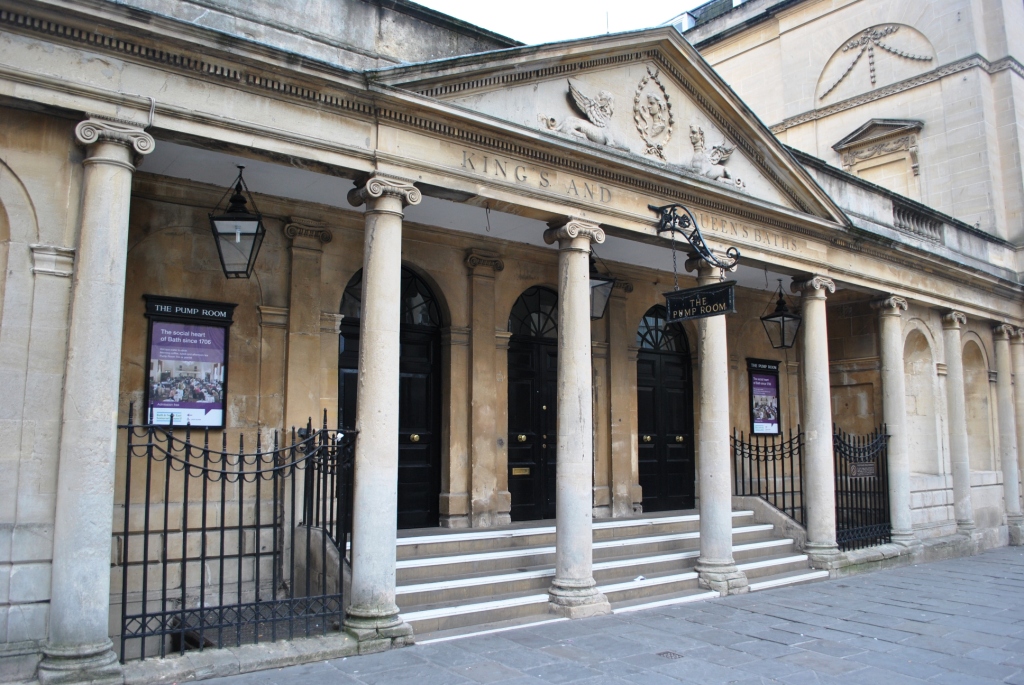
And the front entrance today:

Also, the Pump Room was built as part of a complex that utilized the existing natural springs, to create the King’s and Queen’s Baths which were marketed as health spas; today, only the King’s Bath exists. Here we are arriving at the Pump Room:

Prior Attire Ball Bath Adam

Here I am wearing my wool sack suit- The weather in California is usually just not cold enough for this.

Prior Attire Ball Bath Karin

And here’s an interior shot:

Pump Room Bath

And yes, you can still “take the waters” of Bath…it’s really just warm cloudy water with the hint of various minerals… 🙂

Image result for pump room bath

And here are a few more views:

Image result for pump room bath

Image result for pump room bath

And an earlier view:

Image result for pump room bath

Here’s a few more of us:

Prior Attire Ball Bath Adam Pump Room

And here I am pointing out the King’s Bath…

Prior Attire Ball Bath Karin

And finally, here’s one with our gracious hostess Izabela Pitcher: 🙂

Prior Attire Ball Bath

It was a wonderful culmination to our trip to Bath and it will always be a cherished memory for us.