The Princess Line Dress- One Interesting Example

One of the most noteworthy features of Mid-Bustle Era (roughly 1876-1881), fashion was the advent of the princess line dress. Attributed to Charles Worth who supposedly created the style for Princess Alexandra’s wedding dress, the princess line style was characterized by the lack of the defined waist created by the conventional bodice/skirt combination as seen in these original photographs:

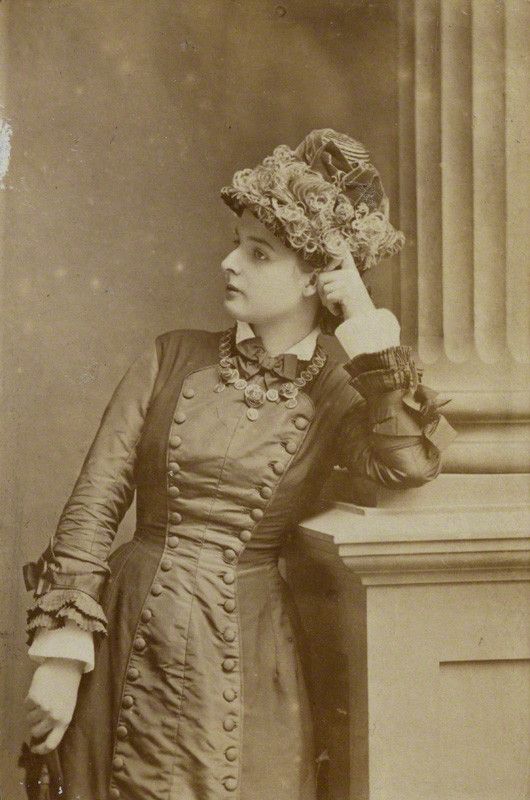
Portrait Princess Line Day Dress c. 1878 - 1881

Portrait Princess Line Day Dress c. 1878 - 1881

Now, here’s one interesting take on the style:

Princess Line Day Dress c. 1878

It’s difficult to make out the specific fabrics from the pictures but we assume that it’s silk. The color combination of pale green, chartreuse, brown and cobalt blue is interesting; not our first choice but it’s a bit different from what is normally seen from extant examples.

Princess Line Day Dress c. 1878

Side Profile

Princess Line Day Dress c. 1878

Rear View

One of the most interesting features of this dress is the use of a capote; that’s not something we’ve seen utilized with a dress. With its upright mandarin collar and capote, it’s more suggestive of outerwear, along the lines of a redingote. Below are some more pictures:

Princess Line Day Dress c. 1878

Upper Front with capote.

As can be seen from this close-up of the capote, it’s been artfully cut in layers so that there is no interruption to the pattern of the fashion fabric.

Princess Line Day Dress c. 1878

Back view with capote.

Princess Line Day Dress c. 1878

Close-up of the front.

Princess Line Day Dress c. 1878

Dress unbuttoned to show interior detail.

The interior detail shown here is interesting in that it employs the same fashion fabric underneath that’s also the outside on the cuffs, train and back.

Princess Line Day Dress c. 1878

Close-Up of the front.

As can be seen here, what we think is “brown” fabric is actually close brown stripes.

Princess Line Day Dress c. 1878

View of the train.

The train is characteristic of Mid-Bustle Era style, lot and fanning out. Not as extreme as some examples with the “mermaid tail” but the pleating does create a pleasing profile.

Unfortunately, we know almost nothing about the dresse’s provenance or the construction details; all we can do is speculate from the available pictures. In terms of dating, it’s probably safe to say that it falls in the 1878 – 1881 period (although the picture that we obtained indicates 1878). We suspect that these pictures were part of some sort of auction listing although we were unable to find out anything specific. But, in spite of the lack of information, it’s still an interesting example of a style that had a fairly short lifespan. Hopefully, we’ll find out more in the future. 🙂

1877: A New Trend In Tournures…

The fashion press can be a useful source for documenting fashion transitions and changes in styles although the search can sometime resemble searching for a needle in a haystack. However, one can find some interesting nuggets of information and especially in documenting the transition from the First Bustle Era to the Mid-Bustle (aka “natural form”) Era. Below is an interesting item that appeared in the August 1877 issue of Peterson’s Magazine:

We also give the latest novelty in Parisian tournure. It is made of muslin, the top laid in a deep double box-plait, perfectly tight-fitting, to which is added two flounces, very full and stiffly starched. This is simply to keep the train out at the bottom. No tournure is worn near the waist, perfect flatness is the present prevailing style.

Tournure_Aug 1877 Petersons Magazine

From the August 1877 issue of Peterson’s Magazine.

While not particularly earth-shattering in terms of the evolution of Bustle Era fashions, it does help to roughly date when a new trend began to emerge. Stay tuned for more! 🙂


Almost There…

Wre’re in the final countdown here at Lily Absinthe as the departure time rapidly approaches for our departure for the United Kingdom. The Atelier is awash in fabrics and trim as we make out last-minute preparations…

20180414_221922.jpg

We promise that we’ll have a ton of pictures to post here when we get back. 🙂


The 1870s Or 1970s?

Sometimes a random encounter can spark an idea and today’s post is no exception. In the course of looking for some pictures for another project, I came across a series of pictures of a circa 1874 day dress made by Charles Worth. While the design was fairly standard, it was colors that jumped out at me- they just screamed “1970s.” At the same time, we know that colors are a universal thing with various colors being emphasized during different eras.

Color has always played a role in defining the fashions of an era, whether it be the 19th Century or today and it’s one of the first things we notice. For some eras, color can exert a very powerful influence and one such era was the 1970s. When most people think about 1970s fashions, the reaction is almost invariably: “What were we thinking?” 🙂

As a generalization, the 1970s were characterized by many unfortunate fabric and style choices (as one of my fashion design textbooks described it) dominated by an earth tone color palette led, of course, by avocado and harvest gold:

1970s Color Palette Pantone

And here’s that color palette in action:

Image result for 1970s fashions

Yes, Paul Poiret would probably not approve… 🙂

So, one would think that the above color palette was unique to the 1970s but in reality, the color palette has been around since the concept of fashion was first developed. In terms of the 1870s, the same “1970s color palette” was present as seen in this circa 1874 day dress attributed to Worth:

Worth Day Dress c. 1874

Worth, Day Dress, c. 1874; Rhode Island Institute of Design Museum ( 2005.89.12)

Worth Day Dress c. 1874

Worth Day Dress c. 1874

The silhouette and style of this dress definitely reads early 1870s and is fairly standard. However, what caught our eye was the color palette which just screamed “1970s” and to be honest, it’s not our favorite color combination but there it is… 🙂

For A Little More Footwear…

In the world of late 19th and early 20th Century fashion, shoes have been a recent topic of discussion. Yesterday, while touring the FIDM Museum in Downtown Los Angeles, we came across two pairs of boots that were on display in the Museum’s permanent collection. The first pair are from 1903:

20180324_142156-e1522018153314.jpg

Here’s a close-up of the shoe:

Boots c. 1903

The toes on these boots are constructed of gold- colored leather while the uppers are of a blue suede with inset gold gilt leather strips that create a floral pattern. Finally, the laces are of a matching blue ribbon. Although we were unable to get a good look at the heel, it appears that it was between 2 and 3 inches.

The second pair are circa 1910:

Boots c. 1910

Boots c. 1910

Boots c. 1910

Although this pair of boots were made seven years later, they are almost identical to the first pair in terms of style although this time, the uppers are of black suede. Also, it must be noted that the first pair were made in Philadelphia, Pennsylvania while the second pair were made in Marienbad, Austro-Hungary (today the Czech Republic). The condition of both pair of boots is simply amazing and most likely these were never worn (or perhaps once or twice) and it also underscores how fashions were becoming increasingly international. Stay tuned for more posts on footwear. 🙂