And Now From Maison Worth 😉

When it came to haute couture, Maison Worth was a master not only noted for its imaginative designs, but also for the sheer output of product as demonstrated by the extensive collections of Worth gowns in many museum collections such as the Met in New York. Also, thanks to the internet and all manner of reference works, many of Worth’s creations are well documented and known so it’s always a treat when one comes across examples that aren’t in museums and thus less well documented- principally from auction websites. Below is one such example, a circa 1900 ball gown we came across on Drouot, a French antique auction website:

Worth, Ball Gown, c. 1900; Drouot Auction Website

In the above view, we get a closer look at the bodice front. What’s interesting is that the bodice pieces make no attempt to match up the pattern and thus it looks a bit jarring when view up close.

As with many of Maison Worth’s gowns of this period, the emphasis was on the fabric itself and thus there was a minimum of trim. The fabric appears to be an ivory silk brocade with a floral pattern (the lighting in the pictures can sometimes make fabric colors deceptive). Here’s a closer view of the fashion fabric starting with part of the skirt:

The floral design is beautiful and we would have liked to be have been able to view it in person. Also, unfortunately, there’s no information online as to the garment’s provenance- that would have been interesting to know. But that all said, this ball gown is a wonderful example of Maison Worth’s late 1890s/early 1900s designs. In future posts, we’ll have some more wonderful new (at least to us) examples to look at. 😉


Antique- Gowns From The Lily Absinthe Collection

Today’s prompt for #FallForCostume hosted by @redthreaded is: “Antique”…I’ve been an antique textile collector all my adult life, it’s nearly impossible to choose what I love best in my museum collection…dresses have souls; or memories that come with them…either way, they exist so we can cherish and share them. First one is my treasured Felix, a beautiful ballgown that came to me with her shoes! Someday, I want to reproduce her, I’ve already (carefully!) taken a pattern.


Second, is our cobalt and sapphire Worth ballgown…another one I have plans to reproduce and have already received the commissioned silk, it’s just finding the time.


Parisian Color Trends For Fall 1889

Georges Garen, Embrasement de la Tour Eiffel, 1889; Musée d’Orsay, Paris

Color is a major element in fashion styles and, as with style in general, it’s constantly in a state of flux. The situation was no different during the Nineteenth Century and while there was no entity like Pantone to constantly monitor the color trends, they were still noted. In the October 1889 issue of Peterson’s Magazine, it was noted that:

The newest color of the season is a rich deep shade of chaudron-red, which has been christened Eiffel-color, after the famous tower of the Exhibition. It is supposed to be of the same hue as the red-painted iron-work of that stupendous edifice, since its tint has been mellowed and modified by the weather. Green, except in the dark-emerald shade, has gone entirely out of vogue. Yellow, in the warm golden tones, will be a good deal used for trimmings,

Probably the most interesting comment is about “chaudron-red” which is a mash-up of French and English for “cauldron red” (or Eiffel Red) and it describes the original color that the Eiffel Tower was painted when it was first erected for the Paris Exhibition of 1889. The original paint was meant as a protective coating and had a copper-red color because of its active ingredient, iron oxide, which gives the paint its protective quality, preventing rust to the steel that made up the Eiffel Tower’s construction (even to this day, iron oxide paint is used for treating steel beams). So what did this look like? Probably something like this:

Interestingly enough, recently, when it’s time to repaint the Eiffel Tower in 2021, it has been suggested that it be repainted in the original chaudron-red, similar to the shade depicted above. So far, the French Ministry of Culture has not made a decision…

Besides “Eiffel Red,” it’s noted that green is completely out except in a dark emerald shade, perhaps along these lines:

And for yellow something like these:

And now well things together with some examples of the above colors at work, starting with this evening dress from Maison Worth:

Worth, Evening Dress, c. 1889; Metropolitan Museum of Art (C.I.59.20)

James McCreary & Co., Visiting Dress, c. 1889; Metropolitan Museum of Art

Detail of Cuff

Both of the above dress examples incorporate many of the colors noted in Peterson’s although we must note that there are also plenty of examples where other colors were used; in fashion there’s never any absolutes, just broad generalizations. We hoped you have enjoyed this brief excursion into trending colors of 1889 and stay tuned for more in the future. 🙂


The Ensemble Dress

Ensemble Evening Reception Dress Worth 1893

One interesting aspect of Charles Worth’s designs was what was called the “Ensemble Dress.” This was a dress that had two bodices, typically one for day wear and one for evening wear so one could have a nice semi-formal dress for calling on friends, going into town, or attending some sort of day function. At the same time, with a change in bodices, one would have also be properly dressed for an evening function. Below is just one circa 1893 example from Worth:

Ensemble Evening Reception Dress Worth 1893

Worth, Evening Ensemble Dress, c. 1893; Metropolitan Museum of Art (2009.300.622a–c)

First, we have a day bodice that’s designed like a jacket; no doubt some wort of a waist was worn underneath even though it would have been covered by the lace strips running down the front. And then we have a night bodice that’s perhaps a little more formal:

Ensemble Evening Reception Dress Worth 1893

The Alternate Bodice

And here’s a rear view of the dress with the day bodice:

Ensemble Evening Reception Dress Worth 1893

Rear View

In terms of silhouette, this is characteristic for the early 1890s with it’s fairly restrained train arrangement- most likely a small bustle pad was worn but not much else. The fact there’s small train points to it being more of a formal dress (with day and night configurations). The fabric is a silver colored silk satin with a gold leaf pattern decoration woven in broken texture that services to provide a contrast both in texture and color. The red silk velvet lapels and sleeve trim on the day bodice and the red bodice front on the night bodice. The effect is exquisite with either bodice. Below is a close-up of the fabric.

Ensemble Evening Reception Dress Worth 1893

Detail of fabric- too bad it’s not in color.

In 1890s fashion, the skirt and bodice have a minimum of trim and Worth lets the contrasting fabrics, both in color and in texture, speak for themselves. Just one of many exquisite examples from Maison Worth.


The Princess Line Dress- One Unique Example

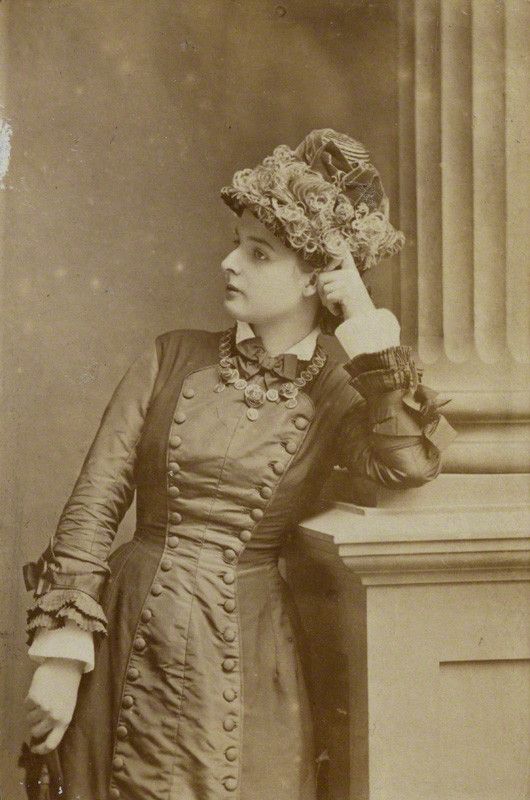
One of the most noteworthy features of Mid-Bustle Era (roughly 1876-1881), fashion was the advent of the princess line dress. Attributed to Charles Worth who supposedly created the style for Princess Alexandra’s wedding dress, the princess line style was characterized by the lack of the defined waist created by the conventional bodice/skirt combination as seen in these original photographs:

Portrait Princess Line Day Dress c. 1878 - 1881

Portrait Princess Line Day Dress c. 1878 - 1881

Now, here’s one interesting take on the style:

Princess Line Day Dress c. 1878

It’s difficult to make out the specific fabrics from the pictures but we assume that it’s silk. The color combination of pale green, chartreuse, brown and cobalt blue is interesting; not our first choice but it’s a bit different from what is normally seen from extant examples.

Princess Line Day Dress c. 1878

Side Profile

Princess Line Day Dress c. 1878

Rear View

One of the most interesting features of this dress is the use of a capote; that’s not something we’ve seen utilized with a dress. With its upright mandarin collar and capote, it’s more suggestive of outerwear, along the lines of a redingote. Below are some more pictures:

Princess Line Day Dress c. 1878

Upper Front with capote.

As can be seen from this close-up of the capote, it’s been artfully cut in layers so that there is no interruption to the pattern of the fashion fabric.

Princess Line Day Dress c. 1878

Back view with capote.

Princess Line Day Dress c. 1878

Close-up of the front.

Princess Line Day Dress c. 1878

Dress unbuttoned to show interior detail.

The interior detail shown here is interesting in that it employs the same fashion fabric underneath that’s also the outside on the cuffs, train and back.

Princess Line Day Dress c. 1878

Close-Up of the front.

As can be seen here, what we think is “brown” fabric is actually close brown stripes.

Princess Line Day Dress c. 1878

View of the train.

The train is characteristic of Mid-Bustle Era style, lot and fanning out. Not as extreme as some examples with the “mermaid tail” but the pleating does create a pleasing profile. Unfortunately, we know almost nothing about the dresse’s provenance or the construction details; all we can do is speculate from the available pictures. In terms of dating, it’s probably safe to say that it falls in the 1878 – 1881 period (although the picture that we obtained indicates 1878). We suspect that these pictures were part of some sort of auction listing although we were unable to find out anything specific. But, in spite of the lack of information, it’s still an interesting example of a style that had a fairly short lifespan. Hopefully, we’ll find out more in the future. 🙂