Pattern Licensing From Maison Worth

Charles Worth is famous for being a pioneer in the world of haute couture and his impact on late 19th Century was immense. Although Worth’s designs are well known, the business aspects of Worth’s fashion empire are relatively unknown, aggravated by a lack of substantial documentation and a natural reticence on his part to discuss the topic. What we do know is fascinating and offers insight into Worth as a designer and below is just one small element for consideration.


One fascinating aspect about Charles Worth was that although he positioned himself as an exclusive couturier, he also licensed printed paper patterns of some of his designs. It’s well noted that Worth himself shied away from any overt publicity this to and you really have look hard for the evidence but it’s there. One example of this is this Redingote style was offered for sale for as a printed pattern in the 1882 edition of The Ladies Treasury:

And here’s the accompanying commentary:

Redingcotes are most popular in Paris. M. Worth makes them for summer dresses instead of polonaises. They are made in grenadines, over contrasting colours, for evening dresses. A mauve grenadine, on which are moons of black satin, two inches in diameter is made plain, over a lining of maize yellow satin. The grenadine is turned off in the front, to the sides, and is outlined in jet embroidery, black. A full frill of thread lace goes round the neck, and continues down the centre of the bodice. The petticoat of black satin has a pleated flounce of satin, and a front breadth of yellow satin, which is nearly hidden in jet embroidery, and bows of moire ribbons.

This style is M. Worth’s protest against the bunched-up paniers at the back, which it is said he detests.

Worth’s licensing of patterns is an interesting aspect of his business and is an area that’s not well documented. Of course, it would be interesting to locate the actual pattern but so far, our efforts to do so haven’t been successful. What’s also interesting is that even though Maison Worth was doing very well financially, it’s interesting that he would even bother with such pattern licensing- the revenue from pattern licensing could not have been much when compared to sales of his haute couture. Unfortunately, details about business side of Maison Worth are thin and we may never know the precise answer but it’s interesting to speculate on. As we find out more, we’ll be posting it here. Enjoy!


Looking Underneath The Dress- La Maison Worth

Haute couture has always been an extremely personal experience for the client and this was especially true during the late 19th Century. Garments were designed to precisely fit the individual and constructed of the finest fabrics and trim; one could not help think that the garment in question had been exclusively designed for the client from the ground up. However, the reality was quite different: underneath all the exquisite fabrics and glittery trim were the garment’s basic structure- a structure that gave a particular garment its shape and that structure was based on common pattern pieces. The fabrics and trim might change from garment to garment but their basic structure utilized the same slopers or basic pattern blocks that could be modified as needed for a particular client and style.1(De Marly, Diana. Worth: The Father of Haute Couture. Holmes & Meier, 1990)

The House of Worth was generally acknowledged as the leading couture houses in Paris (and by extension, the world) and as such, its designs reflected this. However, underneath all the exquisite fabrics and trims, the dresses made by Charles Worth often used the same basic pattern blocks (albeit modified for the individual client). It’s often all too easy to get lost in all the exquisite details found on Worth dresses and especially with ball and evening gowns. For example, let’s take a look at these two ball gowns:

Ball Gown Worth c. 1895 - 1900

Worth, Ball Gown, c. 1895 – 1900; Metropolitan Museum of Art (2009.300.1290a, b)

Worth Ballgown 1898

House of Worth, Ballgown, 1898; Metropolitan Museum of Art (2009.300.1324a, b)

Both of the above gowns were made during the late 1890s and both have the same silhouette and share identical lines. Only the fabrics and trim change. Here’s another pair of evening dresses made during the mid 1890s:

Worth Evening Dress Ball Gown

Worth, Ballgown, c. 1894; Kyoto Costume Institute (AC4799 84-9-2AB)

Evening Dress Worth c. 1895 - 1896

Worth, Evening Dress, c. 1895 – 1896; Metropolitan Museum of Art (35.134.2a, b)

Similarities could also be found in a variety of dress styles:

worth_dinner-dress_1897_1

Worth, Dinner Dress, 1897; Costume Museum of Canada

Worth Evening Dress c. 1897

Worth, Evening Dress, c. 1897; Metropolitan Museum of Art (2009.300.638a, b)

Day Dress Worth c. 1875

Worth Day Dress, c. 1875; Metropolitan Museum of Art (2009.300.1100a, b)

Day Dress Worth c. 1875

Side Profile

Worth Dinner Dress c. 1877

Worth, Dinner Dress, c. 1877; Metropolitan Museum of Art (C.I.69.33.3a, b)

Worth Dinner Dress c. 1877

Side Profile

Surface treatments might differ (i.e. smooth fabric versus ruched fabric) and trains an sleeve lengths and trim can vary but at the root, these dresses share many of the same internal structural components. When one thinks about it, it only makes sense- while haute couture may have only been worn by a narrow segment of the market, within that specific market segment there was a heavy demand and it could only be met by utilizing various industrial production practices. Of course, the client was blissfully unaware of this, their only concern was getting the desired garment. In short, one could term it “mass production luxury goods” which is almost a contradiction in terms.

We hope you’ve enjoyed this little insight into what was going on underneath the dress, so to say, and we hope to be making more posts about this in the future.


Working With An Original…

There are some issues that no restoration can cure. Today, this lady gets photographed for the last time, the silk satin of the skirt is shattering and I want to preserve as much of the embroidery and beadwork as possible.


And Something New From Maison Pingat…

We don’t normally associate Emile Pingat with more casual designs such as tea gowns and morning dresses but that’s not always the case. Recently, we came across this interesting 1890s era example that was on an auction website:  🙂

Pingat, Tea Gown, c. 1890s; Whitaker Auctions

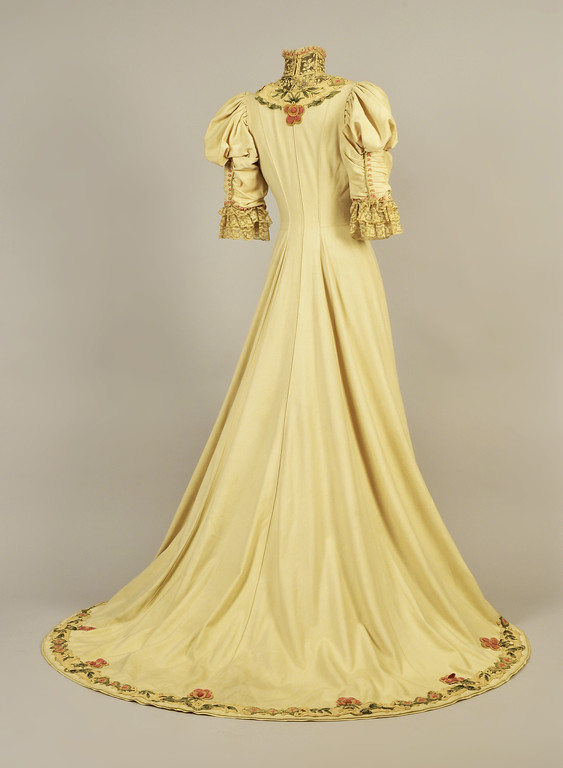
This dress is constructed from cream-colored wool trimmed with ivory lace at the sleeve cuffs and neck. The dress is also trimmed in a floral pattern constructed from soutache cord appliques mounted on linen running along the hem, neck, and dress front.

This dress has a silhouette that approximates the quintessential 1890s x-silhouette yet the lines are more loose and free-flowing, aided by the princess line style. This dress reads “tea gown” although it would also work for a house or morning dress; in any event, this was probably a bit too casual for going outside of the house and was intended for wear at home. As we’ve commented on other tea gowns, Pingat has taken what was meant to be a simple style and upgraded into more of a couture gown. Here’s some close-up views:

This close-up view from the rear shows the princess line seamwork although there are waist lines on the side pieces- whether these are simply stitch lines or actual seams is hard to determine from the picture but either way, the dress reads princess line. The sleeves are elbow length and have moderate poufs on the sleeve caps- based on the sleeve caps, we’d be willing to estimate that this was garment was made something in the 1893-1894 time frame but this is just an estimate on our part.1Unfortunately, like most auction website listings, the dating is very vague and in this case, it just stated that it was “1890s” which is not very helpful.

The above lace collar extends up the neck and is topped off by a row of tiny silk flowers. Also, the pictures above and below show excellent close-up views of the applique decorative design and in many respects it’s reminiscent of trapunto.

The dress was front opening and concealed by this elaborately worked placket consisting of raised appliques worked in a floral pattern designed to mimic a vine with flowers. It’s a very cleaver design solution and keeps the rest of the dress lines clean, unfettered by the need for an opening.

And here we seen Pingat’s label stamped into the petersham, something that was very common for couture houses to do. The petersham was intended as a way to control the dress and keep it firmly attached at the waist. With this tea gown, we see a design is simple and elegant, embodying the oft-quoted idea of “less is more;” it’s definitely that. With dress’s simple, clean lines acting as a canvas for the restrained decorative scheme, and it all harmonizes together nicely.