Fashion Plates & Fashion History

When we originally wrote this several years ago, we were more focused on the fashion plate as an accurate means of documenting how garments looked during the late 19th Century. However, as time went on, our opinion has shifted somewhat to the idea that fashions plates depicted what was possible and as such, served as inspiration more than anything else. This idea is further reinforced by the fact that most of the 19th Century fashion press got its start as a means of promoting the sales of printed paper patterns. For example, The Delineator was owned by Butterick, one of the leading pattern manufacturers and another major publication, Demorest’s Family Magazine for all intents and purposes is glorified pattern catalog. But what is more striking is that the fashion plates of the period go a long ways towards documenting evolutionary changes in fashion silhouettes which is extremely useful. Combined with original photographic images and extant examples, we can get a very good picture of how garments appeared and as such, fashion plates are just one more valuable tool but not the only tool.


Fashion plates are often criticized as fashion history documentation because their representations of period fashions that bear no relation to what those particular period fashions ACTUALLY looked like. At best, they’re fantastical distortions of reality, representing an ideal that could never be attained (of course, the same argument can be made about today’s fashions as depicted in the fashion press).

Cover Petersons 1887

However, nothing could be further from the truth. The reality was that fashion plates, both colored and black and white, played a practical role in the transmission of fashion information during the 19th and early 20th Centuries; fashion photography would not come into its own until the 1910s. While  the study of fashion plates as an art form in itself has become popular today, this was not what they were intended to be. Rather, it was a blueprint for individuals to be able to replicate a given design.

Cover Godeys 1885 Cover Harpers Bazar 1885

However, at the same time, fashion plates did present ideal views of their subject garments with their unnatural poses and the models were perfect physical representations. But never the less, fashion plates were first and foremost meant to be a practical means of transmitting fashion information. Ultimately, the fashion plate was a practical tool and used as such.

Cover Delineator 1890

More specifically, the fashion plate was deliberately constructed to impart information to the viewer and specifically to enable the viewer to be able to make a garment based on the plate- in short, “how to do it” blueprints and as such they were often used as supplements to accompanying sewing patterns and were typically printed in magazines. Magazines such as The Delineator, Godey’s Lady’s Book, Harper’s Bazar, and Peterson’s Magazine were only a few of the many magazines that were available to the home sewer and professional dressmaker.

Petersons June 1870

Fashion Plate from Peterson’s Magazine, June 1872.

Above is a fairly typical fashion plate- it looks like a simple illustration of a group of dresses. Well, yes and no- the poses are somewhat stilted with the emphasis on showing as much of the dress as possible. Notice how the decorative treatments are given the best angle possible and especially on the train. This was deliberately done in order for the viewer to see the entire design in order to replicate it.

But it was not only fashion plates. Patterns and more detailed information were also supplied:

evening polonaiseL

Evening Polonaise Pattern from Peterson’s Magazine, May 1872.

Petersons Nov 1880

Fashion plates simply illustrated what was possible and were meant as a source of inspiration, not necessary something to be followed line-for-line. But more importantly, fashion plates showed the progression of styles through the late 19th Century and just by glancing at them, one can readily see differences and especially in the silhouette as it evolved from the 1870s through the  1890s. Here are some some examples from the 1870s and 1880s:

Godey's Lady's Book, November 1872

Godey’s Lady’s Book, November 1872

Englishwomens Domestic Magazine June 1876

The Englishwomen’s Domestic Magazine, June 1876

Plate 2

The Englishwomen’s Domestic Magazine, July 1877

Le Mode Illustree 1878

La Mode Illustree, 1878

Fashion Plate, 1881 from the Revue de La Mode.

Revue de La Mode, 1881.

Revue de Mode1

Revue de La Mode, 1885

9a31e8c7dc5de5e478bb981478521847

C. 1886

Petersons April 1889

Peterson’s Magazine, April 1889

As we move into the 1890s, still more shifts in the what was considered to be the ideal silhouette can be seen:

1892

Journal Des Demoiselles, January 1892

Journal Des Demoiselles, August 1893

Journal Des Demoiselles, August 1894

Delineator 1898 Dec

The Delineator, December 1898

Delineator 1898 Dec_2

The Delineator, December 1898

What is interesting about this progression of plates is that by the 1890s, it’s all about the front of the dress. While there are frontal views in earlier plates and rear views in later plates, it is still obvious that the emphasis had shifted which is consistent with the movement away from the bustle. The 1880s provide some interesting ground in that the views seem to almost split 50-50, at least based on a very unscientific examination of fashion plates from various sources, both online and in books.

The above is only a small sample of the fashion illustration that was characteristic of the late 19th and early 20th Centuries but it does show that even then, the dissemination of fashion information was being done on a large-scale industrial basis, pushed along by technical advances in the printing trades. Moreover, with the rise of mass-circulation fashion magazines such as Godey’s, Petersons, and Harper’s Bazar, fashion’s reach extended to almost the entire world and most notably in America. The “pretty” and “fantastical” fashion plate served a very specific and practical role that today is easily overlooked. In the end, fashion plates were an art form in terms of their ability to impart information rather than existing as representations of fashion.


Paul Poiret And Fashion Trends: 1907-1908

By 1907, a seismic shift was happening in the fashion world that saw a repudiation of the tightly controlled architectural styles defined by tight corseting to styles that were seemingly unstructured and free-flowing (although undergarments still played a key role, albeit more subdued) a more freer. One manifestation of this new fashion trend was a return to the Directoire and Neo-Classical styles of the early 1800s, styles that were incorporated by Paul Poiret in his couture collections such as with his iconic “Josephine” evening dress that he created in 1907:

Poiret, Evening Dress (aka “Josephine Dress”), c. 1907; Musee de les Arts Décoratifs (UF 70-38-10)

This dress was constructed from an ivory silk satin and cut in an empress silhouette, a silhouette characterized by a fitted bodice with a high waist that ended just below the bust line combined with a loosely fitted skirt that flowed over the body. The dress is trimmed with a fitted black net shawl, trimmed in gold braid along the edges and hem. Finally, on the bodice front is a large silk fabric rose that draws the eye. Here’s another view:

Here’s a comparison between the dress and concept illustration that was published in 1908:

And here’s a close-up of the dress front. Note the black net covering:

This dress definitely looks back to an earlier time and it could be argued that the style completely repudiates the tightly structured styles that had dominated fashion for over half a century. To draw a further parallel, the Directoire and Neo-Classical fashions of the late 18th Century and early 19th Century was also a repudiation of the earlier tightly structured styles that were characteristic of most of the 18th Century up until the 1790s. Just for comparison, here’s just two examples from the early 1800s that are very similar to Poiret’s design:

Merry-Joseph Blondel, Felicite-Louise-Julie-Constance de_Durfort, 1808

And here’s the concept illustration that appeared in Les Robes de Paul Poiret which was a design album illustrated by Paul Iribe that served to promote his fashion concepts1Les Robes de Paul Poiret was a limited edition book- only some 250 copies were printed and almost impossible to find on the used book market. But you can download an electronic version for free from https://archive.org/details/lesrobesdepaulpo00irib[/mfn]:

Poiret’s Josephine dress is a perfect illustration of the basic fashion cycle of action and reaction and it pointed the way forward for fashion into the 20th Century.


Patterns – Building The Foundation

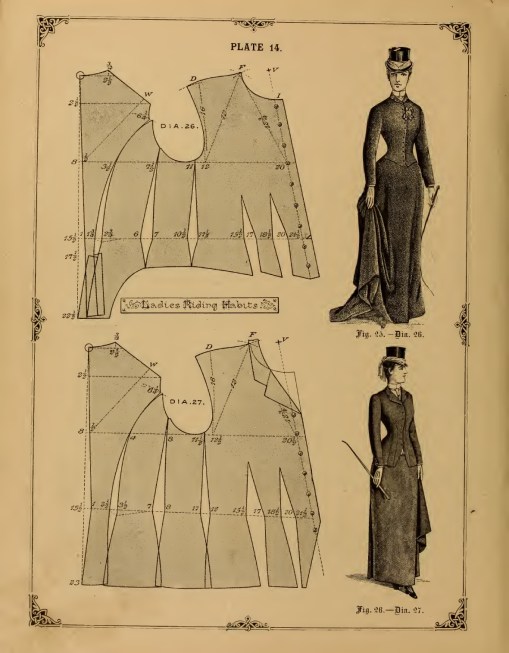
Inspiration is the basis for all of our designs but that is only the start. In order to bring our designs into reality, it is necessary to have an extensive knowledge of just HOW garments are constructed (i.e. “put together”) and an essential part of this are patterns since they provide the “roadmap” for the actual construction process. In this post, we’ll be discussing the nature of our approach towards patterning. Enjoy! 🙂

Patterns1


All garments, whether the are haute couture or bargain basement, start with a pattern and it’s that specific pattern that defines what that particular garment is ultimately going to be. Here at Lily Absinthe, our approach to patterning is a combination of methods that are referred to in the trade as “bespoke” and “made to measure (MTM).” These two terms are often used interchangeably in reality are two different methods. With the bespoke method, an individual pattern is created for a specific client based on their measurements and taking into account the various body characteristics of the client. With MTM, the garment is built on pre-existing pattern blocks that are modified on the basis of the client’s measurements (this is admittedly a bit of an over-simplification but it does convey the essence).

We maintain an extensive library of pattern blocks that we have drafted ourselves and in most instances, we will modify specific pattern blocks based on the individual client’s measurements. More importantly, these modifications also incorporate every nuance of the client’s body. In most instances, the MTM method works perfectly but in some instances, we will draft custom pattern pieces. However, no matter which of these two approaches we use, we guarantee a perfect fit every time and a garment that has been custom made to the client.

Patterning is often presented as a magic and mysterious process that requires the utilization of various arcane procedures to achieve results. On the flip side, in more recent years patterning has been presented as something that can be done quickly on a computer and paper patterns instantly printed out. In reality, while pattern drafting is a relatively simple and straight-forward in theory, it does require an attention to detail, precision, and a lot of patience (and we mean A LOT). For more complicated designs, it often requires a series trials rotating back and forth with muslin mock-ups (aka tolle) and revising the paper pattern to achieve the optimal result.

wp-1469469622815.jpg

Ultimately, whether a garment is “bespoke” or MTM, it’s critical that the fit be perfect, fabric/trim choices are suitable, and most importantly, that the garment is aesthetically pleasing. 🙂

Madame Demorest's Illustration Portfolio of the Fashions for 1880:

How Fashions Develop- A Perspective From 1896

It’s a commonly accepted part of today’s fashion wisdom that specific fashions are introduced on a seasonal basis (or faster) by armies of designers attempting to come up  with the next best thing. However, this connection between designer and customer hasn’t always been the case and in fact, throughout history, fashions have been introduced “from above” by people of higher social status, often a monarch and their inner circle. From there, the specific fashion moves downward through the social strata, adopted by an ever-widening group of people until it reaches the lower class where the fashion eventually becomes extinct.

Charles II

Charles II Presented With A Pineapple. c. 1675 – 1680

Probably one of the most specific examples of a fashion trend starting at the top was when October 7, 1666 King Charles II decreed that a new fashion was to be worn at Court consisting of a vet, waistcoat, and breeches, an outfit that ultimately evolved into the modern three-piece suit. While older fashions lingered on, the nobility and anyone else with pretensions of social standing were quick to adopt the new fashion. The traditional idea of fashion trends starting at the top of society has been largely replaced by the idea that fashion trends can start from a multitude of sources ranging from “street fashion” originating with the lower classes, political leaders, the military, and high-profile media figures. In today’s intern

However, central to the concept of fashion diffusion, whether it starts at the top, the bottom or somewhere in between, is the idea that most people are passive when it comes to fashion, only adopting what’s put in front of them to wear, a phenomenon that was noted during the 19th Century, usually in a negative fashion, by a host of commentators. Here is just one example from the March 10, 1896 edition of the Los Angeles Herald:

The Paris leaders in dress are neither women in private life nor in public life, as one so often reads, but the inventors of toilets in the swell dressmaking establishments, who succeed in interesting their patrons in their creations. Not one woman in 500, or in 5,000, knows what she wants to wear, and not one in 25,000 what she should wear. The designers who make up designs for the dress goods manufacturers have more to do with the fashions in vogue, from season to season, than any queen on any throne.

No longer are fashions being disseminated by those of a particular social class (i.e., a king or queen) but rather it’s being driven by fashion designers. The author goes on to note that:

The loom owners come next, staking much upon their belief that a certain design will sell. Then the dress designers, who do nothing but make pen and ink and colored chalk pictures of fashion figures that they think will show off to advantage the goods in the market, come in for an important place in the line of fashion creators. The “big” dressmakers buy the designs of these artists, and employ other artists of their own to invent fashions, and only then does the woman who buys and wears the clothes come in for any place in the procession of those who are responsible for the modes of the times.

What is interesting here is that the author is describing the fashion industry (of the time)- essentially, the industry itself has created a self-sustaining structure, something that comes as no surprise today. Finally, the author somewhat cynically concludes by stating:

Do heather mixtures and chameleon mohairs, colored damask and taconnes with filete effects, moire velous and wool and mohair jacquards, Mozambique checks and two-toned silk construction crepons, grenadines and et animes, and so on and so forth—do any of these become the fashion because a duchess, wears them, or is It because Worth or somebody else coaxes her into having gowns made from them? The great popular demand for anything does not spring out of the fact that real queens wear certain things; too few people ever see them to know what they wear. It is because some of the people in the popular eye like stage queens exhibit taking toilets.

And here we finally hit at one of the major foundations of fashion trend-setting: the role of popular figures (“fashion influencers” as they are termed today). While the author only touches on this before concluding, it explains much of what we see today. The concept of fashion trends is not as modern as we would think and it’s always fascinating to see people’s reactions in earlier times.

Our Design Process Or How Do Gowns Get Created At Lily Absinthe?

Strathern Ranch Dress

Often, we are asked just exactly how we go about developing our various dress designs. The short answer, of course, is that we get our initial inspiration from history itself through a variety of media to include paintings, photographs, illustrations, and various extant examples found in museums, private collections, and most importantly–our private museum collection.However, this is only part of the equation- we also draw upon the world around us. Whether it be colors of a certain variety of flowers in a garden, an Arizona sunset, or even a piece of music, these also go a long way in the design process. Designing historically-inspired clothing is not the same as simply creating line-for-line reproductions of historical examples, but rather it’s using what came before to build something completely new. Creating line-for-line reproductions has its place (like recreating a dress for a museum display) but for us it offers little inspiration.

So, just what is the process? Well, there’s no “one” method but broadly speaking, here’s a rough outline of what we do:

  1. Discuss with the client what sort of a dress they desire (eg., day dress, evening dress, ball gown, etc.) and what specific period are they looking at.
  2. Discuss with the client their likes and dislikes and basically determine what sort of vision they have for themselves- in short, how they see themselves.
  3. Assess the client’s skin tone and hair color and crate a palette of complementary colors and review with the client.
  4. Based on the above, work up preliminary sketches and review with the client.

This is a continuous interactive process and in reality is as much a matter of art than scientific process.

However, it must be noted that the above process is also informed by our knowledge of historical styles and textiles because each plays an important role in achieving the most optimal design that is not only historically accurate, but also harmonizes with the specific client.

Now let’s take a look at a specific example…


Inspiration is the starting point for any design and it often comes from unexpected sources and often quite suddenly. This project initially started with the vague idea of wanting to design a fairly simple early to mid-1880s day dress in a style that’s not often recreated. While our reference library and the internet provided a wealth of ideas, nothing was really clicking (it happens, even with us. 😉 )

Then one day we found it! Through our Facebook feed, we’d received some images of a dress on display at a small museum. The two things that stood out were the clean lines and the use of pale greens- shades of celadon, you might say. The lines especially caught our eye in that the utilize a pseudo-jacket with large revers, a style that one rarely sees replicated these days. Eureka!  🙂

After a little close-up photo research, we determined that the dress was held in the collection of the Strathearn Historical Park and Museum in Simi, California. This was even better- we’d be able to get a look at the dress in person and not have to rely on pictures alone. 🙂 A quick 40 minutes later, we arrived at the museum and were able to get a good look at the dress even though it was behind plexiglass:

wp-1478109460507.jpg

The dress dates from the late 1870s/early 1880s and is characteristic of the Mid-Bustle period, especially with the cylindrical skirt silhouette and minimal bustle. The material appears to be either a silk or silk/cotton faille and the color is a light celadon (or gray, depending on the light).

wp-1478109460508.jpgwp-1478109460511.jpgwp-1478109460509.jpg

From the above pictures, it would seen that the dress colors are almost shades of gray. When we initially viewed the original pictures of the dress in the Facebook feed, it appeared that the dress color was more of a gray. However, when we had a chance to examine the dress in person and to take our own pictures, it was obvious that the dress was of a celadon color with ribbons of a lighter shade of celadon. It just does to show that lighting can make all the difference in a dress color and it’s one of the pitfalls of doing dress research purely online.

wp-1478109460506.jpg

Nice close-up- the sleeve fabric appears to be a silk faille.

Now for a little historical background starting with our old standby, fashion plates: 🙂

revue-de-la-mode_1879

Revue de la Mode, c. 1879

revue-de-la-mode_1880

Revue de la Mode, c. 1880

journal-des-demoiselles_1882

Journal des Demoiselles, 1882

The following dress is a good example of the pseudo-jacket bodice style although it’s from the Mid 1880s:

1936-61-2front

Day Dress, c. 1883 – 1886; Manchester City Galleries (1936-61)

1936-61-2detail

Close-Up Of Bodice

And just to be complete:

With all of the above in mind, we set out to create a design for an early 1880s day dress that would incorporate defined lapels (or “revers”) along with a two-tone color scheme of lighter greens. As can be seen below, we opted to use a dark gray with green undertones for the lapels, collar, and an outlining strip that would run along the hem of the overskirt. Here are some views of the dress under construction:

1880 Day Dress Strathern Ranch

Strathern Ranch Dress

Below is a more complete side profile view of one sleeve and the skirt. We opted to put four rows of knife pleating on the underskirt, made from a silk dupioni.

Here is a closer view of the lapels:

1880 Day Dress Strathern Ranch

And yes, there’s definitely a range of green shades going on…here we see Adam’s shirt and vest next to the dress. It’s interesting to note that the greens on the shirt and vest are “warm” while the shades on the dress are “cold”. 😉

When the dress was finally completed, Karin decided to unveil at the Helldorado Days event which is held every October in Tombstone, Arizona. Here are just a few pictures of the completed dress: -)

wp-1485241454966.jpg

Strathearn Ranch Day Dress 1880s Karin

The Final Touches…

Strathearn Ranch Day Dress 1880s Karin

And Of Course, The Obligatory “Selfie.”

wp-1485363748784.jpg

And Here We Are!

And so the it is! This is just one example of how our design process works. What really surprised us about this project is how a simple off-hand picture posted on social media lead us on a path of discovery that ultimately led us to bringing an early 1880s dress style back to life. We hope you’ve enjoyed this little journey through the creative process and we hope to be able to design a dress for you.

wp-1485241540494.jpg

Mac, our creative consultant, has decreed that there’s been enough fashion for one day and that he’s ready for dinner.