Finding Inspiration In Paris, Part 2

Bienvenue au musée d'Orsay

Inspiration for us is not limited to water lilies… 🙂 We also too the opportunity to visit the Musee d’Orsay which is home to one of the finest art collections in the world and houses one of the largest collections of Impressionist paintings in the world (no surprise there!). Here’s just a few highlights, starting with Claude Monet:

Here’s a better view, courtesy of the web:

Claude Monet, Essai de figure en plein-air: Femme Ă  l’ombrelle tournĂ©e vers la gauche, 1886

The artist’s technique, when combined with light and color gives the above figure an almost ethereal appearance- individual detail is not as an important as overall effect. What’s also interesting is that the sunlight is somewhat soft and diffuse rather than harsh. The above painting was one of a set of two with the figure facing both to the left and right:

And there’s the fabulous Le DĂ©jeuner sur l’herbe by Manet:

This painting is a lot larger than what I was expecting. Here’s a better version, courtesy of the web:

Edouard Manet, Le DĂ©jeuner sur l’herbe, 1863

Manet’s Le DĂ©jeuner sur l’herbe was considered somewhat risque in 1863, especially in terms of subject matter. One can read many interpretations into this art piece but for us, this represents a freedom of form that runs somewhat counter to the tightly corseted clothing forms characteristic of the period. It’s an interesting contrast.

Renoir’s Bal du moulin de la Galette provides another interesting study in the play of color and light:

And once again, a better version, courtesy of the Musee d’Orsay:

Renoir, Bal du moulin de la Galette, 1876

Now, while it can be argued that paintings only go so far when replicating the natural world, that really misses the point in that we’re not looking for strict realism, rather we’re looking at the artist’s interpretation of the natural world and it’s that interpretation that engages our interest and thus, inspires. The play of light and color is immensely fascinating to us and it often serves as a point of departure our design process. Impressionism is especially compelling because of its focus on light and color, especially when the color can change with the light due to factors such as shade, time of day, and distribution. Renoir’s Bal du moulin de Galette, pictured above, provides an especially good example of this.

And just because, below are some more examples, starting with one of our favorites, The Swing, by Renoir:

Auguste Renoir, La balançoire, 1876

The individual details of the objects and people are somewhat blurred but the colors go a long ways towards filling in the details. Also, we can tell that the woman’s dress is an princess line dress. 🙂 Monet’s A Bridge Over A Pond of Waterlilies is another favorite:

Claude Monet, Le bassin aux nymphéas, harmonie verte, 1899

The play of the various shades of green are striking and even more so viewing them up close and in person. Just for contrast is Monet’s Houses of Parliament depicts of London on a typically misty/foggy day where the sun is trying to burn through:

Claude Monet, Londres, le Parlement. Trouée de soleil dans le brouillard, 1904

Paris is the perfect place for fashion inspiration and during our short stay, we didn’t even scratch the surface of its amazing potential. However, we’ll be going back soon so we’ll have another opportunity to be inspired up close and personal. Au revoir!

You Learn Something New Everyday…

It’s funny how one can be so focused on examining an image for a specific detail that you  completely overlook something that’s glaringly obvious with another detail. In a post we published yesterday, we cite various examples about how color can also be expressed through a pattern on a fabric as well as with a solid colored piece of fabric. One example that we used was this one:

Day Dress, c. 1880; The Museum at FIT (P92.21.1)

On the surface, this dress appears to have the standard silhouette appropriate for the 1878-1881 time frame with it’s princess line. But, it was pointed out to us by one of readers that the dress has a high train  and underlying bustle that firmly puts in the late 1880s. Since we were so intent on the fabric itself, we didn’t stop to look very closely at the pictures, especially with the rear views:

Back Bodice Close-Up

Looking at the rear views, we noticed that the train was definitely NOT late 1870s/early 1880s. Rather, it appears that the extreme train characteristic of the late 1880s was created by the use of what appears to be a simple overdrape of fabric combined with swagging the front skirt and combining it with a underskirt. It’s a complicated and awkward arrangement. Here it is broken down:

When we first looked at the pictures, we originally thought that perhaps the dress wasn’t staged well by the museum staff- it does happen. But on closer examination, we realized that no, this was dress was designed to accommodate a later 1880s style bustle.

So what’s the story? We wished we knew but we can offer some theories. First, we believe that given it’s tightly sculpted cylindrical silhouette and princess lines, this dress started life sometime in the 1878-1881 time frame and was later modified (clumsily) to fit the late 1880s style. But…the fact that the fabric completely matches would suggest that maybe this was made in late 1880s. The princess line wasn’t unknown during late 1880s but it doesn’t show up a lot except with tea gowns and “house” dresses. Also, for a conversion there is a lot of extra work that was put in that really wasn’t necessary with the double layer front skirts. In the end, it’s hard to tell but we tend to lean towards the dress having been made in the late 1880s. It’s probably not the what we’d readily call “haute couture” but then again, garments during this era had quite a lot of variation in the construction quality (like every era…). It’s certainly an interesting riddle and we thank our reader for pointing this out to us. 🙂


Postscript:

After some further consideration, we have to conclude that this dress is truly a product of the Mid-Bustle (aka Natural Form) Era and that it was staged incorrectly for museum display. To us, the biggest giveaways are the functional vertical row of buttons running down the back and the tightly square-off shelf in the rear. First, the button row is consistent with the princess line silhouette- after all, there has to be a way to put on and remove the dress- and this would completely interfere with a proper late 1880s train and bustle. Finally, note that the button row extends out flat on the shelf- this is something that looks awkward and unnatural (and not found on any originals garments or patterns that we’ve examined. The upper rear of a later 1880s dress was more like this:

Also, the earlier dress style emphasized a cylindrical silhouette that was decorated with a second skirt that swagged in both front and rear. With this example, it appears that all of this was undone and stretched out to accommodate the late 1880s bustle. Below are some examples:

Three-Quarter Rear View

Rear View

This has been a fascinating exercise in figuring out the style and time frame based on dress style and how that can be misleading when an extant original isn’t displayed correctly. Of course, we could also be dead wrong but I seriously doubt it. 🙂

The Princess Line, Redux

Our previous post on the Mid-Bustle Period, and the princess line dress in particular got such a favorable response that we decided to follow up on with some more examples.

Le Moniteur De La Mode, 1876

One of the dramatic and interesting styles is the one above utilizing an open redingote combined with an underskirt in two complementary colors and contrasting ruffles. The train also employs several layers of the same complementary colors. Also, the use of revers is taken to an extreme, especially towards the bottom when the revers open out to create the illusion of turn-backs. Overall, the effect is very reminiscent of the 1780s and 90s, an era something that often influences mid-1870s styles.

Le Moniteur De La Mode, 1878

This style is a bit more “conventional” in that it stays with one color, taking its decorative effect from the various ruffles, pleating, and trim. Also, while it’s impossible to tell just what the illustrator had in mind with the fashion fabric, one could easily imagine silk brocade or similar.  🙂

The Englishwoman’s Domestic Magazine, June 1878

Here we see a couple variations with the trains with various degrees of pleating, bows, and contrast colors. In many respects, the only limits are one’s imagination. Also, it must be noted that the illustrator has used a bit of artistic license portraying two ladies’ dressed with trains that are clearly not optimal for trekking through the woods. 🙂

Looking past the sheer beauty of these designs (and making allowances for the fact that these are fashion plates), one can see that there’s a few different design options here when recreating this style. First is the train- trains varied in length ranging from a full train for the most formal of occasions to the demi-train which was pretty standard for the majority of formal occasions (and a lot more practical to maneuver in). For day wear, the train was either short or non-existent. Moreover, with the train, one could choose to leave it relatively unadorned, with maybe a small row of knife-pleating or one could go all out, adding rows of pleating, ribbons, and other lace trim.

Turning to the overall style, while upright sculpted silhouette set the basic shape, one  sees a variety of variations to include a straight skirt all the way to the feet or the skirt is draped and gathered towards the bottom. Also, the entire dress could be styled as an open redingote with revers that opens up to reveal an underskirt that could be in a complementary color with ruching or a similar style. This style could also be done in either a single color or with complementary colors. In short, there was a wide variety of style choices available and designers/dressmakers/individual sewers utilized them all. Below are a few original dresses that help illustrate this point:

Day Dress, Swiss, 1880; Metropolitan Museum of Art (C.I.55.40.5)

With the above dress, we see a simple arrangement of shapes and lines in blue and ivory  combined with contrasts in the fabrics’ textures as well as the use of ruching.

Day Dress, Princess Line, c. 1878; National Museum, Prague (H2-193316)

With this dress, we see the fashion fabrics have similar textures but with contrasting steel gray and ivory. Pleating and trim are kept to a minimum and the style relies more on colors and fabrics to make its statement.

For this dress, while it utilizes complementary colors, it relies more on contrasts in textures: the ruching and pleating on the dress’s front panel are combined with a silk brocade covered by netting.

Afternoon Dress, c. 1878-1880; Manchester Art Gallery ( 1947.4118)

Rear View

This final example utilizes two fashion fabrics in complementary colors combined with contrasting fabric textures: a pale blue flat textured silk combined with a lighter blue silk satin. To further add interest, floral embroidery has been added to the bodice front and train. Also, while the bodice has a fairly simple shape, the lower skirt incorporates a series of ruffles and pleats to give a draped appearance.

We hope you’ve enjoyed this brief excursion through the the world of the Mid-Bustle Era princess line dress and we want to emphasize that while we may have deluged you with a wide a variety of style variations, our intent was to show that one has a wide range of choices when it comes to recreating this style and perhaps provide a bit of inspiration. 🙂


Trending For The Late 1870s- A Look At The Princess Line Dress

As many of you might have figured out already, we at Lily Absinthe have a love for the Mid-Bustle period and we’re always returning to it for commentary. Don’t get us wrong, we love all the styles of the late 19th and early 20th centuries but the silhouette of the Mid-Bustle period of the late 1870s continues to draw our attention. Maybe it’s the upright sculpted lines or perhaps the various fabrics and colors, it’s hard to say. And then, there’s the subset of the princess line style, the focus of today’s post- executed correctly, it’s an aesthetic joy to behold. So without further adieu, here we are… Enjoy!


Today we return to the Mid-Bustle Era to take a look at some interesting examples of the princess line style. With its long horizontal lines and lack of a waist seam, the princess line style was especially suited for the “natural form” aesthetic, especially with its low train and lack of a bustle. First up is this example from circa 1876:

Dinner Dress c. 1876

Dinner Dress, c. 1876; Metropolitan Museum of Art (1975.227.3)

Here’s a close-up of the bodice:

Dinner Dress c. 1876

Dinner Dress c. 1876

Side Profile

Dinner Dress c. 1876

Rear View

And here’s a view of the upper hem:

Dinner Dress c. 1876

Close-up of hem.

Here we see knife pleating combined with bow attached to what appears to be beaded cables. It’s hard to determine just what exactly the bow are made of. Above the upper hem line, we also catch a glimpse of the silk brocade fashion fabric. Here’s a close-up of the fashion fabric which appears to be a silk brocade composed of a combination of French blue and gold:

Dinner Dress c. 1876

Close-up of fashion fabric.

Overall, it’s an incredible dress with a luminescent color combination and very clean princess lines. Next, for a little contrast, we have this example from circa 1876-1880 (although the original auction site had this labeled at 1874, we believe that date is too early):

Side Profile

Rear View

In terms of silhouette, this example is somewhat less “sculpted” (although this may be due to poor staging) and features a more conventional two-color combination of a dark teal silk velvet combined with a light mint green/celedon silk and incorporating lace trim on the front and lower hem to frame the velvet. The low train is typical of the Mid-Bustle style, characterized by a low demi-train. Below is a close-up of the train:

The train is fairly standard with one row of knife pleating running along the hem accented by a strip of teal piping running along the tip. Below are some views of the skirt:

Finally, here are some views of the bodice:

Although the colors are faded and the velvet has worn down, it’s still an interesting color combination. Based on the use of a two-color scheme for the fabric, we would be inclined to date this a bit towards 1876-1877. We hope you have enjoyed this little excursion in the princess line style of the Mid-Bustle Era and we’ll be featuring more in future posts. 🙂


The Princess Line Dress- One Interesting Example

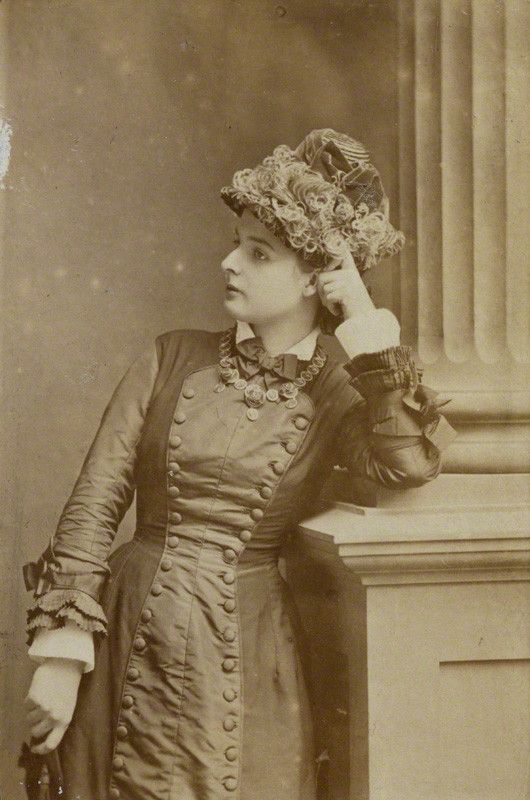
One of the most noteworthy features of Mid-Bustle Era (roughly 1876-1881), fashion was the advent of the princess line dress. Attributed to Charles Worth who supposedly created the style for Princess Alexandra’s wedding dress, the princess line style was characterized by the lack of the defined waist created by the conventional bodice/skirt combination as seen in these original photographs:

Portrait Princess Line Day Dress c. 1878 - 1881

Portrait Princess Line Day Dress c. 1878 - 1881

Now, here’s one interesting take on the style:

Princess Line Day Dress c. 1878

It’s difficult to make out the specific fabrics from the pictures but we assume that it’s silk. The color combination of pale green, chartreuse, brown and cobalt blue is interesting; not our first choice but it’s a bit different from what is normally seen from extant examples.

Princess Line Day Dress c. 1878

Side Profile

Princess Line Day Dress c. 1878

Rear View

One of the most interesting features of this dress is the use of a capote; that’s not something we’ve seen utilized with a dress. With its upright mandarin collar and capote, it’s more suggestive of outerwear, along the lines of a redingote. Below are some more pictures:

Princess Line Day Dress c. 1878

Upper Front with capote.

As can be seen from this close-up of the capote, it’s been artfully cut in layers so that there is no interruption to the pattern of the fashion fabric.

Princess Line Day Dress c. 1878

Back view with capote.

Princess Line Day Dress c. 1878

Close-up of the front.

Princess Line Day Dress c. 1878

Dress unbuttoned to show interior detail.

The interior detail shown here is interesting in that it employs the same fashion fabric underneath that’s also the outside on the cuffs, train and back.

Princess Line Day Dress c. 1878

Close-Up of the front.

As can be seen here, what we think is “brown” fabric is actually close brown stripes.

Princess Line Day Dress c. 1878

View of the train.

The train is characteristic of Mid-Bustle Era style, lot and fanning out. Not as extreme as some examples with the “mermaid tail” but the pleating does create a pleasing profile.

Unfortunately, we know almost nothing about the dresse’s provenance or the construction details; all we can do is speculate from the available pictures. In terms of dating, it’s probably safe to say that it falls in the 1878 – 1881 period (although the picture that we obtained indicates 1878). We suspect that these pictures were part of some sort of auction listing although we were unable to find out anything specific. But, in spite of the lack of information, it’s still an interesting example of a style that had a fairly short lifespan. Hopefully, we’ll find out more in the future. 🙂