Summer is officially on and here’s something that fits the season… 🙂

Summer is officially on and here’s something that fits the season… 🙂
In our second installment on 1890s street style, we’re going to shift focus away from outerwear to more warmer weather outfits. To get us started here’s some images from the same source as the ones in Part 1:

In the above image, the two women are more casually dressed than the women seen in most of these pictures. They appear to be wearing either loose two-piece or one-piece dresses along the lines of the “Mother Hubbard” style, a style that was also popular in dress reform circles. It definitely raises some interesting questions.

This image is interesting in that the skirt and jacket appear to be made from a striped fabric, much like an Ottoman. Although the woman is caught in rapid movement, the horizontal striping is still very visible and creates an interesting texture.


In the above two pictures, the women are wearing variations on the standard waist and skirt combination that became popular during the 1890s. What’s also interesting is that in some instances, you see the waist/skirt combinations being worn with a light jacket (at least lighter than the jackets being worn in the pictures shown in Part 1) It’s definitely a practical style. Below are some examples of the the variety of waists that were available:


The woman in the above picture appears to be wearing a waist done in the style of a sailor middy blouse, a style that was popular in the Mid to Late 1890s. Below are a couple examples of this style:


Two-Piece Day Dress w/ Middy Blouse, c. 1895; The Museum at FIT (P84.25.2)
These two posts of 1890s street style provide a tantalizing glimpse into what was common everyday wear back then, free of the artificialness of posed portrait pictures or fashion plates and bring back to life what surviving original artifacts that we see today. As we find further examples, we’ll be sure to post them here.
As summer begins to wind down, I thought I’d post some pictures of people at the seashore- you could call it “street style at the beach, 1880s style.”
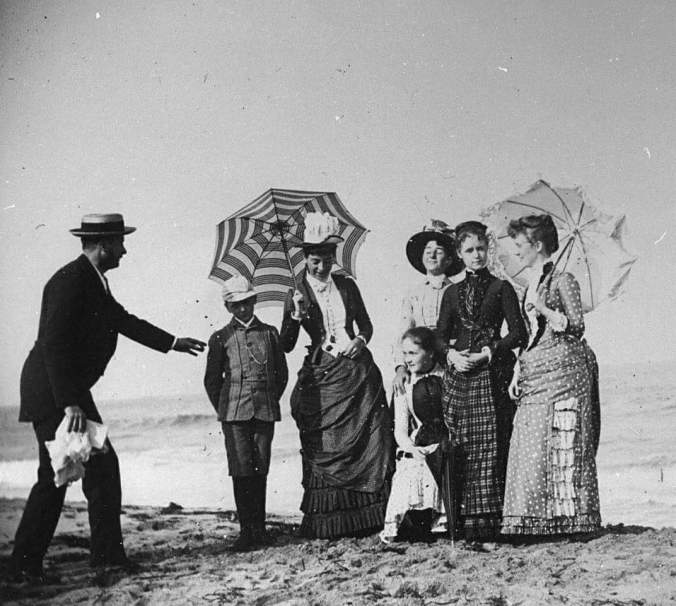
The Montgomery family, all dressed up and preparing to pose by the shoreline of beach at Stokemus, near Sea Bright, August 8, 1886
The above picture is interesting in that here you see a variety of common styles to include vest/faux, open bodice with faux waist, and closed bodice.. For skirts, all follow the bustle silhouette of the later 1880s but not in an extreme manner and each features some variation on the over/under-skirt configuration. The skirt on the woman in the middle with the parasol is the same color (seemingly from the picture) for both skirts and the under-skirt appears to the be ruffled in rows. The woman standing to the immediate rear of the little girl has a contrasting solid color over-skirt with a plaid check underskirt while the woman at the far right has a skirt and bodice made of the same material with no obvious under-skirt. It’s a very useful portrait for determining some common daytime styles that can be readily utilized for recreation purposes.

Collecting Shells, Manhattan Beach, Coney Island, 1885 (New York Historical Society & Museum)
These two women are not deterred by the wet sand or water and have simply taken the expedient of hiking up their skirts. They’re a bit more plainly dressed than the group in the first picture with bodice and skirt of the same color. The woman on the left also appears to be wearing a short coat or jacket that has been designed to fit around the bustled skirt.
And just for contrast, something a bit more upmarket, staged in the photographer’s studio…

The above picture portrays a more elaborate style although it still keeps to the convention of the bustled over/under-skirt combination typical of the later 1880s. In this instance, the bodice appears to drape over the hips and is gathered towards the rear and has a floral print design. Of course, with the woman’s elbow obscuring the waist, it’s hard to tell exactly but judging from the swags of net trimmed in fabric running along the skirt, it appears that the net is the over-skirt with a solid-colored fabric under-skirt. The effect is airy and very appropriate for summer by the beach.
We hope you’ve enjoyed this little glimpse of 1880s street style. 🙂
With the increasing interest in outdoor activities and in particular going to the beach, there was a corresponding increased interest in having the “right” fashion for such occasions. For beachgoing, yachting, or simply spending time at the seashore, designers were quick to respond and by the 1890s, there was a plethora of styles available to women.

Sometimes bathing costume was not available…
It could probably be argued that the first seaside fashions per se where those created for yachting, an activity that was decidedly limited to the upper classes. John Redfern was one of the first to popularize Yachting costume in the 1870s, being conveniently located on the Island of Cowes, the site of the Cowes Regatta which was one of the largest yachting events in Europe. Yachting costume pretty much followed regular day fashions with the only difference being an incorporation of nautical themes derived from naval uniforms, both officer and enlisted (i.e. sailors). Because of the nature of sailing, fabrics tended towards wool, cotton, and linen and trim and ornamentation tended towards the more minimal (although there were always exceptions).

Some of Redfern’s “boating” or yachting fashions in the July 16, 1887 issue of The Queen.
Here is one example of yachting dress that’s possibly attributed to Redfern (according to the auction website) from c. 1895:

Yachting Dress, c. 1895 (originally made in 1890, sleeves have been modified); Kerry Taylor Auctions Website.

Full Front View

Another Close-Up Of Bodice

Close-Up Of Bodice

Side Profile

Rear View
This dress is constructed from a cream-color wool with matching upper sleeves made from a silk “grosgrain”- we suspect that it might be a silk bengaline or faille but the picture quality is not good so it’s hard to determine. It would be interesting to know how it looked in its original configuration before the leg-of-mutton sleeves were installed but we can only assume that the sleeves would have been fairly close to the shoulders with perhaps a small “kick-out” at the top.
Here’s another example from 1897 constructed of a cream-colored linen:

Yachting Dress, c. 1897; Preservation Society of Newport County
This yachting dress was part of the wedding trousseau for Mrs. John Nicholas Brown (née Natalie Bayard Dresser) who had the dress embroidered with the insignia of the New York Yacht Club in 1897.
And as an aside, we have always wondered just how women managed to get on or off of a yacht, given the somewhat confining nature of late 19th Century fashion… 🙂

But it wasn’t all about yachting dress, the nautical theme was carried over into dresses intended simply to be worn at the seashore, whether on the beach or close by:

Day Dress, American, c. 1900; Metropolitan Museum of Art (1980.171.3a–c)

Close-Up Of Front

Front Three-Quarter Profile

Rear View
This dress is made of a mocha or dark khaki-colored linen and was made around 1900; based on the full blouse silhouette (suggestive of the pigeon-breast style), we believe it dates from the early 1900s. With its free-flowing lines, this dress allowed freedom of movement and the linen material was the perfect choice for wear in warm weather.
Taking the nautical theme further, here’s a similar dress from c. 1895:

Day Dress, c. 1895; Metropolitan Museum of Art (1986.150a–e)

Side Profile

Rear View
Like the first dress, this one is also constructed of linen, also in a shade of khaki. This dress is a little more fitted than the first with a slightly longer, narrow skirt and a more fitted blouse but is still practical for wear on the beach on hot summer days. 🙂
Finally, here’s another dress from 1895 that employs a different color combination:

Day Dress, American, c. 1895; The Museum at the Fashion Institute of Technology, New York ( P84.25.2)
The above dress is made from a white cotton pique with salmon-colored cotton trim that’s utilized on the hem, cuffs, belt, and collar. In contrast with the first two dresses, this one is a more structured and definitely has a typical 1890s silhouette (of course, the difference between the dresses may be simply be a matter of staging).

And sometimes one had to improvise at the beach…
Whether or not people had the “right” fashion, the seashore never failed to attract people and especially on a hot summer day. Enjoy your summer! 🙂