Some Late 1880s Daytime Style…

As seen in a recent post, velvet was often used as an accent both in terms of the fabric itself and the rich colors it could hold. Today we take this theme a bit further with this late 1880s day dress:

Day Dress, c. 1880; Metropolitan Museum of Art (C.I.40.181a, b)

This dress is constructed from a medium brown silk faille with dark brown velvet panels on the front and sides of the skirt as well as panels on the bodice front. Also, one can see with the bodice that it’s been constructed to give the appearance of having an open v-neck with a faux velvet waist (it’s all actually a one-piece construction). Further decorating the bodice front, shoulders and cuffs in metallic gold filigree.

For dating the dress, although this has been labeled as being from circa 1880, we believe it was constructed during sometime in the 1888 to 1890 time frame based on the silhouette. In contrast with earlier 1880s dresses, this one’s silhouette is more moderate suggesting that the large bustle trend was beginning to taper off. Of course, it could also be the museum staging but we seriously doubt it.

Compared to the front, the back is plain and unadorned, suggesting that this was more of a mid-range dress than haute couture. This dress is interesting in that darker velvet combines nicely with the lighter brown silk faille. Darker colored velvet tend to absorb light but the gold filigree neatly counters this, thus creating a backdrop that only enhances the luster of the gold filigree decoration. One of the things that makes Victorian Era fashions so interesting is the seemingly endless unique design variations that one finds and it’s a constant source of inspiration to us.


Working With An Original…

There are some issues that no restoration can cure. Today, this lady gets photographed for the last time, the silk satin of the skirt is shattering and I want to preserve as much of the embroidery and beadwork as possible.


Something From The Collection…

Check out how this 1898 British designer chose to conceal the hand worked eyelets…I am currently lifting a pattern and taking notes from this beauty in our collection.

hr />


And Something New From Maison Pingat…

We don’t normally associate Emile Pingat with more casual designs such as tea gowns and morning dresses but that’s not always the case. Recently, we came across this interesting 1890s era example that was on an auction website:  🙂

Pingat, Tea Gown, c. 1890s; Whitaker Auctions

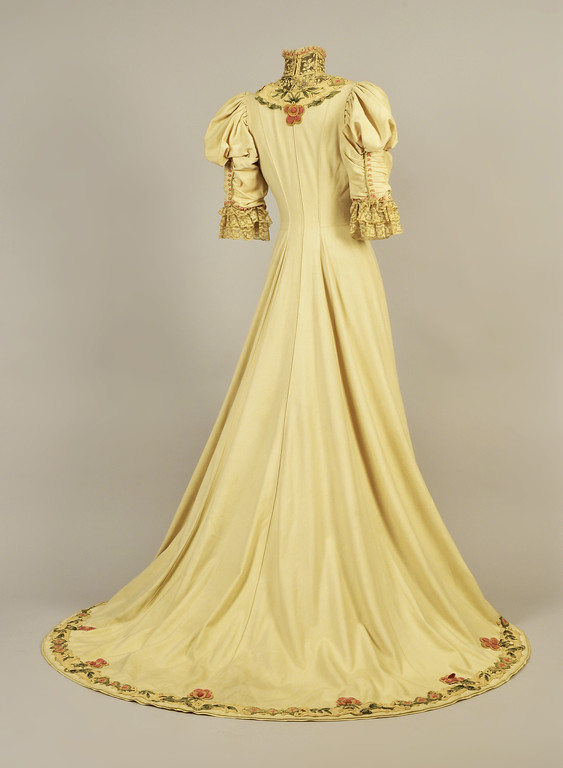
This dress is constructed from cream-colored wool trimmed with ivory lace at the sleeve cuffs and neck. The dress is also trimmed in a floral pattern constructed from soutache cord appliques mounted on linen running along the hem, neck, and dress front.

This dress has a silhouette that approximates the quintessential 1890s x-silhouette yet the lines are more loose and free-flowing, aided by the princess line style. This dress reads “tea gown” although it would also work for a house or morning dress; in any event, this was probably a bit too casual for going outside of the house and was intended for wear at home. As we’ve commented on other tea gowns, Pingat has taken what was meant to be a simple style and upgraded into more of a couture gown. Here’s some close-up views:

This close-up view from the rear shows the princess line seamwork although there are waist lines on the side pieces- whether these are simply stitch lines or actual seams is hard to determine from the picture but either way, the dress reads princess line. The sleeves are elbow length and have moderate poufs on the sleeve caps- based on the sleeve caps, we’d be willing to estimate that this was garment was made something in the 1893-1894 time frame but this is just an estimate on our part.1Unfortunately, like most auction website listings, the dating is very vague and in this case, it just stated that it was “1890s” which is not very helpful.

The above lace collar extends up the neck and is topped off by a row of tiny silk flowers. Also, the pictures above and below show excellent close-up views of the applique decorative design and in many respects it’s reminiscent of trapunto.

The dress was front opening and concealed by this elaborately worked placket consisting of raised appliques worked in a floral pattern designed to mimic a vine with flowers. It’s a very cleaver design solution and keeps the rest of the dress lines clean, unfettered by the need for an opening.

And here we seen Pingat’s label stamped into the petersham, something that was very common for couture houses to do. The petersham was intended as a way to control the dress and keep it firmly attached at the waist. With this tea gown, we see a design is simple and elegant, embodying the oft-quoted idea of “less is more;” it’s definitely that. With dress’s simple, clean lines acting as a canvas for the restrained decorative scheme, and it all harmonizes together nicely.


And For Some Gustave Beer…

Gustave Beer was a successful Parisian couturier who operated during the later 19th and early 20th Centuries. Although not a lot is known about him, it is known that he was born in Germany sometime in 1855 and was residing in Paris by 1876. Originally established in the artificial flower business, he branched out into clothing, first establishing a lingerie shop in in 1886 and later expanding into a complete couture establishment by 1893. Although Beer himself died sometime between 1910 to 1915, Maison Beer continued in operation until 1930 when it merged with Maison Drecoll.1The only book-length study of Gustave Beer is in French by Mathilde Héliot, La maison de couture Beer, 2 tomes, thèse en Sorbonne, 2016. Beer was noted for a middle-of-the road style with an emphasis on “classical elegance” that attracted a conservative clientele. Below are a few examples of Beer’s designs, starting with this circa 1898 ballgown:

Gustave Beer, Ball Gown, c. 1898; Whittaker Auctions

Side Profile

The staging of this dress is not at its best but one can see the classic late 1890s silhouette, especially with the skirt and train. Construction is an ivory-colored silk satin with minimal chiffon trim around the neck and shoulders. The entire dress is decorated with crystals and metallic spangles arranged in a floral motif pattern which is shown to its best advantage on the skirt and bodice. It could be said that the bodice and skirt are just a canvas for the floral design-work. Below are some detail pictures of the design:

Close-uo of bodice.

Close-up of hem.

Close-up of decorative motif.

Label

Next, we have a circa 1905 evening dress:

Gustave Beer, Evening Dress, 1905; The Frick, Pittsburgh (1985.523)

This garment reads as the evening version of a lingerie dress and is constructed from ivory-colored silk chiffon with an ivory-colored silk satin underlayer and is decorated with a gold metallic floral motif both on the bodice and the skirt. The bodice is styled so it resembles the waist/jacket combination that was popular at this time and emphasizes the silhouette created by the S-bend corset. The metallic trim pattern on the skirt is artfully arranged so as to mimic vines climbing up a tree. The front of skirt opens up to reveal a chiffon underskirt, framed by the metallic decorative motif running up the edges of the open overskirt. This dress is definitely in keeping with Beer’s emphasis on classical elegance and it’s too bad that there are no close-up pictures of the metallic decorative design.

To carry the lingerie dress style further, we conclude with this afternoon dress:

Gustave Beer, Afternoon Dress, c. 1900; Drexel University Historic Costume Collection

This dress is constructed black lace and chiffon over a green-colored silk velvet underlayer and represents a highly refined take on the lingerie dress idea. What’s interesting here is that the lace panels are not only arranged in circular rows, but the middle ones criss-cross as they move about the dress. On the bodice, we also see the lace panels shaped so that they form a large eye. The arrangement of the lace panels definitely sets this dress apart from many of its peers. We hope you’ve enjoyed this little excursion through the dress designs of Maison Beer and we hope to be able to have more to show in the future.