On The Road…

Well, after some bumps we finally got out on the road and are headed to Tombstone! Time to put aside the hustle and bustle of LA and sit back and relax for a few days…our schedule is pretty loose while we’re there but we’ll but cooking up something interesting fashion-wise, you can bet on that. 🙂

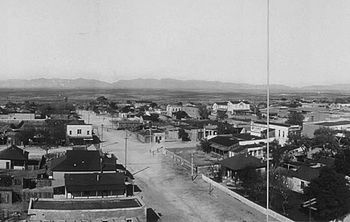
Tombstone, c. 1909 looking north from the roof of the Courthouse.

Fashion Advice – 1881 Style

As long as there has been fashion, there has been fashion advice to go along with it. People anxious to look fashionable, or at least avoid any fashion faux pas, sought fashion advice from others and especially when they were not sure of themselves. With the growth of an affluent middle class during the late 19th Century, fashion was becoming increasingly accessible to more people and with it grew the desire to mimic the upper classes in style and dress (along with the various social anxieties that came along with it). While advice from friends was still sought, people sought out other sources of fashion information and publications arose to meet this new market demand and this in turn created what we would term today the “fashion press.”

One good example of this new phenomena can be found in a passage from the November 1881 issue of Peterson’s Magazine (page 392) that addresses the issue of following fashions:

The beautiful in dress, should he an object of real interest to every woman. But this beauty is not to be sought by a blind following of fashion-plates. Of course, no woman can dress well, who goes against the prevailing style of her generation. The costume of the ancient Greeks, for example, was a very graceful one; but it is eminently unsuited for a climate like ours, or the modesty of Christian civilization. Hence, when Madame Tallien during the French Revolution, appeared, in a classic dress, with bare limbs, even the men of that day were shocked.

Theresa Tallien (July 31, 1773 – January 15, 1835)

No really lady-like woman wishes to appear odd in her dress; for, to appear odd in her dress; for to be singular, is to be talked of too much; and true modesty shrinks from this. But, in following the fashion of the day, there is room for judicious selection. One color suits one complexion: another color another. A bonnet that looks well on one woman, will not look well on another. Fortunately, there is always sufficient variety in the fashions, to allow of tasteful selection; and, when this fails, of adaptation.

The so-called “dress reformers” have always failed, because they make women look like frights. They act as one must be hideous, in order to be healthy, which is sheer nonsense. As the Philadelphia Times says, “pay the fullest respect to anatomy and physiology; but, in doing so, also pay respect to the eternal laws of beauty, and cultivate ‘individualism’ in dress in accordance with artistic principles as distinguished from affectation.” First know what the fashions are, and then select what suits your own style. That is the true way to dress.

In many respects, the above advice still holds true today in that while people are urged to conform to fashion, they should not blindly follow what is depicted in fashion plates (or other, more modern media) but rather, they should cultivate a personal style that works for themselves as individuals. As noted above, what looks good on one person does not necessarily look good on another. Thus, the solution is to be informed about fashion (presumably by reading Peterson’s) and being able to make judicious selections. Also, looking “odd” in one’s dress is the ultimate faux pas and will result in one being talked about by their peers in an unfavorable manner (and by extension, failing socially).

However, it is also interesting in what is said in regard to reform dress: “they make women look like frights.” This was a decidedly  mainstream opinion in 1881, to be sure. With today’s attitudes, the opinion in regard to reform dress and its somewhat rebellious stance towards mainstream fashion has shifted in the opposite direction.

While today we pride ourselves in our individualisms and overthrowing “the tyranny of fashion,” the reality is that we tend to carve out an individual style within current fashion. Probably one of the best examples of this can be found with denim jeans- originally a sign of rebellion from mainstream conformity for many, today those same jeans have become mainstream and we follow right along. 🙂

Ultimately, the best piece of advice and one that has withstood the test of time is “know what the fashions are, and then select what suits your own style” and that is hard to argue against.

And For A Little More From 1878…

Dupain

Edmond-Louis Dupain, “Elegant Lady Walking Her Greyhounds on the Beach”

We have been hitting the Mid-Bustle Era pretty hot and heavy of late so we’re going to give it a rest for awhile. But just to sum up things, we thought that we would show a few final images of day wear from 1878… 🙂


Leslies_June_1878

Frank Leslie’s Lady’s Magazine, June 1878

In the above plate, we see two of the most basic dress styles: the cutaway over-bodice/vest combination and princess line (left and right, respectively). The dress on the left is especially interesting in that that the over-bodice is designed to suggest a cutaway coat who “tail” takes the shape of a long train, somewhat reminiscent of the Regency Era. At the same time, there is no bustle to be seen for either dress and the silhouette is cylindrical and upright. For the dress on the left, the over-bodice is combined with a vest in a contrasting, yet complimentary color, that is also the color of the over-bodice lining. Celadon and gold/yellow are a good color combination for a dress and show up very nicely in almost any type of light. Finally, the train, more properly termed demitrain,  is short (by Victorian standards) for day wear as opposed to a more formal full train.

For the dress on the right, with its lack of defined separation between the bodice and skirt, the princess line emphasizes uninterrupted vertical lines. To take advantage of this vertical “canvas,” panels of contrasting fabric were often used consisting of a front panel and panels on each side. These panels could either be in contrasting colors or the same color but in a different fabric. With the above example, we both panels are an ivory/blush color but the panel running down the front of the dress is a brocade (presumably a silk brocade). On the sides, we also see the same brocade used again for decorative effect. Finally, to finish things off, there is the ubiquitous demitrain.

Le Monitor 1878

In the above plate, we see two more day dress styles which were clearly intended for going out in public. The dress on the left has a minimal train and the dress on the right has no train at all. In the left dress, we see another attempt to accentuate the vertical lines through the use of contrasting black and yellow stripes on the skirt; the use of cascading ruches on the back of the train also adds to this effect. The bodice is a solid color and extends downwards to cover the hips and the overall effect is slimming. The bodice body and sleeves are in contrasting colors of black and yellow (canary yellow?) and the lack of decoration gives a tidy appearance.

The dress on the right is also interesting with its pagoda-like skirt set in three layers. There is no train (or so it would appear from the plate) and once again we see a slim, cylindrical silhouette. In many ways, the skirt is reminiscent of Classic Greek styles. However, the most striking feature of this dress is the fabric which appears to be a multi-colored plaid that with the exception of the bodice top front, is set at an angle. With the row of decorative ribbons running down the entire length of the dress front, the effect is striking although a bit disorienting (one could almost argue that it looks like a modern day military camouflage). Finally, the use of a red waist belt helps to tie the look together. This design is pretty fantastical and we would suspect that it was more of a concept piece rather than anything that was actually made but we have been wrong before… 🙂 In many ways, it could be said that this dress was a harbinger of the styles that were to develop during the Teens.

Le Monitor 1878_2

Journal Des Demoiselles_1878_1

Journal Des Demoiselles, September 1878

The dresses portrayed in the above two plates portray several style variations that were often employed to include over-bodices that could be shaped so as to have a coat-like appearance with a real or faux vest or shirt-waist worn underneath. Also, we seen variations in how trains were arranged: it could be gathered in at several spots, ruched all the way down, or gathered into large masses of fabric. The variations are almost endless. Finally, while most skirts tended to be of one color, there were exceptions such as with the black and white striped lower skirt in the first plate.

We hope you’ve enjoyed our posts on the Mid-Bustle Era and hope that you will find them a source of inspiration for future designs.

Louis Catala

Luis Alvarez Catala, “Woman Before a Mirror,” 1878