Pleating takes time, but it’s the understitching to the foundation skirt that takes even longer! 🙂

Pleating takes time, but it’s the understitching to the foundation skirt that takes even longer! 🙂
And because it’s Monday… 🙂

Here’s another ensemble dress from Maison Worth, also from circa 1893. Style-wise, it’s similar to the example that we presented in yesterday’s post but perhaps a little more restrained. Here are a few views:

Worth, Ensemble Dress, c. 1893; Metropolitan Museum of Art (2009.300.620a–e)
To us, this bodice reads visiting/afternoon dress, more of a formal day-oriented garment. Below, the bodice reads more of a reception dress or possibly evening dress- although that’s probably stretching things a bit.

The Alternate Bodice
Once again, we see a jacket style for the day bodice with a filler of tulle. The skirt and jacket bodice are a pea-green silk brocade with black lace trim and accents. The night bodice with its light cinnamon colored silk velvet provides a pleasant contrast to the pea green. Compared to yesterday’s example, this dress is a bit more restrained but it’s still a nice design. The silk brocade fabric is interesting and we only wish that there were some close-up pictures of the fabric detail. It’s evident that both the dress and the one in yesterday’s post used identical or fairly similar pattern pieces. Finally, here’s an interesting part of the ensemble- matching shoes:

Matching shoes to outfit.
Stay tuned for more posts on this subject. 🙂

One interesting aspect of Charles Worth’s designs was what was called the “Ensemble Dress.” This was a dress that had two bodices, typically one for day wear and one for evening wear so one could have a nice semi-formal dress for calling on friends, going into town, or attending some sort of day function. At the same time, with a change in bodices, one would have also be properly dressed for an evening function. Below is just one circa 1893 example from Worth:

Worth, Evening Ensemble Dress, c. 1893; Metropolitan Museum of Art (2009.300.622a–c)
First, we have a day bodice that’s designed like a jacket; no doubt some wort of a waist was worn underneath even though it would have been covered by the lace strips running down the front. And then we have a night bodice that’s perhaps a little more formal:

The Alternate Bodice
And here’s a rear view of the dress with the day bodice:

Rear View
In terms of silhouette, this is characteristic for the early 1890s with it’s fairly restrained train arrangement- most likely a small bustle pad was worn but not much else. The fact there’s small train points to it being more of a formal dress (with day and night configurations). The fabric is a silver colored silk satin with a gold leaf pattern decoration woven in broken texture that services to provide a contrast both in texture and color. The red silk velvet lapels and sleeve trim on the day bodice and the red bodice front on the night bodice. The effect is exquisite with either bodice. Below is a close-up of the fabric.

Detail of fabric- too bad it’s not in color.
In 1890s fashion, the skirt and bodice have a minimum of trim and Worth lets the contrasting fabrics, both in color and in texture, speak for themselves. Just one of many exquisite examples from Maison Worth.
Inspiration is the basis for all of our designs but that is only the start. In order to bring our designs into reality, it is necessary to have an extensive knowledge of just HOW garments are constructed (i.e. “put together”) and an essential part of this are patterns since they provide the “roadmap” for the actual construction process. In this post, we’ll be discussing the nature of our approach towards patterning. Enjoy! 🙂

All garments, whether the are haute couture or bargain basement, start with a pattern and it’s that specific pattern that defines what that particular garment is ultimately going to be. Here at Lily Absinthe, our approach to patterning is a combination of methods that are referred to in the trade as “bespoke” and “made to measure (MTM).” These two terms are often used interchangeably in reality are two different methods. With the bespoke method, an individual pattern is created for a specific client based on their measurements and taking into account the various body characteristics of the client. With MTM, the garment is built on pre-existing pattern blocks that are modified on the basis of the client’s measurements (this is admittedly a bit of an over-simplification but it does convey the essence).
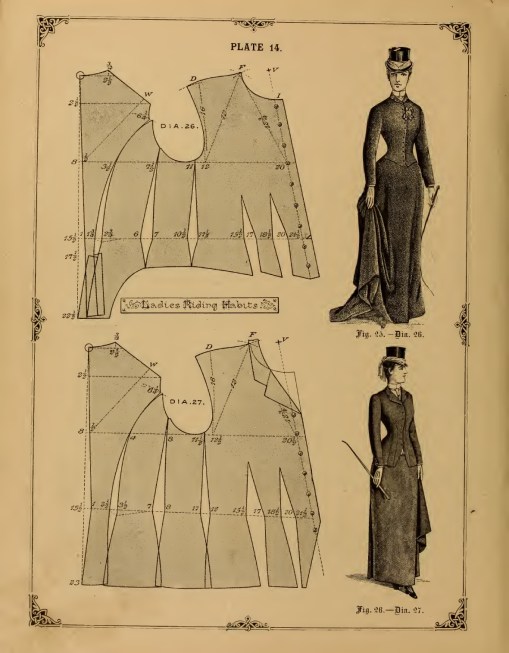
We maintain an extensive library of pattern blocks that we have drafted ourselves and in most instances, we will modify specific pattern blocks based on the individual client’s measurements. More importantly, these modifications also incorporate every nuance of the client’s body. In most instances, the MTM method works perfectly but in some instances, we will draft custom pattern pieces. However, no matter which of these two approaches we use, we guarantee a perfect fit every time and a garment that has been custom made to the client.


Patterning is often presented as a magic and mysterious process that requires the utilization of various arcane procedures to achieve results. And, in more recent years patterning has been presented as something that can be done quickly on a computer and paper patterns instantly printed out. In reality, while pattern drafting is a relatively simple and straight-forward in theory, it does require an attention to detail, precision, and a lot of patience (and we mean A LOT). For more complicated designs, it often requires a series trials rotating back and forth with muslin mock-ups (aka tolle) and revising the paper pattern to achieve the optimal result.


Ultimately, whether a garment is “bespoke” or MTM, it’s critical that the fit be perfect, fabric/trim choices are suitable, and most importantly, that the garment is aesthetically pleasing. 🙂

