At The Seaside, 1890s Style

With Summer almost here, we can’t help but think about how Victorians experienced the seashore during the 1890s and thus this post was born. It’s a little off our usual path but we think that you’ll like it.  🙂


During the late 19th Century, various forms of specialized dress rapidly developed and especially when it came to sporting activities. This was an especially revolutionary development for women in that it signaled that the status of women in society was changing. Where once Women were expected to remain focused solely on domestic activities, they were now increasingly leading public lives and often independent of men (granted, this was an uneven process that continues up to the present).

One of the most dramatic developments was the development of “bathing costume” which allowed women to go swimming at a lake, river, or seashore while maintaining decorum and modesty. However, this was not a smooth process and there was resistance from the more conservative elements to the point where the wearing of bathing costume was either completely illegal or subject to stringent regulation to the point where women could be arrested for indecent exposure if their bathing costume failed to meet local standards.

Le Monitor 1893

Le Moniteur de la mode, c. 1893

Specific bathing costume can be traced back at least the 1850s but it wasn’t until the 1890s that bathing costume emerged as a major trend, spurred by the idea that going to the beach was considered to be a healthful social activity.

Too often we think of people in the Victorian era as being bored or even morose. These photos humanize an era by capturing those elusive smiling Victorian faces.:

And the market responded… 🙂 The catalog advertisement below is only one of the wide variety of ads that were out there during the 1890s:

Jordan, Marsh & Co., Women's Bathing Suits Spring and Summer, 1897 Mohair plus water plus a hot summer day, what could be more comfortable than that?:

Page From An 1897 Jordan Marsh Catalog

Bathing costume during the 1890s usually consisted of a top, blouse, short bloomers or knickers and a skirt. Stockings and special “bathing boots” made of canvas and cork soles were also worn, all with the idea of the woman not showing too much skin. The fabrics used for making bathing costume were usually wool flannel, wool jersey, mohair, linen, cotton, or some combination thereof. Needless to say, these were not intended for serious swimming (that would come later) but rather wading or simply lounging on the beach. Style-wise, bathing costumes had a nautical theme with sailor collars and the predominant use of blues and blacks.

Victorian Bathing Suits

Posed Picture, c. 1902; Library of Congress

Below are some examples of bathing costume. First, here is one from c. 1878 – 1880 where we see the basic silhouette and style that was to predominate in the 1890s starting to become established:

CI50.77.1a–c_F

Bathing Costume, c. 1878 – 1880; Metropolitan Museum of Art (C.I.50.77.1a–c)

CI50.77.1ac_B

Rear View Of The Top

CI50.77.1ac_F

Front View Of The Top

CI50.77.1b_F

The Bottom

Here’s a later version from the 1890s:

M992.115.2-P1

Bathing Costume, c. 1890s; McCord Museum (M992.115.2)

As can be seen from the above, bathing wear had a nautical style reminiscent of naval uniforms of the period, a theme that was to continue on into the early 1900s.

However, even back in the 1890s, there could be dramatic exceptions to the norm when it came to fashion and that was especially evident with this “startling bathing costume” pictured in the August 22, 1897 edition of the San Francisco Call:

fashion1_sfcall_aug22_1897

The above outfit is certainly a departure from the typical dark-colored nautical-theme in that the base color is white, constructed of horizontal layers of white wool serge. The model is wearing only the knickers and a one-piece bodice/shirt. She appears to be perhaps holding a skirt or cape of sorts. What is interesting is that the front and back of the top match the horizontal layers of the knickers and it appears to almost be a one-piece outfit. This is definitely fashion-forward beach wear of the time. 🙂

Finally, we leave you with this picture below of some frolicking beach-goers, all dressed in variations of the standard 1890s bathing costume style:

Santa Monica 1898

“Out for a Time,” Long Beach, c. 1898; California State Library

We hope you have enjoyed this little summer excursion to the beach. 🙂


Revisiting The Natural Form/Mid-Bustle Era

Aa you have no doubt discovered by now, the Mid-Bustle Era or Natural Form Era is one of our most favorite periods of the late Nineteenth Century and it has been a constant source of inspiration for many of our designs, especially because it runs counter to the popular perception of what characterized the “typical” look of the Bustle Era. At the risk of being redundant, we offer some further observations about this relatively short-lived period.

Dupain

Edmond-Louis Dupain, Elegant Lady Walking Her Greyhounds on the Beach


The early 1880s were an interesting time in the fashion world in which we see the bustle silhouette style characteristic of the early and mid-1870s give way in the late 1870s to a slim, upright, cylindrical silhouette. Often referred to as the “natural form era” or Mid-Bustle Era, the period from roughly 1878 through 1883 saw a dramatic reversal in dress styles: where once the style focused on draping and gathering of varied fabrics over a bustle, the emphasis was now on the controlled use of fabrics and trim to create a style with clean, sharp lines.

Petersons_Sept 1880

Peterson’s Magazine, September 1880

Below are some examples, albeit idealized, of the basic style which could be found for both day and evening wear:

Journal Des Demoiselles 1880

Journal Des Demoiselles, 1880

Revue de la Mode_1880_1

Revue De La Mode, 1880

Journal Le Printemps October 1881

Journal Le Printemps, October 1881

Journal Le Printemps June 1881

Journal Le Printemps, June 1881

Journal Des Demoiselles 1881

Journal Des Demoiselles, 1881

In examining this relatively short-lived period, it must be noted that “natural form” is somewhat of a misnomer in that the term refers to the ideal of the reform dress movement which centered around the idea that clothing should enhance the body’s natural form rather than constrict and re-shape it. The styles of 1878-1883, like there predecessors, relied on structured undergarments to modify the body’s appearance- something that dress reformers did not have in mind.

So with that said, let us explore a bit…

We start with this reception dress from the early 1880s:

C.I.38.61ab_F

Reception Dress, French, c. 1881 – 1883; Metropolitan Museum of Art (C.I.38.61a, b)

C.I.38.61ab_d

Close-Up Of Front

C.I.38.61ab_S

Side Profile

C.I.38.61ab_TQL

Three-Quarters Rear View

Rear View

 Just for completeness, here’s some details:

Detail of bodice.

The above dress illustrates several elements of the Mid-Bustle Era style and in particular, the silhouette which is slim and cylindrical with a minimal bustle. Day dresses tended to have either no train or at most, a demi-train while evening dresses and ball gowns retained a longer train. However, either way, the train was low, flowing from the bottom of the skirt rather than off of an elevated bustle.

The use of rows of vertical pleating on the rear of the skirt combined with rows of flounces trimmed with embroidered leaves on the front help emphasize the vertical lines. Finally, the ruching on the bodice front also reinforces the idea of vertical lines.

And because we just can’t resist, here is Charles Worth’s take on the wedding dress:

2006BD5667_jpg_l

Wedding Dress, Charles Worth, c. 1879 – 1880; Victoria & Albert Museum (T.62 to B-1976)

The dress silhouette is characteristic for a formal dress of the Mid-Bustle Era. Also, while it is not easy to make out, the trim on the front and sides also helps to emphasize the vertical lines. Here’s one more from Worth, circa 1880, where the trim pattern on the front can be readily seen:

42523035a47ee62d1edf06ce17a388ed

Finally, one more example to illustrate some of the trends happening in the late 1870s – early 1880s:

M2003.76.1.1-3-P1

Day Dress, c. 1878 – 1883; McCord Museum (M2003.76.1.1-3)

M2003.76.1.1-3-P3

M2003.76.1.1-3-P2

Note in the above example that the bodice extends over the hips and that there is no bustled train. At the same time, there is a train extending out, above the hem of the skirt; an train extending out at a low level was one style variation found during this period and in extreme cases was known as the “mermaid tail.” This was probably meant as more of a reception dress and a dress meant for everyday activity. Also, note that these dresses often came equipped with a “train hook,” a small loop attached to the end of the train that allowed the dress’ wearer to pick up end of the train so it would not drag on the ground.

In terms of color, we see the use of two shades of red with silk for the lighter shade and velvet for the darker shade that read as a jewel tone. The use of velvet for the dark burgundy red provides a contrast to the lighter silk in that the velvet traps the light while the lighter silk provides a more reflective luster. This is a common effect used during much of the late 19th Century but a beautiful one nonetheless.

No discussion of the Mid-Bustle Era would be complete without some discussion of the princess line style. The princess line style further refined the era’s trend towards a more upright, slender silhouette. The primary characteristic of the princess line style was that the bodice and skirt were one unified body which provided a large, continuous space for decoration.  Below is one example of the princess line style:

2012FH8114_jpg_l

Day Dress, Princess Line, c. 1878 – 1880; Victoria & Albert Museum (CIRC.606-1962)

2006AG4306_jpg_l

Close-Up Of The Front

2012FH8116_jpg_l

Rear View

The dress design attempts to create the effect of a contrasting bodice/outer skirt and under skirt; the lines are somewhat reminiscent of an 18th Century coat worn with an outer and under skirt. The dress itself consists of a top and rear train made from a blue silk woven in the Jacquard manner combined with a white ruched silk running along the complete and at the bottom of the train. Running along the hem are rows of white silk knife-pleating and the top is trimmed with white lace around the neck. Finally, there is a minimal trailing “tail” on top of the train. Finally, what is striking is the contrast between the silk floral leaf top and train combined with rows of ruching providing a contrast between smooth and textured fabrics as well as color and fabric.

Here is another example, only this time it employs contrasting colors while keeping the same fabric type:

Princess Line Dress c. 1878

Day Dress, Princess Line, c. 1878; National Museum, Prague (H2-193316)

Czech Dress3

Three-Quarter Side View

Czech Dress4

Three-Quarter Rear View

Style-wise, this dress is simpler than the first example in that there is simply two contrasting colors with little added except for rows of knife-pleating along the hem and some ribbon trim on the front and shoulders and some lace around the neckline.

Ultimately, while the Mid-Bustle/Natural Form Era style strove to create a silhouette that was more “natural” to the wearer’s body (as opposed to the bustle/train), it was still a product of sculpting and shaping through the use of foundation garments, principally the corset and various underpinnings such as these:

Le Moniteur De La Mode 1876

We hope you have enjoyed this small tour through the late 1870s/early 1880s and it helps illustrate some of the basic Victorian ideas about fashion and style.


Patterns – Building The Foundation

Inspiration is the basis for all of our designs but that is only the start. In order to bring our designs into reality, it is necessary to have an extensive knowledge of just HOW garments are constructed (i.e. “put together”) and an essential part of this are patterns since they provide the “roadmap” for the actual construction process. In this post, we’ll be discussing the nature of our approach towards patterning. Enjoy! 🙂

Patterns1


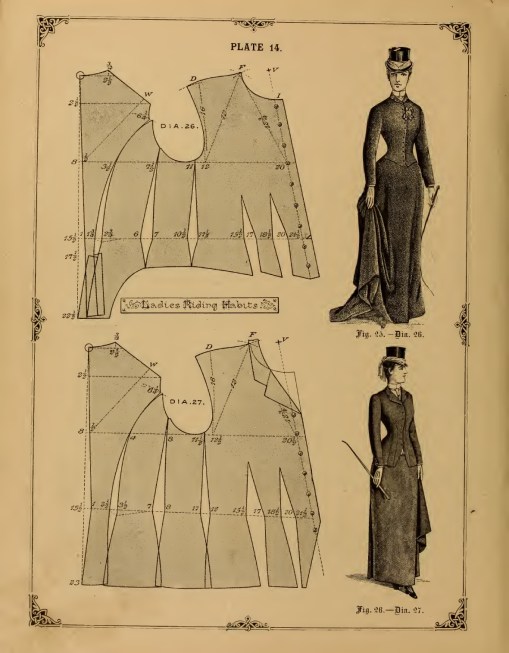
All garments, whether the are haute couture or bargain basement, start with a pattern and it’s that specific pattern that defines what that particular garment is ultimately going to be. Here at Lily Absinthe, our approach to patterning is a combination of methods that are referred to in the trade as “bespoke” and “made to measure (MTM).” These two terms are often used interchangeably in reality are two different methods. With the bespoke method, an individual pattern is created for a specific client based on their measurements and taking into account the various body characteristics of the client. With MTM, the garment is built on pre-existing pattern blocks that are modified on the basis of the client’s measurements (this is admittedly a bit of an over-simplification but it does convey the essence).

We maintain an extensive library of pattern blocks that we have drafted ourselves and in most instances, we will modify specific pattern blocks based on the individual client’s measurements. More importantly, these modifications also incorporate every nuance of the client’s body. In most instances, the MTM method works perfectly but in some instances, we will draft custom pattern pieces. However, no matter which of these two approaches we use, we guarantee a perfect fit every time and a garment that has been custom made to the client.

Patterning is often presented as a magic and mysterious process that requires the utilization of various arcane procedures to achieve results. On the flip side, in more recent years patterning has been presented as something that can be done quickly on a computer and paper patterns instantly printed out. In reality, while pattern drafting is a relatively simple and straight-forward in theory, it does require an attention to detail, precision, and a lot of patience (and we mean A LOT). For more complicated designs, it often requires a series trials rotating back and forth with muslin mock-ups (aka tolle) and revising the paper pattern to achieve the optimal result.

wp-1469469622815.jpg

Ultimately, whether a garment is “bespoke” or MTM, it’s critical that the fit be perfect, fabric/trim choices are suitable, and most importantly, that the garment is aesthetically pleasing. 🙂

Madame Demorest's Illustration Portfolio of the Fashions for 1880:

Creating The Look…

Styles are defined by their silhouette and nowhere is this more evident in the styles of the 1870s and 1880s which were built upon skirts being draped towards the rear and supported by a supporting structure known as the bustle (also known as the tournure). As described previous in this previous posts and others, the size and positioning of the train might have varied but the overall effect was still the same. So how was this achieved? Simply, draping fabric and fastening to the rear only works with the lightest of fabrics, in almost all cases support is required and that’s where the bustle came into play. Bustles varied in styles and shapes and were made from various materials, ranging from ones constructed of elaborate steel cage structures to ones that were little more than a pillow.

Bustle_Phases

A somewhat simplified chart depicting the three major Bustle Era styles.

Below is a selection of some of the bustle styles that were out there during the 1870s and 1880s:

Bustles The Galliera Museum – the Musée de la Mode de la Ville de Paris

The above examples show two of the more common bustle styles, the “lobster” and the pillow. The “lobster” style gets its name from its resemblance to a lobster shell and was held rigid by steel boning or reeds.

Here’s a semi-rigid example from the 1870s (probably more mid-1870s):

Bustle c. 1870s

Bustle, c. 1870s; Metropolitan Museum of Art (2008.89)

Bustle c. 1870s

The above style employed a fabric shell, typically made of a tightly woven cotton fabric with steel boning or reeds. This style was also common during the 1880s:

Bustle 1883

Bustle, 1883; Metropolitan Museum of Art (1985.23.3)

Bustle 1883

Side Profile

The above example is interesting in that while it’s similar to the 1870s example, it differs at the top where a large pad has also been installed- no doubt to help create the more sharply defined silhouette characteristic of the Late Bustle Era dresses such as this one:

Evening Dress c. 1884 -1886

Evening Dress, American or European, c. 1884 – 1886, silk; The Metropolitan Museum of Art (C.I.63.23.3a, b)

Here’s another typical example from 1885 that employs an open cage-like structure made from flexible steel bones secured by tape strips:

Bustle 1885

Bustle, 1885; Metropolitan Museum of Art (2009.300.3095)

Bustle 1885

Side Profile

Bustle 1885

Interior

Steel or reed boning where not the only materials in use as demonstrated by this 1873 example utilizing horsehair padding:

Bustle 1873

Bustle, 1873; Metropolitan Museum of Art (2002.251)

Bustle 1873

The idea of the bustle creating the dress silhouette can especially be seen from this example:

Bustle 1870 - 1888

Bustle, c. 1870 – 1888; Metropolitan Museum of Art (1972.209.48)

Bustle 1870 - 1888

The example below is especially fascinating in that its shape dates it: late 1870s, most likely circa 1878 – 1880 (although the museum has is labeled 1870 – 1888). Note that the silhouette is slender from the waist to mid-way down and then flares out in the demi-train style that was characteristic of the later 1870s such as with these examples:

Day Dress 1878

Side Profile

Day Dress 1880

Side Profile

The above bustle examples are on the complex side and could almost be considered works of art on their own. However, there were more simple designs out there such as various types of pads:

Bustle c. 1895 - 1905

Bustle, c. 1895 – 1905; Metropolitan Museum of Art (C.I.44.48.8)

Bustle Pad 1875

Bustle Pad, made from linen and stuffed with horse hair. Victoria & Albert Museum (T.57-1980)

Bustle Pad c. 1885

Bustle Pad, French, c. 1885 Glazed calico trimmed with silk cord and stuffed with what appears to be straw; Victoria & Albert Museum (T.337-1978)

And there were some other interesting designs:

Bustle 1884

Bustle, Steel Frame, c. 1884; Victoria & Albert Museum (T.131C-1919).

Bustle 1880s

Bustle, 1880s

Bustle 1871

British, c. 1871. Metropolitan Museum of Art (1985.27.4)

The above examples are only a small sampling of what was available and no matter what style a bustle came in, its primary job was to support the dress and help define its shape. When we reproduce 1870s and 1880s fashions, we are constantly mindful of the supporting structures that are necessary for wearing these fashions in the most optimal way and they are almost as important as the dresses themselves.


A Quick Look At A Worth Ballgown…

In the course of doing photo dress research, it’s sometimes easy to miss interesting details because of the way that the garment is staged as in the case of this circa 1899 ballgown made by Maison Worth for Margaret Georgina Curzon, the sister of George Curzon, Viceroy of India:

Dress, 1899; John Bright Collection

Dress, 1899; John Bright Collection

The skirt is constructed of an ivory silk satin decorated with a wheat motif with turquoise velvet ribbon and jeweling. And below is the bodice. According to the John Bright Collection website, the bodice is too fragile to be placed on a mannequin for display, hence why it’s flat in the pictures.

It’s easy to overlook this ballgown since the bodice is displayed flat but one can make out the turquoise silk velvet trim and jeweling against an ivory silk satin fashion fabric combined with white lace and dark turquoise netting. Here’s a view of the bodice interior:

This ballgown is very similar to this one that was made by Maison Worth in 1900:

Worth, Ball Gown, 1900; Metropolitan Museum of Art (2009.300.1250a, b)

Close-Up Of Skirt Design