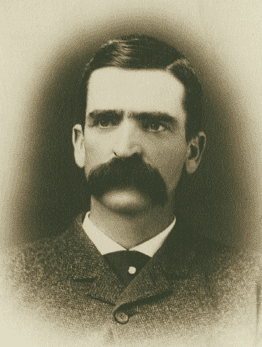
Recently someone asked me the question: “What did lawmen wear in the Old West?” The easy answer is: “the same clothes that everyone else wore.” OK, I’ll admit that that answer is a bit snarky and it is a legitimate question. Our perceptions of what lawmen wore have been to a great degree shaped by what we’ve seen in film and television with all its inherent inaccuracies.


When considering the question of fashion and lawman, one’s head is filled with images from such iconic movies as Tombstone or from television shows such as Gunsmoke. In reality, “lawmen” in the American West during the late 19th Century took several forms to include town and county sheriffs/marshals, state rangers such as the Texas or Arizona Rangers, and federal marshals. Also, there could be a variety of semi-private “lawmen” such as Pinkerton detectives (who often functioned as a law unto themselves).

Pinkerton Detectives c. 1880. The man sitting in the middle is purported to be Allan Pinkerton, the company’s founder.
Also, it must be noted that for many jurisdictions throughout the American West, the position of “Sheriff” at the country or municipal level was typically an elected one with all its inherent flaws and they had a variety of job duties of which apprehending criminals was only a part. Other duties could include serving warrants and summonses, supervising executions, jailing prisoners, investigating crimes, collecting stray dogs, and collecting taxes. Collecting taxes was one of the most important parts of the job since it was taxes that paid for the sheriff’s deputies and the costs of running the government.
While the popular conception of the Old West lawman is that one of a steely-eyed gunfighter staring down one or several desperados, all intent on murder and mayhem. The reality was that it more about dealing with drunks and generally keeping public order, specially in the newly-formed cow towns such as Wichita and Dodge City.
That said, let’s move to the clothes- here are just a few pictures of real Western lawmen:


Looking at the above pictures, it’s easy to discern that their clothing pretty much mirrored what was generally worn. For the most part, it mostly consisted of trousers, shirt, vest, and a sack coat. In warmer weather, a jacket was not worn and sometimes just the shirt was worn. Allowing for the “dressing up for the camera” effect, it’s still obvious from the more informal portraits that it wasn’t an affected style. In many instances, there was little difference between what a lawman wore and what others wore except for the badge and perhaps more guns.

Lawmen as seen on film.
For anyone desiring to recreate the look of a Western lawman, probably one of the best places to start is with either a sack suit or for something more “out on the trail,” a pair of trousers, shirt, and vest but that’s only a suggestion. There are a lot of original pictures that one can use to base their research on and they can adjust their look depending on what sort of an impression. One thing I do want to note is that except during times when lawmen were in active pursuit of a criminal or otherwise expecting trouble, they were not walking arsenals with multiple pistols and a rifle or shotgun. In town, lawmen frequently simply carried a small caliber pistol in a trouser or coat pocket (often reinforced because of the weapon’s weight).

And another…
Finally, it should be noted that as an elected public official, a county or town sheriff or marshal was expected to project an image of respectability (although the definition of “respectable” could be somewhat elastic) and as such, they tended to dress the part. For many, the position was viewed as more of a means to a political career than anything else and they acted accordingly. One good example of this was with Johnny Behan, the Sheriff of Cochise County. For the most part, he was more concerned with collecting taxes and keeping up appearances; for the actual work of enforcing the law, deputies were hired. Pictures of Behan show him dressed in a sack suit, looking like any middle class small town businessman (which he basically was). Like today, image and respectability were important during the Victorian Era and dressing correctly played a key role.
Reality is often pretty dull when compared to what is portrayed in film and television and that especially applied to the lawman of the American West and we hope that you have found this post to be informative. 🙂