More Frock Coats…

The frock coat were one of the most commonly worn items of men’s daywear in the Western World during the 19th Century. Even in locations as vastly separated as Great Britain and New Zealand (or Russia and the United States, for that matter), the frock coat reigned supreme and even after it began to be supplanted by the morning coat and the sack suit, it still maintained a strong position in men’s wardrobing.

As we noted in a previous post, the frock coat started out as a longer, full garment that somewhat resembled a great coat. As the 19th Century progressed, the frock coat gradually evolved to a shorter, more tailored garment:

Frock Coats4

Frock Coat, c. 1820 – 1830; Victoria & Albert Museum (T.294-1910)

Frock Coats5

Frock Coat, c. 1876; Kent State University Museum (1983.1.2392)

Frock Coats6

Frock Coat, c. 1870s; Metropolitan Museum of Art

7d40d01bc320364b8f335778649507d9

Frock Coat, American, c. 1870s; Kansas State University Museum (1984.21.1 ab)

M973.49.7

Frock Coat, c. 1880 – 1890; McCord Museum (M973.49.7)

So, just for fun, how does this translate when it comes to film and TV and especially with that Gunfight at the OK Corral? 🙂  Well, let’s start with the iconic movie Tombstone:

tombstone11

Well, all said and done, not as bad as as one would think…except for Wyatt Earp. So what’s Wyatt wearing? Well, the best we can figure out is that it’s an elongated frock coat or a black-colored duster, your choice (I lean towards elongated frock coat myself 🙂 ).

Here’s one from Tombstone’s major competitor, Wyatt Earp:

wyatt-earp-doing-the-walk

Interesting, we see at least two in frock coats (it’s hard to make out what the second guy on the left is wearing) although Doc Holliday’s coat seems to border on being a light great coat.

And now we go back a little to Hour of the Gun:

 hour-of-the-gun

Again, not too bad…in this movie, only Doc Holiday is wearing a frock coat. Finally, here’s one from Gunfight at the OK Corral:

gunfight-at-the-corral-doing-the-walk1

And in this one, nobody is wearing a frock coat. 🙂

Now, let’s look at some Spaghetti Westerns… first we have A Fistfull of Dollars: 🙂

Lee Van Cleef1

And the classic The Good, The Bad, And The Ugly:

Lee Van Cleef2

And finally, there’s Quigley Down Under:
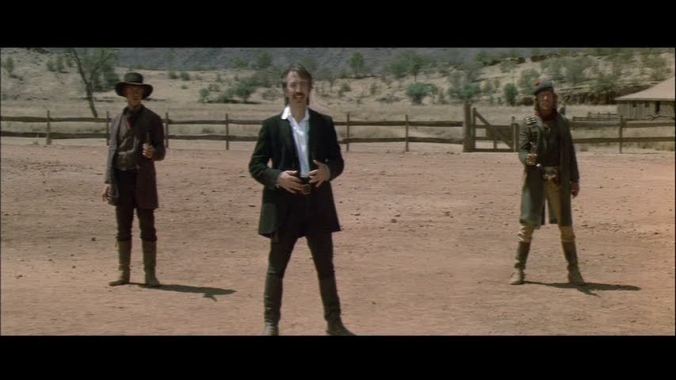
Quigley-Down-Under-Screencap-alan-rickman

From the small sampling above, we would be inclined to believe that the frock coat is alive and well in the movies. 🙂 What’s also interesting is that often in Westerns in film and TV, the villain is often well-dressed and the frock coat is perfect for this.

For the recreationist, reproduction frock coats are available from a variety of sources at all sorts of prices. The cheaper ones are often simply patterned off of a modern men’s suit coat that’s been lengthened. The better ones are based off period patterns with the proper sleeve and shoulder styles. Also, the frock coat was a tailored garment with padded shoulders and chest that were constructed so that the coat keeps it shape even when taken off; a proper frock coat’s construction should reflect this.

We hope you’ve enjoyed this little side-trip and be on the lookout for more posts on men’s clothing in the future. 🙂

A Brief View Of Men’s Clothing- The Frock Coat

Frock Coats3

In a previous post, we gave an overview of the sack coat and sack suit during the late 19th Century from 1870 through 1900. While the sack suit was probably one of the most commonly worn outfit for men, there were other styles that bear mention, principly the frock and morning coats.

The frock coat got its start in the early 19th Century as an informal alternative to the dress coat (also referred to as the tailcoat or claw-hammer coat) and as such, was a coat with full skirts that extended to the knee and had a distinct waist seam that gave it a tailored appearance. In contrast to dress coats, the skirts on the frock coat was constructed of distinct upper and lower pieces rather than being cut as one piece.

In the examples below, the difference between the types of coats is readily apparent and especially in the skirt:

Dress Coat1

Note the distinct, fuller skirt pieces on the frock coat. Also, frock coats could be single or double-breasted:

lm109b

d-16231-163

Frock coats were primarily made from wool although other materials such as linen were also used. In terms of color, frocks coats came in a variety of colors with darker colors predominating. Also, frock coats were made in both single and double-breasted styles; the double-breasted style was considered to be more formal than the single-breasted version. Finally, the frock coat could be worn open or closed.

edwardian_men_style_frock_coat

Here’s an example of a frock coat made from linen:

0386

Frock Coat, c. 1860 – 1870; Augusta Auctions

Below is an early version of the frock coat. As the 19th Century progressed, the skirts gradually became less exaggerated:

Man's_silk_and_wool_twill_frock_coat_c._1820

Frock Coat, French c. 1816 – 1820, constructed of wool/silk twill; Los Angeles County Museum of Art (M.2010.33.7).

And now some from the 1870s:

f49afb73661056c03a482d67bfe4d901

From Gazette of Fashion, and Cutting-room Companion, 1870

7d40d01bc320364b8f335778649507d9

Frock Coat, American, c. 1870s; Kansas State University Museum (1984.21.1 ab)

And the 1880s:

M973.49.7

Frock Coat, c. 1880 – 1890; McCord Museum (M973.49.7)

And finally, the 1890s:

Frock Coat1

Frock Coat, c. 1890; Victoria Albert Museum T.624-1996)

54e34a7f76f224fff8fff4ef47b8d52b

As a general rule, frock coats became shorter and more tailored with a slimmer silhouette and were often worn with a pair of lighter-colored trousers as shown in some of the pictures above. Also, it’s interesting to note that during the 1880s and 90s, we increasingly see frock coats being worn open with wide lapels.

Frock Coats1

Frock Coats2

For people desiring to recreate period fashions of the late 19th Century, the frock coat offers one possibility for those desiring a more formal, conservative look. However, it must be noted that the frock coat is more representative of the period prior to the 1870s and as such, it was being supplanted by the morning coat for formal wear. In a future installment, we will be covering the morning coat so stay tuned! 🙂

(To Be Continued)


And For A Little More Crimson Peak…

As noted before in a previous post, the movie Crimson Peak has been a favorite with us this year and we were captivated by the display of costumes from the movie at the 24th Annual Art of Motion Picture Costume Design at the FIDM Museum. As a follow-on, the FIDM Museum Blog recently posted an article about the costumes’ designer Kate Hawley that gives some insight into the thought process that went into the costumes’ design. What was very interesting was the costumer’s use of color to sharply differentiate the characters with the heroine Edith being clothes in lighter colors, mostly shades of yellow, gold, taupe, and the like. In contrast, her nemesis Lucille is dressed in black and dark blue with bright crimson thrown in (the “drop of blood dress” as it’s termed).

Crimson Peak

The “Drop of Blood” Dress

 Besides the visual aesthetics, it’s also interesting to see the various mood boards and costume sketches and it gives insight into why the designs are what they are. Finally, we are simply stunned by the large amounts of hand-work that went into the construction of the costumes and many of their accessories. We’re no strangers to long hours of hand-work here at the atelier and it gives us an even greater appreciation of the creative effort that went into costuming this film.

crimson1

We strongly urge you to check out the FIDM Museum Blog and this interview that Kate Hawley did for Variety. Enjoy! 🙂

Lilly Absinthe & Movie Costumes, Part III

In today’s post, we wrap up our review of the 24th Annual Art of Motion Picture Costume Design at the Fashion Institute of Design and Merchandising Museum in Downtown Los Angeles. First, because we just can’t let it go, we’ll show one more dress from Crimson Peak :-):

20160325_104040.jpg

The above dress is worn by Edith in the picnic scene. This outfit is a mashup of various styles, combining a skirt from the mid-1890s with a pigeon-breast waist from the early 1900s. The hat reads early 1900s and while the belt style was correct for most of the period from c. 1890 through 1905, the buckle is somewhat larger than what was historically worn. No doubt the director was attempting to make a point with the oversized-hands buckle.

Below are some scenes from the picnic:

 Picnic Dress1

Picnic Dress2

As with Edith’s other dresses, this reads light and airy, a contrast to Lucille Sharp’s dresses. Finally, before moving on, here are some shoes that were produced for the movie for the Edith character to wear:

20160325_103936.jpg

On the left are the original shoes and on the right are the reproduction. Needless to say, we see the gold theme carried on even with the shoes which are concealed from view most of the time that they’re worn in the movie- talk about attention to detail! 🙂

Now, for a different type of horror, there is The Revenant:

While we are no expert on the Fur Trapper/Mountain Man Era in American History, we do can appreciate the effort that went into making these costume authentic and “lived in” to even include blood. These are brutal clothes for a brutal period, to be sure, and are definitely not the usual “Mountain Main” costumes of beads and roadkill that one normally associates with movies set in that era.

And for even more contrast, we switch from “man versus nature (and man sometimes)” to “women versus men” in the struggle for women’s right to vote with Suffragette:

The movie, from all accounts, is pretty gritty with the focus was on everyday women who took up the struggle and their clothing reflects that. This is not meant to be pretty or elegant:

20160325_105347.jpg

20160325_105354.jpg

20160325_105359.jpg

Close-Up Of The Medal

Suffragette3

20160325_105337.jpg

20160325_105342.jpg

Suffragette2

What is striking about the costumes from this movie that were on display is the use of a muted color palette. While this is not a surprise, it does provide a contrast to what we usually associate with costuming from a period piece. This movie is definitely on our list of must-sees. 🙂

Thank you all for enduring three days worth of blog posts on movie costumes with a heavy dose of Crimson Peak. It looks like we’ll be acquiring some nee DVDs to watch while we sew. 🙂

Lily Absinthe & Movie Costumes, Part II

We continue with our review of the 24th Annual Art of Motion Picture Costume Design at the Fashion Institute of Design and Merchandising Museum in Downtown Los Angeles. Today, we’re going to focus a bit on the costumes from the movie Crimson Peak. And now to set the scene… 🙂

crimsonpeak_trailer

The costuming definitely reflects the dark, horrific nature of the movie. First we start with the heroine Edith:

20160325_104058.jpg

20160325_104104.jpg

Close-Up of the bodice.

20160325_104109.jpg

Close-up of the shoulder. Yes, that’s embroidered on to the fashion fabric.

This dress reads mid-1890s and with its leg-of-mutton sleeves and clean silhouette. The bodice is a gold-colored silk (or yellow, depending on the light) satin with a skirt that appears to be a shade off, leaning more towards a champagne. However, on camera the dress almost appears to be bright yellow that stands in stark contrast to the dark interiors of the Sharpe House where she goes to live and have her encounters with ghosts and past secrets. Also, her dress stands in contrast to the clothes of the other two main characters.

In the movie, the butterfly motif is used often as a symbol for the heroine Edith’s seeming fragility and this is incorporated into this and other of her costumes both with color and with decoration. Besides the related floral embroidery on the sleeves, there is also this butterfly-like decoration on the rear of the dress:

f31f4957181721f00ea5033ee5d32b6e

Here are a few more pictures:

To us, the golden-yellow dress symbolizes a purity and naivete that sets Edith apart from Thomas and Lucille Sharp who are the embodiment of corruption and evil.

In contrast to Edith is Lucille Sharpe’s costuming:

f4c551854e795036ae2ca0ed826cfc0c_600x400

20160325_104141.jpg

20160325_104148.jpg

The bodice and overskirt are made from a dark blue velvet and the underskirt appears to have been made from a silk shantung of some type. The velvet acts as a light trap, emphasizing the dark nature of the Lucille Sharp character and this is very apparent when viewed on film. Decorating the dress is a vine that runs up the bodice front to the neck and down the bodice back. The vine trim also is seen running along the hem of the overskirt. In terms of silhouette, it would appear to be late 1870s/early 1880s (Mid Bustle Era), judging from the low demi-train. There does not appear to be any form of a bustle or it’s too subtle to detect in the dress display.

Although we were unable to get a shot of the rear of the dress, here it is from another source:

7b396ed11564b5c6139bc9404392ea98

Here we see an interesting vine effect on the back that continuous to the front. Although one can read many interpretations, the one we took away was that it represents Lucille’s hold over everyone and everything in her world and how it also threatens to entwine and trap Edith.

And now, the dress in action:

It is interesting how the dress changes color when viewed on film versus the static environment of a museum setting. In the film, the blue takes on a shade that harmonizes with the interior of the house while the brown trim almost fades  out to a black.

And just to note, her brother, Thomas Sharpe, also has a coat in a similar shade of blue:

20160325_104158.jpg

Crimson Peak_Blue Coat

crimson-peak

For contrast, we now look at another dress of Lucille’s:

20160325_104215.jpg

The bodice and skirts are made from a crimson (naturally!) red satin with the underskirt being completely knife-pleated. It certainly emphasizes Lucille’s nature- attractive and enticing yet deadly at the same time.

20160325_104221.jpg

Here we see the dress in action:

One interesting detail we noted what that on this dress and the preceding blue dress, the skirts were not hemmed (we were unable to get a good one of the blue dress):

944971_10153284808107693_7464895273696542597_n

Although one could argue that it was simply due to oversight since they were working with multiple garments in a sub-optimal situation (the red clay effects), we believe that it was more due to calculation on the part of the costume designer. Much of the movie revolves around themes of seduction, appearance, corruption and ultimate horror. While Lucille and her brother Thomas have an elegance and seductive beauty, underneath there is corruption and ultimate evil and this dress symbolizes that neatly. One is attracted to the rich, crimson red silk satin and Lucille’s seeming beauty but peaking out here and there is what truly lies underneath (if one looks for it and isn’t swept away by surface appearances). The frayed hem subtly but effectively conveys this.

Finally, we just want to note that in contrast to Edith and her female contemporaries we see in the beginning of the movie, the costumes that Lucille wears are roughly 15 to 20 years older in terms of style and it puts them a little out of synch with the world around them- a cleaver and subtle touch to be sure. While the average viewer would probably not pick up on this detail, it does add to the fantastical/horrific elements of the movie.

We’ve spent a lot of time on Crimson Peak but those are the costumes that had the greatest impact on us. While we have no plans to create replicas of the costumes, we can safely say that it will serve as a further source of inspiration for us (well, maybe not the frayed hems 🙂 ). Stay tuned for more!

(To be continued…)