Lily Absinthe Sails Down The River Of No Return…

And just for a change of pace, today we’re going to take a brief look at movie costumes and specifically, one particular costume- one of Marilyn Monroe’s gowns from the movie River Of No Return. Set in the American Northwest in 1875, this movie centers around a widower Matt Calder (played by Robert Mitchum) who has just been released from prison after serving time for killing a man while defending another. He arrives in a boomtown in search of his son who had been left in the care of a dance hall singer named Kay (played by Marilyn Monroe). Needless to say, the plot continues from there and we’ll leave it to you, dear reader to chase down the rest. 🙂

River of No Return (1954) film poster.jpg

Naturally, where there are dance hall singers, there will be musical numbers and more so if the movie casts Marilyn Monroe. And of course, a singer needs a suitable dress…so here’s one:

River of No Return1

And here are few of more of the dress itself:

 Marilyn Monroe_Emerald Dress_River of No Return1

67953308

The dress is constructed from jade green velvet and is trimmed along the hem and edges with black embroidery along with beading. It appears that the velvet started out as a dark jade color but it’s no doubt experienced some fading over the years.

Marilyn Monroe_Emerald Dress_River of No Return4

Close-Up Of The Beadwork

And here’s nice view of Marilyn in the dress that shows the underskirt:

Marilyn Monroe_Emerald Dress_River of No Return2

784f7a514675636e03a6fec9354689a7

From the pictures, it would appear that there was also a split underskirt of red chiffon and acts as a contrast to the overall green of the dress. Needless to say, the effect was dramatic as Marilyn performed her song and dance number. 😉

The movie itself was not particularly great and probably the best that could be said for it was that the scenery was excellent (it was filmed in Alberta, Canada). As a final note, the dress recently sold at auction for $525,000, proving that the mystique of Marilyn Monroe is still alive and well. 🙂

Costuming & Historical Movies

Today we’re going out on a limb on this one but we feel that it needs to be discussed: over the years, we have often been approached about making garments for film and TV projects and while we readily accept this work, we have also found that creating a garment (or garments) that are within budget, accomplishes the production design or vision, and look good on film can be challenging. So here we go…


One of the guilty pleasures of working with historical fashion is seeing how it’s portrayed in film and television. Almost nothing gives greater pleasure than watching a period piece made by Merchant-Ivory with its lush production values and excellent wardrobing and it’s a real treat to see a particular era in history portrayed correctly. Unfortunately this is a somewhat rare experience and often what passes for “historical costuming” is akin to nails being dragged across a chalkboard.

Now, before we go any further, we just want to clarify that having worked a little in the film business ourselves, we understand the enormous challenges that costume designers undergo in trying to wardrobe a production under often less-than-ideal circumstances. We understand that costuming exists to help propel the story and that liberties can be take at times towards this end BUT at the same time, it does not excuse poor or non-existent research, ignorance, or just sheer laziness.

This is admittedly a subjective thing and what we would consider to be substandard in a certain film or television show might be given a pass by someone else. However, we firmly believe that if one is attempting to draw the viewer into a story set in a specific time and place in the past, it is incumbent on the costume designer to make an effort to support this.

Now, just to put a bit of a scientific spin on this, let’s consider some of the key factors that can make or break the effectiveness of the costuming in a period production. Below is a basic list of what we consider to be some critical areas when we look at a film or television show:

    • Is the basic silhouette appropriate for the period?
    • Is the style appropriate for the period?
    • Are the materials used appropriate for the period?
    • Is the actor’s grooming and makeup appropriate for the period?

So you probably now thinking, just what do you mean? Well, let’s start with silhouette. By silhouette, we mean that basic outline of the garment. For example, if we have a production depicting a middle class woman of c. 1885, we’re going to be looking for a bustle, and in particular a “shelf” bustle. Conversely, if we are depicting a middle class woman c. 1897, we’re going to be looking for an A-line skirt and a bodice with some large leg-of-mutton sleeves.

One example where the costume’s dating is contrary to the declared date of the story can be found in the 1992 movie Dracula. The story is allegedly set in 1897 yet the dresses that that Mina wears read c. 1885:

Mina2

One of Mina’s Day Dresses- Note the train.

a61949796130a3fff6d7273d2d782937

Rendering of the same day dress.

Day Dress_Mina_Dracula_1

Day Dress- Rear View.

From the above pictures, this dress reads mid-1880s. Perhaps the bustling is a bit muted but it’s still pretty obvious and it’s definitely NOT 1897. While this is certainly not a deal-breaker in the major scheme of things, it’s still irritating.

Next, is the particular style appropriate for the period or more precisely, the particular time and place that is supposedly being depicted in the movie? This is a pretty broad question and volumes of ink (or electrons these days) has been spilt over this one. However, for our purposes, just about any Western made during the 1950s and early 1960s will do- here’s one example worn by the character “Laura” from the 1957 movie Gunfight at the OK Corral:

Rhonda Fleming_Yellow Dress1

Rhonda Fleming as Laura, Wyatt Earp’s love interest

Rhonda Fleming_Yellow Dress3

Costume rendering of the Laura dress.

Laura is supposed to be a “lady gambler” who Wyatt Earp first meets up with in Dodge City. Historically, Wyatt was in Dodge City during the years 1876 – 1879 so a correct dress for Laura would be something involving a bustled dress- probably an evening dress or perhaps a ball gown. So what do we have here? The 1950s version of an evening dress with off-the-shoulder sleeves and a weak attempt at some skirt draping and underneath it, she’s certainly not wearing a corset appropriate to the 1870s.

Correct materials go hand-in-hand with style and even if a style might be correct, it might be made of material(s) that are not appropriate for the period. The classic offender is using polyester or some other cheap synthetic as a substitute for period fabrics and this is really evident with dresses that are supposed to be made from silk. One example of this can be found in the poly-acetate dresses found in the TV miniseries North and South:

Not only are these a travesty in terms of materials, for the most part they bear a faint resemblance to anything remotely having an 1860s style or even silhouette- at best, they’re 1980s era prom dresses and we’ll leave it at that.

Finally, we get to the actor’s grooming- does it support the period being portrayed? This is probably one of the most problematic areas. Below is just one example of Kevin Costner from Dances With Wolves:

What is it? The closest thing we can think of is an overgrown mullet… Just to add to this, the pictures above from North and South are a great example of incorrect hair styles. While they have nothing to do with the historical 1860s, they are a reflection of the 1980s when the series was created, thus proving once again the old adage that film and TV costumes say more about the era in which the production was made than the historical period being portrayed.

And while we’re at it, just one last note: one of the worst offenders are war movies, mostly modern, where the main character does not have a haircut that is appropriate to the military organization of a particular historical period. Often times, the reason for the lapse in authenticity is as simple as the actor refusing to get a proper military haircut (yes, it does happen and if they’re a big enough star, the hair stays on).

Well, we hope you’ve enjoyed this short excursion through the world of costuming for film and TV and while it’s by no means exhaustive, we hope we’ve distilled things down to their basic elements. What we find so amazing is that a good part of the time, it costs as just as much to do something right as to do it wrong and while we appreciate that productions do labor under various constraints, it does show just how short of mark things can fall at times.

P.S. For a detailed view of costuming for film and TV, we highly recommend Frock Flicks.


Hitting The Trail To Paramount Ranch

After enjoying all the excellent food and drink at the wedding yesterday at Heritage Square Museum, I decided that it was time to work off some of that indulgence so I decided to take my horse and head out to Paramount Ranch/Malibu Creek State Park for some extended trail riding. I have a soft spot for Paramount Ranch, Karin and I having worked on a number of productions that were being filmed there over the years.

Waiting for the next scene to be shot. As usual in film, it's hurry up and wait.

Here I am on the set of Just Kill Me.

One of my favorite things to do is to ride through Western Town. If you are familiar with the TV show Dr. Quinn, Medicine Woman, this should look familiar. 🙂 Here are a few shots of me and my horse Max in Western town:

wp-1468858182679.jpg

wp-1468858182681.jpg

wp-1468814511013.jpg

After some lengthy riding up and down several mountainous trails, we arrived in Malibu Creek State Park. Formerly the site of the 20th Century Fox Ranch, many productions were filmed here over the years to include Planet of the Apes and most notably, the MASH TV series. Here’s a few pictures from there:

wp-1468858212123.jpg

Me and a friend at the MASH site. The park has restored some of the markers from the show to include this sign post and built a picnic area with cammo netting to create shade.

wp-1468814511010.jpg

My horse Max and I taking a break.

wp-1468814511015.jpg

And Max… 🙂

Overall, we rode about 9 miles and saw some wonderful scenery. It was a nice opportunity to take a break from work and otherwise simply chill out. 🙂

Dressing The Lawman

Recently someone asked me the question: “What did lawmen wear in the Old West?” The easy answer is: “the same clothes that everyone else wore.” OK, I’ll admit that that answer is a bit snarky and it is a legitimate question. Our perceptions of what lawmen wore have been to a great degree shaped by what we’ve seen in film and television with all its inherent inaccuracies.

Tombstone-Val-Kilmer-Sam-Elliott-Bill-Paxton-Kurt-Russell

Wyatt Earp Movie1

When considering the question of fashion and lawman, one’s head is filled with images from such iconic movies as Tombstone or from television shows such as Gunsmoke. In reality, “lawmen” in the American West during the late 19th Century took several forms to include town and county sheriffs/marshals, state rangers such as the Texas or Arizona Rangers, and federal marshals. Also, there could be a variety of semi-private “lawmen” such as Pinkerton detectives (who often functioned as a law unto themselves).

TEXAS RANGERS — (Standing from left) Jim King, Bass Outlaw, Riley Boston, Charley Fusselman, Tink Durbin, Ernest Rogers, Charles Barton and Walter Jones. (Seated, from left) Bob Bell, Cal Aten, Captain Frank Jones, J. Walter Durbin, Jim Robinson and Frank L. Schmid. – Courtesy Texas Ranger Research Center; Texas Ranger Hall of Fame & Museum —:

Texas Rangers, c. 1888

This photograph was made in about 1880, and shows three agents from the Pinkerton Detective Agency. The man in the middle is William Pinkerton, son of the group's founder, Allan Pinkerton. Allan Pinkerton was a personal friend of Abraham Lincoln, and provided protection for the president while he was in office.:

Pinkerton Detectives c. 1880. The man sitting in the middle is purported to be Allan Pinkerton, the company’s founder.

Also, it must be noted that for many jurisdictions throughout the American West, the position of “Sheriff” at the country or municipal level was typically an elected one with all its inherent flaws and they had a variety of job duties of which apprehending criminals was only a part. Other duties could include serving warrants and summonses, supervising executions, jailing prisoners, investigating crimes, collecting stray dogs, and collecting taxes. Collecting taxes was one of the most important parts of the job since it was taxes that paid for the sheriff’s deputies and the costs of running the government.

While the popular conception of the Old West lawman is that one of a steely-eyed gunfighter staring down one or several desperados, all intent on murder and mayhem. The reality was that it more about dealing with drunks and generally keeping public order, specially in the newly-formed cow towns such as Wichita and Dodge City.

That said, let’s move to the clothes- here are just a few pictures of real Western lawmen:

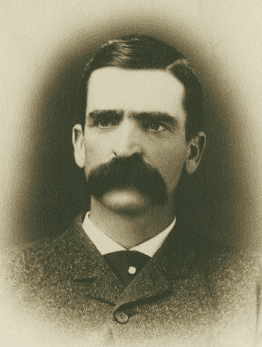
John Slaughter, Sheriff of Cochise County, Arizona 1887 – 1890

Bass Reeves Lawman the Original Lone Ranger ✔️:

Bass Reeves, Deputy US Marshal, 1876 – 1907

Old West lawman | old-west-lawman_edward-johnson.jpg:

Henry Andrew "Heck" Thomas born January 3, 1850 was an lawman on the American frontier most notably Oklahoma. He was appointed US Deputy Marshal out of Fort Smith, Arkansas working under Judge Isaac Parker.:

Looking at the above pictures, it’s easy to discern that their clothing pretty much mirrored what was generally worn. For the most part, it mostly consisted of trousers, shirt, vest, and a sack coat. In warmer weather, a jacket was not worn and sometimes just the shirt was worn. Allowing for the “dressing up for the camera” effect, it’s still obvious from the more informal portraits that it wasn’t an affected style. In many instances, there was little difference between what a lawman wore and what others wore except for the badge and perhaps more guns.

Lawmen as seen on film.

For anyone desiring to recreate the look of a Western lawman, probably one of the best places to start is with either a sack suit or for something more “out on the trail,” a pair of trousers, shirt, and vest but that’s only a suggestion. There are a lot of original pictures that one can use to base their research on and they can adjust their look depending on what sort of an impression. One thing I do want to note is that except during times when lawmen were in active pursuit of a criminal or otherwise expecting trouble, they were not walking arsenals with multiple pistols and a rifle or shotgun. In town, lawmen frequently simply carried a small caliber pistol in a trouser or coat pocket (often reinforced because of the weapon’s weight).

And another…

Finally, it should be noted that as an elected public official, a county or town sheriff or marshal was expected to project an image of respectability (although the definition of “respectable” could be somewhat elastic) and as such, they tended to dress the part. For many, the position was viewed as more of a means to a political career than anything else and they acted accordingly. One good example of this was with Johnny Behan, the Sheriff of Cochise County. For the most part, he was more concerned with collecting taxes and keeping up appearances; for the actual work of enforcing the law, deputies were hired. Pictures of Behan show him dressed in a sack suit, looking like any middle class small town businessman (which he basically was). Like today, image and respectability were important during the Victorian Era and dressing correctly played a key role.

Johnny Behan, c. 1871

Reality is often pretty dull when compared to what is portrayed in film and television and that especially applied to the lawman of the American West and we hope that you have found this post to be informative. 🙂  


And For More “The Wild Wild West”…

Wild Wild West1

While James West might have been the star of The Wild Wild West, he could not have succeeded without the help of his associate Artemus Gordon, played by Ross Martin. Although just as suave and debonair as West, Gordon was more the cerebral type, utilizing his mastery of disguise and mechanical devices to foil the villains’ various nefarious plots. Gordon’s mechanical device were often instrumental in rescuing West at some critical moment. It was a perfect contrast to West’s more direct physical approach and provided a nice one-two punch that set the show apart from either the usual sorts of Western or spy television series of the 1960s.

Today we’ll take a brief look at Gordon’s costumes which tended towards the flashy (when he wasn’t in disguise). We begin with a few in black and white:

7ae015f5c4432db99c5b600c42560670

Gordon dresses just as flashy as West although his clothes tended to be a bit more functional (no wardrobe malfunctions here! 🙂 ). Interestingly enough, the gunbelt pictured above is far more historically accurate than the usual run of low-slung “buscadero” rigs that were usually used in film and television Westerns during the 1950s and 60s.

Below are a few pictures of Gordon in his various disguises:

And here are a few of Gordon as himself- note that like West, the colors on Gordon’s outfits were selected to take advantage of the newly emerging color television technology: 🙂

0871f111a8526227f8a0d2aec26e4901

Gordon’s bright blue suit with complementing tie and waistcoat makes an interesting contrast to West’s more understated brown/green color palette.

www-114

And here we have a contrast between Gordon’s brown windowpane plaid coat and West’s hunter green jacket. And finally, here’s Gordon and West at their finest:

tumblr_lwvpohtBy11qgof78o2_1280

The above is a little over-the-top, combining 1960s rental wedding wear with older elements. The waistcoats could work for c. 1900 although the ivory silk satin might be pushing things a bit (by the 1870s, waistcoats/vests were becoming subdued). It’s hard to tell from the picture what sort of coats they have on but they work. The shirts are a bit overdone with the ruffled sleeves; it definitely reads 1960s formalwear. While the above outfits are by no stretch of the imagination representative of the historical 1870s, they work for the purposes of the show. 🙂