Patterns – Building The Foundation

Inspiration is the basis for all of our designs but that is only the start. In order to bring our designs into reality, it is necessary to have an extensive knowledge of just HOW garments are constructed (i.e. “put together”) and an essential part of this are patterns since they provide the “roadmap” for the actual construction process. In this post, we’ll be discussing the nature of our approach towards patterning. Enjoy! 🙂

Patterns1


All garments, whether the are haute couture or bargain basement, start with a pattern and it’s that specific pattern that defines what that particular garment is ultimately going to be. Here at Lily Absinthe, our approach to patterning is a combination of methods that are referred to in the trade as “bespoke” and “made to measure (MTM).” These two terms are often used interchangeably in reality are two different methods. With the bespoke method, an individual pattern is created for a specific client based on their measurements and taking into account the various body characteristics of the client. With MTM, the garment is built on pre-existing pattern blocks that are modified on the basis of the client’s measurements (this is admittedly a bit of an over-simplification but it does convey the essence).
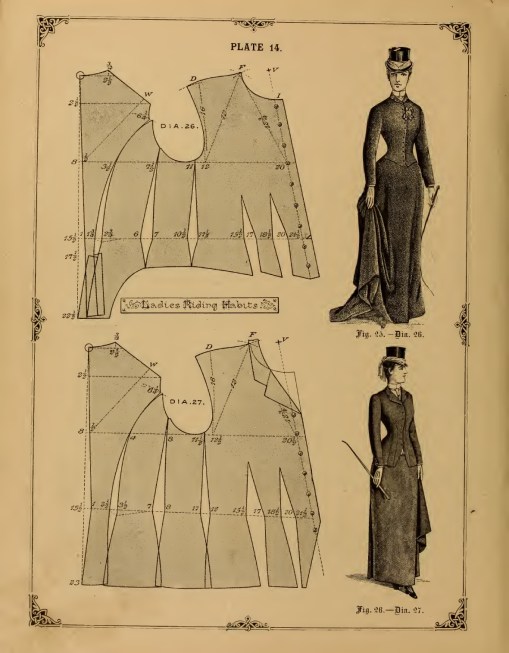
We maintain an extensive library of pattern blocks that we have drafted ourselves and in most instances, we will modify specific pattern blocks based on the individual client’s measurements. More importantly, these modifications also incorporate every nuance of the client’s body. In most instances, the MTM method works perfectly but in some instances, we will draft custom pattern pieces. However, no matter which of these two approaches we use, we guarantee a perfect fit every time and a garment that has been custom made to the client.

Patterning is often presented as a magic and mysterious process that requires the utilization of various arcane procedures to achieve results. On the flip side, in more recent years patterning has been presented as something that can be done quickly on a computer and paper patterns instantly printed out. In reality, while pattern drafting is a relatively simple and straight-forward in theory, it does require an attention to detail, precision, and a lot of patience (and we mean A LOT). For more complicated designs, it often requires a series trials rotating back and forth with muslin mock-ups (aka tolle) and revising the paper pattern to achieve the optimal result.

wp-1469469622815.jpg

Ultimately, whether a garment is “bespoke” or MTM, it’s critical that the fit be perfect, fabric/trim choices are suitable, and most importantly, that the garment is aesthetically pleasing. 🙂

Madame Demorest's Illustration Portfolio of the Fashions for 1880:

Creating The Look…

Styles are defined by their silhouette and nowhere is this more evident in the styles of the 1870s and 1880s which were built upon skirts being draped towards the rear and supported by a supporting structure known as the bustle (also known as the tournure). As described previous in this previous posts and others, the size and positioning of the train might have varied but the overall effect was still the same. So how was this achieved? Simply, draping fabric and fastening to the rear only works with the lightest of fabrics, in almost all cases support is required and that’s where the bustle came into play. Bustles varied in styles and shapes and were made from various materials, ranging from ones constructed of elaborate steel cage structures to ones that were little more than a pillow.

Bustle_Phases

A somewhat simplified chart depicting the three major Bustle Era styles.

Below is a selection of some of the bustle styles that were out there during the 1870s and 1880s:

Bustles The Galliera Museum – the Musée de la Mode de la Ville de Paris

The above examples show two of the more common bustle styles, the “lobster” and the pillow. The “lobster” style gets its name from its resemblance to a lobster shell and was held rigid by steel boning or reeds.

Here’s a semi-rigid example from the 1870s (probably more mid-1870s):

Bustle c. 1870s

Bustle, c. 1870s; Metropolitan Museum of Art (2008.89)

Bustle c. 1870s

The above style employed a fabric shell, typically made of a tightly woven cotton fabric with steel boning or reeds. This style was also common during the 1880s:

Bustle 1883

Bustle, 1883; Metropolitan Museum of Art (1985.23.3)

Bustle 1883

Side Profile

The above example is interesting in that while it’s similar to the 1870s example, it differs at the top where a large pad has also been installed- no doubt to help create the more sharply defined silhouette characteristic of the Late Bustle Era dresses such as this one:

Evening Dress c. 1884 -1886

Evening Dress, American or European, c. 1884 – 1886, silk; The Metropolitan Museum of Art (C.I.63.23.3a, b)

Here’s another typical example from 1885 that employs an open cage-like structure made from flexible steel bones secured by tape strips:

Bustle 1885

Bustle, 1885; Metropolitan Museum of Art (2009.300.3095)

Bustle 1885

Side Profile

Bustle 1885

Interior

Steel or reed boning where not the only materials in use as demonstrated by this 1873 example utilizing horsehair padding:

Bustle 1873

Bustle, 1873; Metropolitan Museum of Art (2002.251)

Bustle 1873

The idea of the bustle creating the dress silhouette can especially be seen from this example:

Bustle 1870 - 1888

Bustle, c. 1870 – 1888; Metropolitan Museum of Art (1972.209.48)

Bustle 1870 - 1888

The example below is especially fascinating in that its shape dates it: late 1870s, most likely circa 1878 – 1880 (although the museum has is labeled 1870 – 1888). Note that the silhouette is slender from the waist to mid-way down and then flares out in the demi-train style that was characteristic of the later 1870s such as with these examples:

Day Dress 1878

Side Profile

Day Dress 1880

Side Profile

The above bustle examples are on the complex side and could almost be considered works of art on their own. However, there were more simple designs out there such as various types of pads:

Bustle c. 1895 - 1905

Bustle, c. 1895 – 1905; Metropolitan Museum of Art (C.I.44.48.8)

Bustle Pad 1875

Bustle Pad, made from linen and stuffed with horse hair. Victoria & Albert Museum (T.57-1980)

Bustle Pad c. 1885

Bustle Pad, French, c. 1885 Glazed calico trimmed with silk cord and stuffed with what appears to be straw; Victoria & Albert Museum (T.337-1978)

And there were some other interesting designs:

Bustle 1884

Bustle, Steel Frame, c. 1884; Victoria & Albert Museum (T.131C-1919).

Bustle 1880s

Bustle, 1880s

Bustle 1871

British, c. 1871. Metropolitan Museum of Art (1985.27.4)

The above examples are only a small sampling of what was available and no matter what style a bustle came in, its primary job was to support the dress and help define its shape. When we reproduce 1870s and 1880s fashions, we are constantly mindful of the supporting structures that are necessary for wearing these fashions in the most optimal way and they are almost as important as the dresses themselves.


A Quick Look At A Worth Ballgown…

In the course of doing photo dress research, it’s sometimes easy to miss interesting details because of the way that the garment is staged as in the case of this circa 1899 ballgown made by Maison Worth for Margaret Georgina Curzon, the sister of George Curzon, Viceroy of India:

Dress, 1899; John Bright Collection

Dress, 1899; John Bright Collection

The skirt is constructed of an ivory silk satin decorated with a wheat motif with turquoise velvet ribbon and jeweling. And below is the bodice. According to the John Bright Collection website, the bodice is too fragile to be placed on a mannequin for display, hence why it’s flat in the pictures.

It’s easy to overlook this ballgown since the bodice is displayed flat but one can make out the turquoise silk velvet trim and jeweling against an ivory silk satin fashion fabric combined with white lace and dark turquoise netting. Here’s a view of the bodice interior:

This ballgown is very similar to this one that was made by Maison Worth in 1900:

Worth, Ball Gown, 1900; Metropolitan Museum of Art (2009.300.1250a, b)

Close-Up Of Skirt Design

And For A Little Pingat…

This is probably one of the most extraordinary things that’s occurred since we started this blog back in 2013 and it’s all because of a post we did on Emile Pingat, a Parisian couturier who operated at about the same time as Charles Worth.


We have been blessed by an early portrait of Emile Pingat that was kindly sent to us by one of our readers, M. Jacques Noel, who is a descendant of M. Pingat. M. Noel gave us permission to post the picture here and we are very grateful, anything pertaining to one of the foremost couturiers during the late 19th Century.

Emile Pingat

An early portrait of Emile Pingat; Courtesy of Jacques Noel, jacnoel21@gmail.com

Pingat was famous for the sheer luxury of his designs, utilizing the best fabrics to create styles that, in our opinion, surpass those of Worth. Although we have discussed M. Pingat in prior posts, here’s just a sample of his work:

From day dresses…

Pingat1 1885

Reception Dress, Emile Pingat, c. 1885; Shelburne Museum (2010-75)

Pingat1 1885

Emile Pingat, Dinner Dress, c. 1883 – 1885; Smith College Historic Clothing Collection (1989.1.3ab)

To outerwear…

Pingat 1

Pingat, Evening Jacket, 1893; Metropolitan Museum of Art (2009.300.139)

Pingat Opera Cape1

Opera Cape, Emile Pingat, c. 1882; Metropolitan Museum of Art (C.I.60.42.13)

To something more formal…

Pingat7

Pingat4

The above is just a small sampling of Pingat’s work and we salute him.  🙂


The Fashion Show…

A few years ago, a good friend of our invited us to participated in a fashion show at Clockwork Alchemy, a steampunk-themed convention annually held in the Bay Area. Participating in a fashion show has got to be one of the most stressful, yet exhilarating experiences in the fashion world and this show was no exception. 🙂


After much hard work, staying up late many nights, and otherwise working out a host of logistical details both big and small, we’re happy to say that it’s all done and we are extremely happy! We presented two dresses, an evening dress and a day dress, both following an amethyst/violet color palette. Below are just a few pictures to whet the appetite, we’ll be providing a more detailed overview in future posts:

Karin_Thena1

The evening dress on the left is our latest design, the “Lucy”, named after Lucy Westenra, the ill-fated companion of Mina Harker in Bram Stoker’s book Dracula and the subsequent Dracula movies. The dress on the right, the “Camille” is a lavender day dress in shades of lavender with amethyst accents. Both dresses are executed in the Mid-Bustle Era style (late 1870s/early 1880s) and represent some our most recent creations. In future posts, we’ll be providing more details so stay tuned. 🙂

Here are a couple of pictures taken post-show against a very interesting backdrop… 😉

Karin_Thena2

And here are a couple of post-show views of the Lucy dress showing the train in all its glory:

20160529_152313

wp-1464574114266.jpg

And for a little post-show silliness…it’s been a long weekend. 🙂

Afterwards

We look forward to being able do this in the future! 🙂