During the holiday season, sometimes it’s hard not to think about dear friends who have departed, in this case Miss Molly. She was my ever-present companion and she always kept me company out in the Atelier as I worked. She’ll always be remembered.

During the holiday season, sometimes it’s hard not to think about dear friends who have departed, in this case Miss Molly. She was my ever-present companion and she always kept me company out in the Atelier as I worked. She’ll always be remembered.
Afew years ago we published this Thanksgiving greetings and to us, it still applies now more than ever and we thought we’d post it again. Since we first posted this, there has been a lot of changes in our lives which has sent us in various new directions and along the way, we’ve met some pretty wonderful people so for that we especially give thanks. 🙂

We at Lily Absinthe want to wish everyone out there a happy Thanksgiving, no matter where you are. Thanksgiving is a somewhat unique holiday in that it speaks to our ideals and aspirations as a nation and while throughout the years we may have fallen short of the ideal, we still strive to make it a reality. President Rutherford B. Hayes’ Proclamation No. 247, officially establishing the holiday, says it best:
At no period in their history since the United States became a nation has this people had so abundant and so universal reasons for joy and gratitude at the favor of Almighty God or been subject to so profound an obligation to give thanks for His loving kindness and humbly to implore His continued care and protection.
Health, wealth, and prosperity throughout all our borders; peace, honor, and friendship with all the world; firm and faithful adherence by the great body of our population to the principles of liberty and justice which have made our greatness as a nation, and to the wise institutions and strong frame of government and society which will perpetuate it – for all these let the thanks of a happy and united people, as with one voice, ascend in devout homage to the Giver of All Good.
I therefore recommend that on Thursday, the 25th day of November next, the people meet in their respective places of worship to make their acknowledgments to Almighty God for His bounties and His protection and to offer to Him prayers for their continuance.
In witness whereof I have hereunto set my hand and caused the seal of the United States to be affixed.
Done at the city of Washington, this 1st day of November, A.D. 1880, and of the Independence of the United States the one hundred and fifth.
R.B. HAYES
By the President:
WM. M. EVARTS, Secretary of State.
With that, we give thanks for our good fortune and we give thanks to all our friends for being friends!
Adam & Karin

One wouldn’t normally associate glass with dress fabric but glass fabric does exist but it does and originally made its appearance at the World’s Columbian Exposition of 1893 in Chicago in the form of an evening dress constructed by the Libbey Glass Company from glass fabric.
In an effort to increase the company’s public profile, William L. Libbey became a major exhibitor at the Columbian Exhibition, creating a large pavilion in featured the company’s products and even included a complete glass factory where the public could witness the various phases of glass manufacture. Also Libbey created a number of displays featuring various glass products to include household furnishings to include screens, window curtains, and lamp shades. And of course, there were all manner of souvenir glass novelties such as neckties and that were distributed by Libbey. 🙂

The Libbey Pavilion.

One of the glass novelties was this tie made from glass cloth.
The displays provided to be very popular and in response, an well-known stage actress named Georgia Cayvan asked if Libbey could make a glass dress. Up for a challenge, Libbey agreed to do so and proceeded to make one, constructed of a glass fabric developed by Hermann Hammesfahr who worked for Libby.

Weaving the glass fabric.
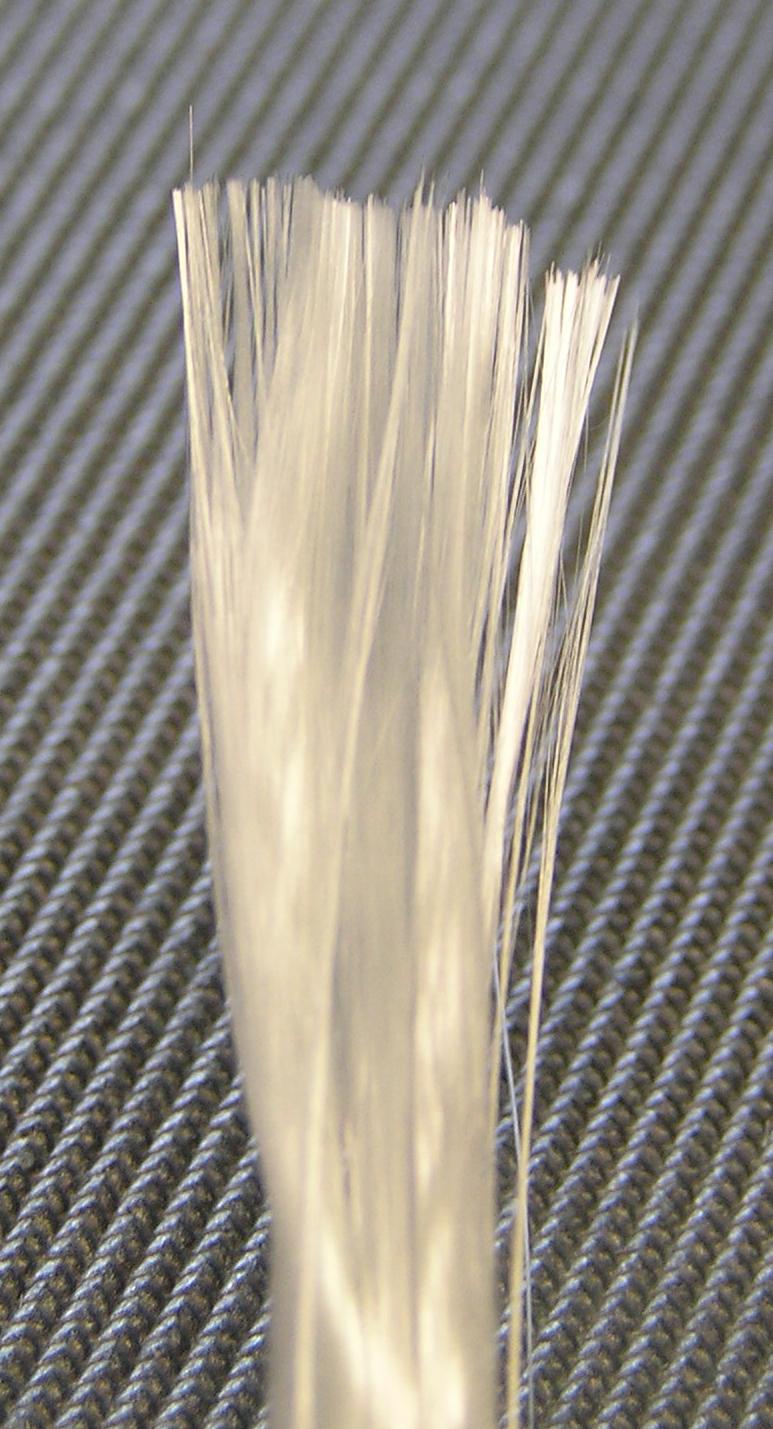
The glass fabric was actually a combination of glass and silk filaments which provided for greater flexibility; the warp threads were silk and the weft threads were glass (work on developing glass fabric would eventually lead to such modern-day products such as fiberglass and fiber optic cables). Below are some pictures of the dress, which was put on display at the Libbey Pavilion:


 The dress proved to be very popular to the point where one newspaper even predicted that eventually everyone would be wearing glass clothing. One of the viewers, Infanta Eulalia of Spain, saw the dress and commissioned one for herself in the form of a very simple evening dress:


For some more details on the Infanta’s dress, the particulars can be viewed here:

Apparently, the dress was a hit with the Infanta and as thanks, she gave the Libbey Glass Company permission to use the Spanish Coat of Arms as part of its advertising artwork. As for the dresses themselves, while the glass fabric was flexible enough to allow them to be worn, they provided to be brittle and not practical for any sort of extended wear. In the case of Ms. Cayvan’s dress, it was worn for at least one performance but that was pretty much it. What became of the dress is unknown.

In the of the Infanta’s dress, it was eventually donated to the the Deutsches Museum in Munich in 1924 where it remains today. Unfortunately, only the skirt has survived and was in poor condition until restoration was begun in 2016. An interesting set of blog post documenting the skirt’s restoration can be found here. Here are some views of the restoration process:


These glass dresses were a bit ahead of their time and it would have been fascinating to have been able to see these dresses when they were new. 🙂

One of the most iconic museums in Paris is the Louvre and since we were in Paris, we decided to pay a visit (in the full expectation that it would be crowded). For those who may not know, the Louvre was originally a royal palace that was eventually converted to an art museum after the French Revolution. Today, the Louvre contains extensive holdings ranging from Ancient Egypt all the way through the 1848. To cut down on having to deal with crowds, we decided to go in the evening on a rainy Friday (they’re open until 9:45 on Fridays). Unfortunately, a lot of other people had the same idea so things were a bit crowded in the more popular areas.

For what it’s worth, we found that the best way to avoid much of the lines is to enter by way of the Carousel du Louvre, an vast underground shopping mall (it’s actually pretty cool, as malls go) that’s linked to the Paris Metro and has an entrance into the museum- the best part about this is that we were able to avoid not having to wait outside in the rain. Also, it’s highly recommended that you buy a Paris Museum Pass before arriving at the museum (you can buy them at the airport or a number of different outlets).

So after quickly moving through the security line, we decided to go towards areas that weren’t that crowded so we soon found ourselves in Coptic section which roughly spans the 4th through 12 Centuries. Here’s a few things that caught our eye starting with some funerary masks from the late Roman Era (2nd-4th Centuries AD):

And an interesting Pagan holdover from late Roman Egypt (c. 300-450 AD), a square of fabric depicting Aphrodite’s marriage to Adonis:

And then we move onto Christianity:


The above illustration is Ethiopian…amazing!

We eventually made our way to the painting galleries and were greeted by some very familiar paintings by some of the biggest names in French painting such as Gericault, Delacroix and David:

Eugene Delacroix, Liberty Leading The People, 1830
This is probably one of the most iconic French paintings and captures the spirit of Republican France. This is a HUGE picture! We was unable to get a good picture so we borrowed one from Wikipedia. 🙂

Jacques-Louis David, The Death of Marat, 1793

And a better version:

Jacques-Louis David, The_Coronation_of_Napoleon, 1805-1807

Here’s a better view:

Antoine-Jean Gros, Napoleon on the Battlefield of Eylau, 1808
Please excuse the poor pictures, the paintings are HUGE and it was difficult to get decent head-on shots but you get the idea. The thing that really jumped out at us was the sheer scale of most of these paintings- some of these pictures are easily two stories tall. The Louvre is the perfect place for display but the whole thing can be a bit overwhelming with all the people. We were at the Louvre for some three hours and it was time to go- our energy was flagging and there was a face with our name calling. Just to conclude, in no way had we even scratched the surface of their collections- there’s no way one is going to view the Louvre’s collections in a day, let alone three hours so there’s more to see the next time we come to Paris. 🙂
2016 was a noteworthy year for historical costuming with the release of the movie Crimson Peak and to this day, it’s remained a favorite with us. As noted in a previous post, the costuming was simply captivating and it demonstrates some some of the basic principles regarding the use of color. As a follow-on, the FIDM Museum Blog posted an article about the costumes’ designer Kate Hawley that gives some insight into the thought process that went into the costumes’ design. Hawley uses color to sharply differentiate the characters with the heroine Edith being clothes in lighter colors, mostly shades of yellow, gold, taupe, and the like. In contrast, her nemesis Lucille is dressed in black and dark blue with bright crimson thrown in (the “drop of blood dress” as it’s termed). Just for comparison, here are several color palette/mood boards from the movie. First, Edith:

And then Lucille…there’s two different views:


The contrast in colors between the two characters is fascinating and it’s really obvious from the above mood boards. Color selection has always been central to our designs, even if Gothic horror is not involved. 🙂