A Brief View Of Men’s Clothing- The Sack Coat

Over the years we have been asked about making men’s clothing. While we are naturally flattered by the prospect of creating more period clothing designs from the late 19th Century, we have had to politely refuse on the grounds that it’s not our main business focus. More importantly, men’s clothing calls for a skill set- primarily tailoring- that is different from those used for women’s clothing. While there is some overlap (Redfern and especially with tailor-mades for women), it’s very much a separate speciality and we would argue that it’s an art form with a rich set of traditions that are not easily mastered. Well tailored clothes are a joy to behold and just the words “Savile Row” sets our hearts racing.

All hyperbole aside, we have chosen to restrict ourselves to the female side of historic clothing simply because if we made both types of clothing, we could not do justice to either. With that said, we would still like to present our views on the men’s side of clothing so from time to time we will be posting articles here covering various topics of men’s clothing and accessories. We would you enjoy our occasional series. 🙂


So, where to begin? Probably the best place to begin is with the sack coat/sack suit which gradually developed into the dominant style for men’s daywear during the late 19th Century, supplanting the earlier frock coat and the derivative morning coat. The sack coat/suit and the frock coat. The sack coat was meant for informal day wear while the frock coat/morning coat were reserved for more formal occasions (although there was often a lot of overlap between the two).

Styles1

The sack suit, or lounge suit as it was termed in Great Britain, originated in France as the sacque coat during the 1840s and took its name from the way it was cut (contrary to popular belief, the sack coat did NOT get its name from its loose fit “like a sack”). In contrast to the more elaborate frock coat whose back was constructed from four basic pieces, the sacque coat was simplified, consisting of two basic pieces. Moreover, the sack coat was designed to fit loosely.

EPSON scanner image

Sack coats usually had three or four button holes and often it was worn buttoned only at the top. In terms of colors and fabrics, wool of various weights was the predominant fabric although linen was often used for lighter weight coats intended for wear in more warmer climates. In terms of colors, they could range from solids to plaids, stripes, and checks. However, towards the end of the 19th Century, the dominant style increasingly were darker, sober colors such as charcoal gray, black, brown, and navy blue. Often they were accompanied by a matching pair of trousers and waistcoat, thus creating the three-piece suit. At the same time, the sack coat and trousers could be in different colors and fabrics. Below are some examples:

To start, here’s an image of an early sack coat from c. 1863 – 1864:

Sack Suit - Early

Sack Suit, c. 1863 – 1864

image002

Three men wearing sack coats, c. 1860s; Image from Joan L. Severa, Dressed for the Photographer: Ordinary Americans and Fashion, 1840-1900, 1995

The second image really shows up just how loose-fitting sack coats were in the 1860s, especially with the coat worn by the man with his back to the camera. This is in contrast to the 1880s, 90s, and early 1900s where the coats (and accompanying trousers) become increasingly more narrowly-fitted and cut closer to the body.

In the next image, we have one from 1870:

WaterfallsAugust1870

The West End Gazette, August 1870

The coat still hangs relatively loose but the trousers are gradually becoming cut more narrow.

6b240ed1262cafce380e8ea797cd11bd

Sack Suit

Sack Suit, British, c. 1875 – 1880

A bit on the loud side, the use of loud fabrics steadily diminished during the late 19th Century. Sack suits could be made from linen as well as wool as with this suit that was intended for wear in warmer weather:

Sack Suit4

Sack Suit, c. 1885 – 1900; McCord Museum (M973.137.4.2)


67acfb2bc992f7bf2d46bb64708b8470

Sack Suit2

5d85a31e84b3aab23b71775fd36cf71c

Sack Suit, c. 1895

Sack Suit3

Sack Suit, c. 1911; Los Angeles County Museum of Art

The above picture depicts the ultimate development of the sack suit and it’s easy to see that the modern business suit was not far off in the future.

During the late 19th Century, the sack suit became the standard “uniform” for anyone aspiring to a degree of respectability and especially those involved in business and the professions. In fact, it could be argued that the sack suit was instrumental in democratizing clothing in that it allowed any man to look like someone substantial and respectable. The sack suit was relatively cheap which had been made possible by industrialization and the development of the ready-made garment industry in America and Great Britain.

In conclusion, we would argue that if you are looking for that “one” outfit that accurately symbolizes the 19th Century man, it would have to be the sack suit. While fashion choices were often dictated by social and economic factors, it would be safe to say that the sack suit was the “default” outfit to be worn wherever possible- the sack suit symbolized respectability and social status. Even the laborer, miner, cowboy, and farmer wore sack suits when the occasion demanded and they had the means. In contrast with today’s emphasis on casual wear, dressing up was considered essential to showing one’s better side and more importantly, securing respect from one’s peers. Naturally, the above is a broad generalization but it does go a long way towards capturing the zeitgeist or spirit of the time.


1914 – Couturiers Under Arms

On August 2, 1914, France formally began mobilizing its forces in response to Germany’s declaration of war. As part of the mobilization process, reservists were recalled to the Army and soon all of France was in turmoil as men reported to their pre-assigned deports and were issued their uniforms, arms, and equipment. One such reservist was Paul Poiret and on August 4 he reported for duty, having first closed his couture house.

Robes of Paul Poiret 1908

From “The Robes of Paul Poiret” (1908), illustrated by Paul Iribe.

When war broke out, Poiret was 35 years old and still had an outstanding reserve obligation so he very quickly found himself in uniform. By his own admission, he was a somewhat indifferent soldier when he had initially entered the Army in 1900 to fulfill his military service obligation, characterizing it as a complete waste of time (in 1900, all French males had a military service obligation of two years active service although under certain circumstances, some soldiers only had to serve for one year). But that was in peacetime; things were different now that a war was on and France was being invaded.

After a series of misadventures due to bureaucratic foul-ups, Poiret was assigned the task of working on the production of uniforms and one of his most notable achievements was creating a new design for a greatcoat that saved four hours of labor and nearly a yard of fabric. Moreover, Poiret was instrumental in setting up a production facility for producing greatcoats that employed many of his former employees who had been put out of work with the closure of Poiret’s fashion house.

1914 Greatcoat_Poiret

The P1914 Greatcoat, First Pattern (aka “The Poiret”). Poiret was instrumental in designing this coat and facilitating its production.

Ironically, when Poiret initially arrived at his regiment, his occupation was noted in military records as being that of a tailor- no doubt pigeonholed as a result of his work as a couturier- and set to work as a regimental tailor, responsible to ensuring that soldiers’ uniforms fit correctly to regulation. Ironically, he had no skill in this area and when he attempted to inform the military authorities, he was dismissed as a malcontent and trouble-maker (during this time, many fashion designers have little or no sewing ability and even today, this is common in the fashion industry).  Eventually, the situation was resolved but it added to Poiret’s dislike of the military.

vogue-1914-10-15-p44-poiret-enlisted-pic

Paul Poiret in uniform, Vogue, October 15, 1914

Poiret eventually re-opened his fashion house in 1919 but the damage had been done, both in terms of the direct effects of lost business and more indirectly in that he had become increasingly out of touch with fashion developments (four years is a long time in the fashion industry). Worse, Poiret had been unable to exercise much influence over developments in fashion and it simply moved on without him (most notably, new designers such as Coco Chanel were able to take advantage of wartime conditions to establish herself as a new force in the French fashion industry). Although Poiret was still able to create a number of striking designs during the 1920s, he was never able to achieve the over-arching prominence he had enjoyed prior to the war.

Evolution of a Gown, 1879

In keeping with the theme of fashion inspiration and design, we present a short overview of the process applied to a picnic gown, narrated by Karin.  With the coming of Spring, comes longer and warmer days and the opportunity to get outdoors and enjoy those days. 🙂 Picnics are a favorite with us because they give us an opportunity to wear our designs in a relaxed atmosphere (balls are fun too, don’t get me wrong) and we just naturally associate it with Impressionist picnics. 🙂

Claude Monet1

Claude Monet- “The Artist’s Family In the Garden” (1875)

With the arrival of spring, vegetation begins to flower in a riot of color and that is where we find our inspiration. As we noted in a previous post, greens are a special favorite with us but they’re not the only favorite…

There is a host of other colors to include shades of blue, red, magenta, pink, and lilac…

Lilac is one of those easily overlooked colors but it struck a responsive chord with us. We’ll let Karin continue the story…:-)

Adam_Vintage1

..


It’s no secret, I have a thing for sheer frothy summer picnic gowns straight from an Impressionist painting. My favorite lilac summer gown started with every intention of being “that white Met dress” that I have a crush on:

wp-1460063527109.jpg

The original gown inspiration from the Metropolitan Museum of Art website. It has three of the four “food groups” that interest me with gowns: pleating, ruffles, shirring, ruching…guess which one this one doesn’t have. 🙂 Pleating…mine will have it.

However, the moment I announced that I was going to make this gown on Facebook, a friend of mine posted that she was going to use this same cotton batiste! Thus, the evolution began…so I decided to dye it.

First, the lilac rinse. The top of the sample has been left plain:

wp-1460063540531.jpg

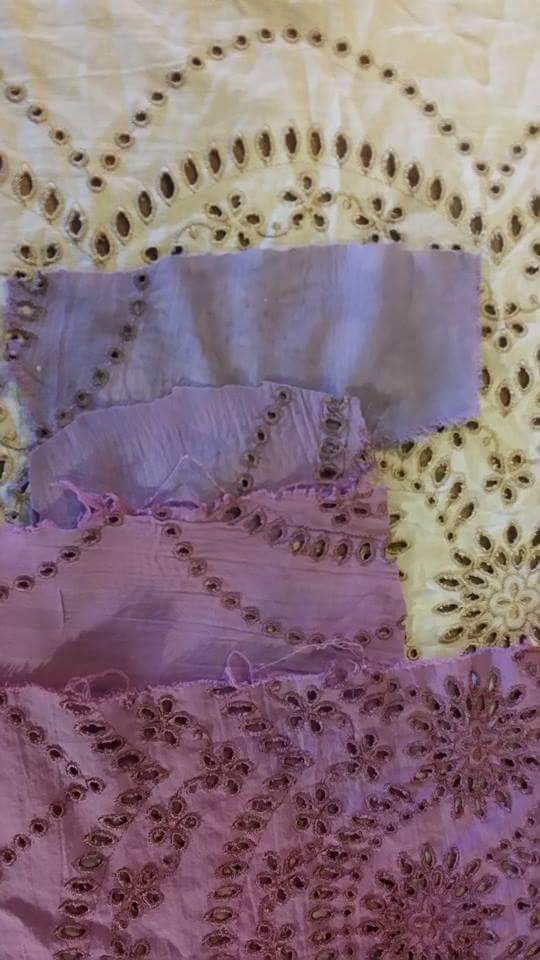
Everything came from my work studio and was carefully dyed to harmonize and not match. This is how to create depth so things don’t appear to be flat.

wp-1460063579709.jpg

Vintage fabrics have stories to tell. This vintage eyelet came from a Lid family friend’s chalet in Switzerland (and some stories, I’m sure!) It took over four sheet dips of  color to get the right shade. I’ve been carefully using this gift of fabric over the years and there are only two meters left.

wp-1460063597430.jpg

Second and final color later and silk ribbons to match, because…you never know, right? Color is clear and not muddy, not an easy thing to do. I’m an artist myself and as such, I usually get ideas from other painters…Tissot is one of my favorites. 🙂

wp-1460063863480.jpg

Foundation skirt front, very girly with both micro pleats, shirring, and ruffles, book is showing my inspiration dress. That’s a lot of narrow hemming! Et voila…

wp-1460063846741.jpg

Lilac summer gown (the first version) standing next to my W&G treadle machine that I made the hat with. The gown (like most of mine) will eventually evolve. This version had no collar, just an antique piece of lace slipped in the piped neck edge and after wearing it once, I hung it up and told Adam:

“It’s BORING and flat, it will never again be worn”.

A re-direct was required. I like the next version much better…

wp-1460063829377.jpg

Final version with a shaped velvet edged lapel that is curved to fit over the bust with no ruffles…more tailored, much better! The difference is that it’s now balanced visually, nothing “floats” near the face, which is better for me. I’ve learned to say “never say never”…

wp-1460063810801.jpg

Summer gowns and stagecoaches? Count me in! See how the collar curves with the bust? That has to be done with a curved neck edge (on the lapel) slipped onto a straight neckline. I like that much better. 🙂

wp-1460063793911.jpg

Of course, the garden photo Rancho Los Camulos…matching the bougainvillea was a happy surprise. <3 Monet would approve.

And now, back to Adam…


So there you have it, straight from the designer herself- often the design process takes various twists and turns, sometimes in response to a change in conditions or sometimes as simple as someone else is looking to create a similar dress. Also, a chance encounter with a specific piece of fabric or variable dye results can send the design process spinning in an unanticipated direction. In short, it’s not a mechanical process as one would find with designing a car or an airplane: it’s more art than science. But also note that “design” is not the only factor at work here; it’s also essential to have an understanding of how garments are constructed and the interactions between textiles, dyes, and construction.

Fashion plates, original images, and extant examples are all useful (and essential) but unless one understands what is going on “under the hood”, so to say, the end results will not be optimal. The design process is a bit more complicated than one would initially think but at the same time, it’s not magical and mysterious (no matter what some designers will claim). The key is diligent study and constantly being open to new possibilities and have a willingness to learn new techniques.

We hope you’ve enjoyed this excursion through the design process here at Lily Absinthe and we’ll be commenting more on this topic in future posts. 🙂

Butterflies, Ballgowns And Spring Fashions

The natural world has always been a source of inspiration for artists and fashion designers and the late 19th Century was no exception. Examples of natural inspiration in fashion abound but there were a few specific examples that caught our eye.

The first example is a ballgown created by the House of Worth in 1898 (Frederick Charles Worth himself has passed from the scene by this time) and it incorporates butterflies as a design motif:

Worth

Ballgown, Worth, 1898; Metropolitan Museum of Art (2009.300.1324a, b)

Worth4

Three-Quarter Front View

Worth

Rear View

Worth

Three-quarters view of skirt.

This dress has a relatively simple, clean silhouette characteristic of late 1890s design. The skirt itself is made from a pale blue silk satin and has a full train and an unadorned hemline. The bodice is constructed of the same pale blue silk satin trimmed in a taupe silk chiffon. All of this is fairly standard but what separates this dress from others is that it’s decorated with butterflies on the skirt and bodice, are arranged to give the appearance that they are fluttering away from the hem.

The butterfly decorations appear to be of champagne/gold with metallic highlights and black beading; most notably, they’re woven into the fashion fabric rather than appliqued. Even more remarkable is that the butterflies are scaled, shrinking in size moving away from the hem- the fabric was deliberately woven this way, and there’s little doubt that there were “up” and “down” sides of selvage; this fabric was specifically commissioned by Worth. Worth sourced most of its silks on a custom-production basis from various firms in Lyon, France and the results were amazing such as in this case.

As a sidelight, what is even more remarkable about the butterfly fabric is that its width would have had to have been wide, no doubt approaching the 54 or 60 inch wide. 54 to 60 inch widths for fabric are standard in the textile industry today but that was not the case in the 19th and early 20th Centuries. Then, fabric widths tended to be narrow, ranging from 30 to 40 inches wide (or the metric equivalent thereof). In our collection of vintage bolts of fabric, none are wider than about 34 inches.

This “natural” theme can be also be found in this ball gown that was also designed by Worth in 1900, only this time incorporating wheat-like motif:

57.83.22a-b_front_CP4

Ballgown, Worth, 1900; Metropolitan Museum of Art (2009.300.1250a, b)

57.83.22a-b_side_CP4

Side Profile

57.83.22a-b_detail3 0002

Skirt Detail

57.83.22a-b_detail1 0002

More Skirt Detail

And here it is being “worn”:

57.83.22a-b

The silhouette is identical to the first dress only the basic fashion fabric for skirt and bodice is now a pink-colored silk satin. The skirt is decorates with a series of wheat stalks flowing upwards from the hem both on the front and the back. It is difficult to tell from the pictures if the yellow/gold wheat stalks were integrated into the basic fashion fabric (we suspect it is) but combined with the beading, the effect is imaginative. The pink color of the dress is further enhanced by the taupe/gold chiffon and fabric flowers that trim the neck and shoulders of the bodice. Once again, we see the natural world as interpreted into fashion.

As a side note, the above two ballgowns illustrate one of Worth’s basic design methods in that each dress was based on a standard pattern block that was modified for the individual client. At root, the construction details for each type of garment remained fairly similar, only the fabrics, decoration, and trim varied. From a business perspective, it was efficient-no point reinventing the wheel, so to say, each time a client ordered a dress. It’s also easily overlooked with all the distraction caused by the exquisite fabrics and trim found in Worth’s designs (the goal of every designer of the time 🙂 ). We hope that you’ve enjoyed this little excursion to the House of Worth. 🙂


“>

And For Something Different…

Just for something different, here is a picture of myself from last weekend at a First World War living history event. I am in a German infantry uniform, circa 1915-18 consisting of the 1915 pattern Bluse and 1907 pattern infantry trousers. I am wearing a Feldmütz bearing the national cockade of Imperial Germany on top and the state cockade for the Kingdom of Prussia (the German Empire at this time was essentially a federation of states with Prussian having the dominant role).

wp-1459954584020.jpg

Compared to the fashionable garments I normally work with, this is as utilitarian and ugly as it gets and it amply shows the contrast between the decorative and the functional and mirrors the profound changes that occurred as a result of the First World War.

But not too worry, I am back to my usual. 🙂

Adam41