The $300 Shirt…

wp-1483987230339.jpg

$300 for a shirt?! Are you serious? In some cases, yes, when it comes to shirts made to fit a specific individual. 🙂 And with online ordering, you don’t even have to leave home- what can be better? Well, let’s qualify this a bit- most places offering “custom tailored” shirts are in reality modifying existing pattern blocks based on industry standard sizes. In many cases, a person’s measurements will fall within the parameters for a specific standard size and thus require no modification whatsoever. So in reality, one is not getting a “custom” but rather a standard sized shirt in a specific color/fabric/collar combination that has been selected from the seller’s list of options. In some cases, it’s little different than ordering from a standard online catalog. Finally, price-wise, you’re often paying about the same that you would if you were simply ordering something ready-made and giving the standard size/neck, and arm length measurements.

Image result for shirt pattern blocks

The next step up still involves working off standard pattern blocks but it’s done with more precision and detail, utilizing a greater number of measurements. The better concerns will have an individual take the measurements in person to ensure that they are correct. Also, interaction with a live sales representative/tailor ensures that whatever particular fit issues you may have can be addressed up front. Also, you’ll have a far better selection of better quality shirting fabrics and more options in regard to cuff styles, stitching, etc.

Finally, this takes us to “bespoke” tailoring which is the most expensive and the most rarely done and basically involves creating a custom pattern to the individual client. Essentially an individual patter is drafted from the client’s measurements to ensure a perfect fit. The pattern drafting alone is time-consuming (and the prices reflect that 🙂 ). This method is rarely, if ever, found outside of exclusive tailor shops such as Saville Row.

I recently decided to try my version of a “custom shirt.” This being the first time I’ve made a modern shirt (as opposed to 1880s and 90s), I decided to start with to a commercial pattern. Yeah, I know I probably should have drafted a pattern but I opted for the easy way on this. 😉

wp-1484014215220.jpg

I opted for Style D but only with a left-hand pocket and minus the flap. The pattern itself was the usual commercial tissue type so I first cut out the pieces and mounted them on tag board (the same cardboard that manila file folders are made from). I selected an Italian-made cotton shirting fabric in a French blue with white stripes along with a snow white Kona cotton for the collar and cuffs. Unfortunately, while this is a nice shirting fabric, it’s also slippery and prone to shifting so cutting out the pattern pieces and the subsequent sewing were a challenge- I made liberal use of pins and even then, I found myself having to restitch at various points (fortunately, I didn’t have to re-cut any pattern pieces).

Below are some pictures of the shirt under construction:

wp-1483987150715.jpg

Front Pocket Intalled

wp-1483987108322.jpg

Front And Back Stitched Together

wp-1483987193131.jpg

Sleeves And Cuffs Installed

wp-1484028983950.jpg

Collar and Cuffs Installed

So how is the fit? Well, so far it’s perfect and I didn’t have to make any alterations… 🙂 Now while this may seem fairly trivial when compared to custom and bespoke tailored shirts, it’s not so much in terms of the labor required. Naturally, there’s been a bit of a learning curve so it’s taken longer for to construct the shirt than it should. But even so, it’s been a labor-intensive process especially since each of  the seams had to be finished individually and everything checked to make sure it was set right.

Finally, on to the finishing details: 🙂

Adam Shirt

Setting The Buttonholes

Adam Shirt

Close-Up: Buttonhole Setting

And finally, for a little seam finishing, bias tape made in the same fabric:

wp-1484328908088.jpg

And voilà!

wp-1484891775679.jpg

Putting On The Dog (aka Going Formal)…

Tonight we took a small break from our various projects and attended the Holiday Grand Ball put on by the Social Daunce Irregulars. The Holiday Grand Ball is somewhat of a Thanksgiving Weekend tradition for the two of us, providing a bit of a break from all the usual pressures created by project deadlines and the overall holiday frenzy as well as providing an excuse for use to wear some our latest creations. 🙂

This year was no exception for Karin but for me it represented a new departure. For years, I tended to avoid men’s formal wear like the plague, usually opting for some sort of uniform. However, uniforms get old after awhile and I decided that it was time for a change so I opted for formal wear but only on my terms. Like many, I raised on the idea that if one needed formal wear, one rented it and that usually meant some sort of cheap polyester nightmare (I still have prom pictures from 1978 with me wearing a powder tuxedo that I might actually be bold enough to post one day…). In the end, it just seemed to be of such limited use item that it simply wasn’t worth the expense.

So what changed my view? Well, a small confession is in order: it was from watching way too many episodes of Downton Abbey. Yes, that Downton Abbey… For many years, I regarded formal wear (or “penguin suits” as I normally called them) as an affectation that really bore little relevance even though I do a variety of 19th Century living history events and presentations. Besides, uniforms are just way more cool… 🙂 However, after watching Hugh Bonneville I changed my mind- I like the character and he seemed to pull of the look with a sense of presence without looking affected. It simply looked way too good for me not to try it. 🙂

Image result for hugh bonneville downton abbey

So, after doing some research I decided to have a tail coat and trousers constructed based on a style that was appropriate for the 1880s/1890s. Here’s some of the inspiration for my set of tails. First, we start with some overall impressions:

6d86c98e1ed5a1207cb707af85c588ab

8dc87fd58bcf95f8002579ecd2249c00

1ed64bc65f6e56b7421769f043d8e514

Wedding Suit, 1886; Metropolitan Museum of Art (C.I.47.76.10a–c)

bfd157812c8eab94211238510c7ce299

Evening Suit, c. 1885; Victoria & Albert Museum (T.171 to B-1960)

Obviously the color choice was going to be black with both coat and trousers made form wool. Because I live in Southern California, I opted to have the coat and trousers made from a tropical weight wool. Also, I decided to have the coat made with panels of black silk set within the lapels- the contrast in fabrics between the wool and the silk make for a more interesting appearance and it’s a detail that one rarely sees on modern formal coats.

For the vest, I opted for one with a shawl collar made of white pique fabric with silk lapels, somewhat along these lines:

aad0212194c6b67fdac46ae3628b24c9

Vest, c. 1880; Metropolitan Museum of Art (1991.388a–f)

Just for contrast, here’s one in black wool:

1991-388c_f

Vest, c. 1880; Metropolitan Museum of Art (1991.388a–f)

It’s difficult to discern in the picture but it also have a shawl collar. Finally, I decided that I’d go for the “white tie” look, which was considered more formal, so I had a fixed bow tie made from ivory silk and opted for a straight detachable collar. Below is the final product:

wp-1480319803592.jpg

Not bad for the first time out! 🙂

I’ll be making some additional improvements for the next to time to include a more comfortable collar and not forgetting my white gloves. See you at the next ball…


Adam’s Atelier Travels To Heritage Square

This past Saturday, we were guests at a very nice wedding for one of our clients that was held at the Heritage Square Museum in Los Angeles. The wedding was a period affair, Edwardian to be precise although clothing ranged a bit on either side (not including the outright modern). Karin arrived early just to make sure that there were no last-minute complications (there weren’t, thank god) and otherwise assist. In the meantime, I was pretty much on my own so I decided to walk around and get some pictures.

 wp-1468854489113.jpg

It was a warm day so I decided to take these pictures from a nice, cool shady spot. 🙂

wp-1468854544868.jpg

wp-1468854520775.jpg

Heritage Square is composed of a series of restored houses that were moved (yes, moved) to the museum site from various sites in Los Angeles and the structures have been restored over the years. It’s come a long way since I first visited the museum in 1994. It’s a wonderful slice of a vanished Los Angeles, a Los Angeles that pre-dates the car, freeway and all it’s attendant growth and development. For a description of the various buildings at Heritage Square, click HERE.

One of the more striking houses was the Hale House which was built in 1887. I was unable to get a good picture of it so I lifted one off the internet 🙂 :

Hale House, Heritage Square, Los Angeles - Hale House - Wikipedia, the free encyclopedia:

To me, this house is especially striking and especially the brick chimneys (which are all unreinforced masonry). Beautiful to look at but not the most optimal for earthquake county here in California. Unfortunately, I was unable to capture any interior shots on this visit, but I can assure you that those are just as interesting and especially when you look at some of the details as impossibly small, curing stair cases and the like (in an era where building codes were minimal to non-existent).  In many ways, the museum is a living time capsule and well worth a visit for anyone interested in architecture and interior design of the late 19th century.

As for myself, well I was definitely dressed for occasion and keeping cool at the same time:

wp-1468856216855.jpg

Here I am dressed in my linen sack suit. Although it’s not too visible, I am also wearing a starched fabric detachable collar which is a lot more comfortable than the much stiffer paper/celluloid variety. Believe it or not, wearing a detachable collar is quite comfortable and it’s now standard for me whenever I am wearing civilian clothing.

Also, because of the heat, I decided to give my new straw boater hat a try. I bought it from Darcy Clothing in the UK (highly recommended) and it presented an interesting wearing challenge. The crown is very low and it almost perches on the top of my head. I was able to create some inner tension by adding a thickness of cotton fabric inside of the hatband but I would be careful wearing this on a windy day. Otherwise, after wearing the boater for a few hours, I forgot about the low crown and it was quite comfortable. It’s a look that I highly recommend for summer and in fact is very appropriate for the late 19th Century.

wp-1468856238272.jpg

And finally, the selfie…it seems to be de rigueur these days. 🙂

wp-1468707653157.jpg

OK, that was extremely silly…in future posts, there will be more about the wedding dress and wedding itself so stay tuned. 🙂

Dressing The Lawman

Recently someone asked me the question: “What did lawmen wear in the Old West?” The easy answer is: “the same clothes that everyone else wore.” OK, I’ll admit that that answer is a bit snarky and it is a legitimate question. Our perceptions of what lawmen wore have been to a great degree shaped by what we’ve seen in film and television with all its inherent inaccuracies.

Tombstone-Val-Kilmer-Sam-Elliott-Bill-Paxton-Kurt-Russell

Wyatt Earp Movie1

When considering the question of fashion and lawman, one’s head is filled with images from such iconic movies as Tombstone or from television shows such as Gunsmoke. In reality, “lawmen” in the American West during the late 19th Century took several forms to include town and county sheriffs/marshals, state rangers such as the Texas or Arizona Rangers, and federal marshals. Also, there could be a variety of semi-private “lawmen” such as Pinkerton detectives (who often functioned as a law unto themselves).

TEXAS RANGERS — (Standing from left) Jim King, Bass Outlaw, Riley Boston, Charley Fusselman, Tink Durbin, Ernest Rogers, Charles Barton and Walter Jones. (Seated, from left) Bob Bell, Cal Aten, Captain Frank Jones, J. Walter Durbin, Jim Robinson and Frank L. Schmid. – Courtesy Texas Ranger Research Center; Texas Ranger Hall of Fame & Museum —:

Texas Rangers, c. 1888

This photograph was made in about 1880, and shows three agents from the Pinkerton Detective Agency. The man in the middle is William Pinkerton, son of the group's founder, Allan Pinkerton. Allan Pinkerton was a personal friend of Abraham Lincoln, and provided protection for the president while he was in office.:

Pinkerton Detectives c. 1880. The man sitting in the middle is purported to be Allan Pinkerton, the company’s founder.

Also, it must be noted that for many jurisdictions throughout the American West, the position of “Sheriff” at the country or municipal level was typically an elected one with all its inherent flaws and they had a variety of job duties of which apprehending criminals was only a part. Other duties could include serving warrants and summonses, supervising executions, jailing prisoners, investigating crimes, collecting stray dogs, and collecting taxes. Collecting taxes was one of the most important parts of the job since it was taxes that paid for the sheriff’s deputies and the costs of running the government.

While the popular conception of the Old West lawman is that one of a steely-eyed gunfighter staring down one or several desperados, all intent on murder and mayhem. The reality was that it more about dealing with drunks and generally keeping public order, specially in the newly-formed cow towns such as Wichita and Dodge City.

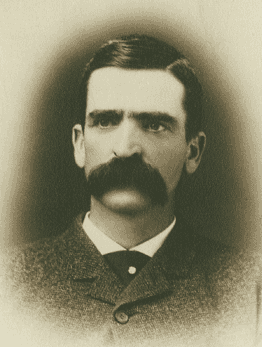
That said, let’s move to the clothes- here are just a few pictures of real Western lawmen:

John Slaughter, Sheriff of Cochise County, Arizona 1887 – 1890

Bass Reeves Lawman the Original Lone Ranger ✔️:

Bass Reeves, Deputy US Marshal, 1876 – 1907

Old West lawman | old-west-lawman_edward-johnson.jpg:

Henry Andrew "Heck" Thomas born January 3, 1850 was an lawman on the American frontier most notably Oklahoma. He was appointed US Deputy Marshal out of Fort Smith, Arkansas working under Judge Isaac Parker.:

Looking at the above pictures, it’s easy to discern that their clothing pretty much mirrored what was generally worn. For the most part, it mostly consisted of trousers, shirt, vest, and a sack coat. In warmer weather, a jacket was not worn and sometimes just the shirt was worn. Allowing for the “dressing up for the camera” effect, it’s still obvious from the more informal portraits that it wasn’t an affected style. In many instances, there was little difference between what a lawman wore and what others wore except for the badge and perhaps more guns.

Lawmen as seen on film.

For anyone desiring to recreate the look of a Western lawman, probably one of the best places to start is with either a sack suit or for something more “out on the trail,” a pair of trousers, shirt, and vest but that’s only a suggestion. There are a lot of original pictures that one can use to base their research on and they can adjust their look depending on what sort of an impression. One thing I do want to note is that except during times when lawmen were in active pursuit of a criminal or otherwise expecting trouble, they were not walking arsenals with multiple pistols and a rifle or shotgun. In town, lawmen frequently simply carried a small caliber pistol in a trouser or coat pocket (often reinforced because of the weapon’s weight).

And another…

Finally, it should be noted that as an elected public official, a county or town sheriff or marshal was expected to project an image of respectability (although the definition of “respectable” could be somewhat elastic) and as such, they tended to dress the part. For many, the position was viewed as more of a means to a political career than anything else and they acted accordingly. One good example of this was with Johnny Behan, the Sheriff of Cochise County. For the most part, he was more concerned with collecting taxes and keeping up appearances; for the actual work of enforcing the law, deputies were hired. Pictures of Behan show him dressed in a sack suit, looking like any middle class small town businessman (which he basically was). Like today, image and respectability were important during the Victorian Era and dressing correctly played a key role.

Johnny Behan, c. 1871

Reality is often pretty dull when compared to what is portrayed in film and television and that especially applied to the lawman of the American West and we hope that you have found this post to be informative. 🙂  


A Brief Look At Men’s Hats – The Opera Hat

Today we continue our story of the top hat a little further with a brief look at the opera hat (aka the Gibus or chapeau claque)… 🙂

Opera Hat 7


One interesting version of the top hat was the opera hat. The opera hat was a collapsible version of the standard top hat and was intended to make the hat easier to store, typically underneath one’s seat at the opera, hence the name “Opera Hat.” It is said that necessity is the mother of invention and that certainly applies to the fashion world. As discussed in a previous post, during the 19th Century, the top hat rapidly made a place for itself as being one of the key pieces of men’s formal wear. A symbol of respectability (and especially for a growing middle class), the top hat was worn at all formal social events such as the opera.

Opera Hat 8

However, as noted above, once one had arrived at a formal social event, what was one to do with their hat and especially at an event such as an opera or other theatrical performance- holding a top hat in one’s lap can be awkward. One could try to put it underneath their seat but there was the risk of the hat being crushed or dented (or simply not fitting). Of course many venues provided cloak rooms but even then, one ran the risk of having their hat crushed or dented. Also, dealing with one’s top hat could be a problem when getting into a covered carriage with a low ceiling.

Opera Hat 9

In the case of the top hat, the solution was somewhat obvious- find a way to collapse the crown. One solution was devised in 1812 by a hatmaker in England named Thomas Francis Dollman who patented an “elastic round hat” in which the sides of the crown were made of a thinner material than the top or brim. A steel spring was sewn into each side of the crown and the hat was fitted with ribbons so that it could be held in a collapsed position. Dollman’s patent expired in 1825 and it would appear that his invention never took hold, at least when it came to top hats.

Opera Hat 1

Opera Hat, c.1901 – 1904; National Gallery of Victoria

Opera Hat 2

Interior View

The next step came in 1834 when a Parisian hatmaker named Antoine Gibus applied for a patent for what was described as a chapeau mècaniques in which the top hat was fitted with a hinged frame so that the crown would collapse and the top of crown would become flush with the brim. With this design, the wearer would have to manipulate the frame open and closed- there was no spring action. Subsequently, on November 30, 1837 Gabriel Gibus (Antoine’s brother) filed a patent for an improved version that included a spring mechanism (from what information I was able to glean, it appears that a series of patents were filed).

premier_20gibus

A patent drawing of the collapsable top hat by Gabriel Gibus, November 30, 1837.

With the spring mechanism, the hat could now be opened quickly and because of the distinctive “snap” the hat made, it was often referred to as chapeau claque. The usefulness of the collapsable top hat, or opera hat, was self-evident and it became popular (although there were a few hold-outs 🙂 ). Starting in the 1850s, several more patents were filed by the Gibus family and they became wealthy from the royalties paid for their invention.

Gibus-Label

Below are some x-ray pictures that show the mechanical workings of the hat:

And here are some more examples:


Opera Hat 11

Close-Up Of Collapsed Opera Hat

Opera Hat 3

Opera Hat & Box

Functioning vintage opera hats are available today but many of them are in fragile condition and not really suitable for wear. Reproductions, or rather new ones, are available from specialty hatmakers but they are not cheap.

We hope that you’ve enjoyed this little diversion into the world of opera hats and while getting one is not on the top of my “must have” list, it’s certainly a tempting possibility. 🙂