A Brief Look At Men’s Hats – The Top Hat

Austin_Lane_Crothers,_photograph_of_head_with_top_hat

Austin Lane Crothers, 46th Governor of Maryland (1908–1912)

Nothing symbolizes the height of 19th Century men’s fashion than the top hat. The symbol of respectability, the top hat reigned supreme as the ultimate fashion accessory and at one point was worn by people of every social class, including workmen. The top hat had a tall crown and a short brim that could either be curled or straight and was primarily made primarily from wool, rabbit, or beaver felt. Beaver was especially prized because it was waterproof and warm. However, due to Beaver’s popularity, the supply rapidly diminished during the 1830s (the over-trapping of Beaver was one factor leading to the demise of the “Mountain Man” lifestyle).

As a replacement, silk plush fabric was developed in France during the 1830s and was increasingly used, especially because of its natural shine. The variety of silk plush (sometimes referred to as milliner’s silk plush)  used in top hats was a textile with a raised pile or nap that gave a high luster. According to some authorities, silk plush has not been manufactured since the late 1940s thus giving rise to a thriving market in vintage tops hats. Also, the odds of finding a genuine beaver top hat are on the open market are very small and many hats that are marketed as “beaver” are actually made of silk plush (compared to silk plush, beaver is actually duller). Finally, top hats were came two types, a “town weight” and “country weight” which was a more reinforced version (typically worn while riding).

Top Hat 1885

Top Hat, 1885, worn by President Grover Cleveland at his First Inauguration on March 4, 1885; National Museum of American History, Smithsonian Institution

The specific origins of the top hat are obscure but generally speaking, its origins can be found during the 1780s and 1790s when the earlier “sugarloaf” style was revived. From the 1790s on, men’s hats began to take the form of what would later become the top hat and they were made in a variety of crown and brim shapes. This shift in fashion was especially noticeable in France at the height of the French Revolution when fashions rapidly shifted away from 18th Century fashion which was deemed to be too aristocratic.

5bbb4ba4a66ab6c90a683070a58f016b

portrait-of-a-young-man-wearing-a-red-cape-and-large-hat-ca-1795-1800-by-francois-xavier-fabre

Portrait of a Young Man, Francois-Xavier Fabre, 1795 – 1800.

1795_pierre_seriziatby_jacques_louis_david_wikpedia

Monsieur Seriziat, J.L. David, 1795.

By the early 1800s, the top hat had established itself as the leading form of men’s hat and they came in a variety of styles (more than the later part of the 19th Century):

1830_whole_art_of_dress_hats

9daeaf458bdbde7241bb7ec5ed36c358

Fashion Plate, c. 1810.

During the early to mid 19th Century, top hats went through a number of style trends to include the bell-crown with its curved upper crown and the stovepipe with its tall crown and harrow brim. Below are a few examples:

Top Hat1

Top Hat, c. 1820 – 1825, wool fur felt; Philadelphia Museum of Art (1912-216)

tumblr_lx8qpxvNEk1qa51rdo1_500

Another Bell-Crown Top Hat, c. 1850s

038ad78df7cd1f7c109a1cf57544c26e

Another example from the 1850s

Top Hat2

Top Hat, c. 1855 – 1860; Fashion Institute of Design Museum (2010.5.13)

Caillebotte_Hugot

Gustave Caillebotte, Portrait of Paul Hugot (1878)

By the 1890s, the top hat had taken the form that more or less survives to this day: a relatively low crown with a slightly curved brim:

CP160_CP1

Men;s Top Hat, c. 1890; Metropolitan Museum of Art (2009.300.6127)

412234ff306cca6b6ce513960dde4da7

Portrait, c. 1890

lord-ribblesdale

Lord Ribblesdale by John Singer Sargent, 1902

And naturally, there was also a special case for transporting one’s top hat when they were not wearing it:

Top Hat Box c. 1910

Top Hat Box, c. 1910 (Elekes Andor – Own work, CC BY-SA 4.0)

Top hats were also available in a straw version for more warmer climes although this seems to have been more of an early 19th Century style:

SC110206

Men’s Top Hat, Straw, c. 1820 – 1840; Museum of Fine Arts, Boston (44.199)

By the early 20th Century, wear of the top hat was increasingly limited to formal occasions rather than worn as part of everyday dress and this trend has continued on into the 21st Century.

0ebdcc9b05953933e02475e41b393740

Advert for silk top hats, 1885.

The top hat is the centerpiece of any man’s formal wardrobe for the late 19th Century and a definite “must-have” for anyone recreating the clothing of this period. We hope you’ve enjoyed this brief tour of the world of top hats. 🙂

A Brief Look At Men’s Hats – The Bowler/Derby

Hats have always been fascinating to us here at Lily Absinthe and millinery/hat-making is an artform all its own. In contrast to today, hats were an essential part of men and women’s wardrobes and they helped to shape and define an individual’s appearance and how the presented themselves to the world. In this post and others to follow in the future, we’ll be taking a look at hats as a means to educating and especially in connection with recreating styles from the late 19th Century. With that, let’s begin…

Mens_hat_Advertisment


For men, hats were an essential part of their wardrobe, ranging from the purely practical for protecting oneself from the elements to the purely decorative for fancy dress. For the most part, the situation/social function determined what clothing was proper to wear and this in turn also affected hat selection.

For everyday wear from 1870 through 1900, probably the two most popular style was the derby or bowler (frontier regions such as the American West had their own peculiar hat styles and we’ll leave those aside for the moment.).  The terms “derby” and “bowler” have been used interchangeably with bowler predominating in Great Britain and derby in the United States.

Derby

Derby, American, Wool, c. 1880; Metropolitan Museum of Art (C.I.49.49.18)

The bowler/derby was characterized by a curved brim and a rounded low crown and was made of stiffened wool felt, reinforced by the addition of shellac to the manufacturing process.  The hat was said to have been invented by a London hatmaker in 1849 as an alternative to the top hat for riding due to the top hat’s tendency to catch branches and get knocked off (although there are some other conflicting stories as to its origins). No matter the case, the bowler/derby’s popularity grew as the 19th Century progressed and was popular with both the working classes as well as the more prosperous middle classes and it was ideal as both practical and semi-formal headwear.

Below are just a few examples:

5ba54f437224da957e78b0ba6cec8e84

3638374990_1859083d1d

a13b7d177e1a3d09bd360a47c6539def

c933fdf3e3543bf612d064adad5b6cd9

The bowler/derby was widely worn, even in the West, and it has even been claimed to have been “the hat that won the West.” Below are just a few notables that sported a bowler/derby hat (at least for the camera):

Bat_Masterson_1879

Bat Masterson, 1879

butch-cassidy

Butch Cassidy

4c3a326f4c191a7cd5d5de20b0dedd92

The Wild Bunch

As can be seen from the various pictures above, the bowler/derby was usually worn with the sack suit although it could also be seen with morning suits and even occasionally with a frock coat.  Just to show how ubiquitous this style was, here’s one interpretation that was made in Japan in the 1890s:

Kimono_001

Bowler Hat, Japanese, c. 1880 – 1897, constructed of rattan and bamboo with cloth bands; Metropolitan Museum of Art

For those desiring  to recreate men’s styles of the later 19th Century, the bowler/derby hat combined with a sack suit is a very good place to start- it provides an outfit that will work for most sorts of daytime events and even a few evening ones. In fact, we would argue that the sack suit and bowler/derby combination is probably the most versatile style for men, more so that the usual pseudo “gunfighter style” that seems to be prevalent these days.  But that’s just our opinion. 😉

Stay tuned for more posts in the future on men’s hats….

A Brief View Of Men’s Clothing – The Morning Coat

During the 1880s and on into the the early 20th Century, the morning coat increasingly supplanted the frock coat as the standard for men’s formal daywear. The morning coat (or cutaway) evolved out of the earlier dress coat (aka tail coat) and frock coat styles and was a single-breasted coat characterized by having a cutaway front with the front edges of the coat sloping away towards the rear:

Morning Suit_1

Morning coats got their name from being worn in “the morning” (which in reality could extend into the early afternoon) for men conducting business and making formal calls- this was considered the proper dress for presenting oneself to the world (although as previously noted in a previous post, the sack suit could also fulfill this function). Also, according to some sources, the morning suit was envisioned as being a proper outfit for a gentleman taking their morning horseback ride but we somewhat question the assertion- I leave that up to you to decide. 🙂

Morning Suit2

629fedb1980475b50f024fe63df6ae8e

Morning Suit, c. 1900

As with frock coats, morning coats came in a variety of materials and weights either as separates or as part of a three-piece suit with matching trousers and waistcoat (aka vest) and below are a few examples:

Morning Suit

Morning Coat Ensemble, British, c. 1890 – 1900; Metropolitan Museum of Art (1983.423a, b)

Morning Suit2

Rear View

Morning Suit3

The matching vest.

Morning Suit 1

Morning Suit, British, c. 1894; Metropolitan Museum of Art (2009.300.548a–c)

Morning Suit 2

Rear View

As seen in the two above examples, the morning coat/suit did not just come in dark, somber grays and blacks but could also be found in various lighter colored plaids. Morning suits also came in darker colors, principally black and various shades of gray:

Morning Suit

Morning Suit, 1885; Philadelphia Museum of Art (1933-13-1a–c)

Morning Suit

Morning Suit, c. 1880s; Los Angeles County Museum of Art (M.2010.33.15a-b)

Morning Suit3

Morning Suit, c. 1875; The FIne Arts Museums of San Francisco (1985.40.34a-d)

Morning Coat_1880s_1

Morning Suit, c. 1880s

As can readily be seen from the above, black was a popular color and often various details such as taped edges, cuff details, and contrasting fabrics (principally black silk on the lapels) were used to add some variety to what would otherwise be a monotonous expanse of black. Finally, note that the coat front could have a variable amount of buttons, usually ranging from two to five, and the coat could be worn buttons or unbuttoned. Interestingly enough, morning coats made today typically have less buttons and are meant to be worn up.  Often times, the morning was worn buttoned only at the top, a popular convention for wearing coats during the late 19th Century:

Morning Suit_1880s_1

Morning Suit, c. 1880s; Los Encinos State Park

Here are a few more pictures of morning coats/suits being worn:

346b85b4e10dc0866265f47ee113c180

f9db7b09388dac497f15adf2dc60ab07

The above is just a sampling of what was out there but we do believe that it gives a pretty good idea of how they were worn. Although they were typically worn with top hats, that was not always the case and sometimes one can see derby or homburg hats being worn. In contrast to the earlier frock coat style of the 1840s – 1860s, the morning coat tended to have a more narrow, fitted silhouette and was not meant to be worn loose- this is especially evident when one examines the shoulder and back seams on extant garments.

Unfortunately, time has not been kind to the morning suit- for the most part, it lives on today as ill-fitting garments usually worn at weddings (and perhaps at a few speciality formal occasions). As with fashion in general, men’s fashion has become dominated by more informal styles of dress and the morning suit has become a casualty. However, from a recreationist perspective, it is very much alive and a well-tailored morning coat is a truly treat to behold. 🙂

We hope you’ve enjoyed this brief glimpse at what is often an overlooked staple of 19th and 20th Century men’s wear and stay tuned for more in the near future.


How The West Was Worn…Dressing Up

Lawmen2

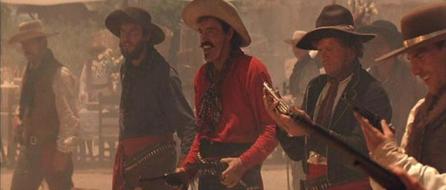
In a previous post, we presented a brief overview of the sack coat/sack suit during the late 19th Century. In the course of writing that post, it prompted us to think about men’s clothing in the American West and especially how the reality often differs from the image that’s been created through film and television. It has been often noted that the 19th Century was a much more formal time than today and one’s clothing choices reflected one’s status and how one was regarded by their peers. While occupations such as laborers, cowboys, miners, farmers, and the like required rugged practical clothing, this did not mean that these individuals wanted to project a rough image to project to the world and when possible, more formal clothing was preferred. The idea of “keeping it real” was an alien one and would have made little sense to the average 19th Century man.

Here are several interpretations of the same events/people:

Tombstone-Val-Kilmer-Sam-Elliott-Bill-Paxton-Kurt-Russell

Gunfight-at-the-OK-Corral-2

Clanton Gang

As a bit of a corrective, below are some pictures of “real people” of the American West. While it’s obvious that many of these people sitting for these pictures had dressed themselves up for the camera, the fact that they DID speaks volumes. Clearly, social convention and a desire to portray oneself to the best advantage played a major role here.

To begin, here are some pictures of some famous people, as they really looked:  🙂

Earp1

Wyatt Earp

Bat_Masterson_1879

Bat Masterson, 1879

Lawmen Dodge City

Original photograph of the ‘Dodge City Peace Commission’ in June 1883. Front, l-r; Chas. E. Bassett, Wyatt S. Earp, Frank McLain, and Neil Brown. Back, l-r; W. H. Harris, Luke Short, W. B. Bat Masterson, and W. F. Petillon. This is the version with Petillon beside Masterson. Ford County Historical Society, Dodge City, Kansas

IkeClanton4125

Ike Clanton

Pat Garrett

Pat Garrett

Curley Bill Brocious

Curley Bill Brocious- One of the only known portraits.

Lawmen1

But lawmen and outlaws are only one aspect, there were also others:

xt7.jpg

Cowboys, John Slaughter Ranch

Cowboys_1880

Cowboys, c. 1880

This is only a small sampling but we think it conveys the basic idea that there’s definitely a bit of a difference between what actually existed and what we THINK existed. Of course, this has been an issue ever since the first Western was ever filmed but it still bears consideration in that in order to gain a better historical understanding, we need to keep the two separate.

We hope you’ve enjoyed this little side-trip into the West and we want to make it perfectly clear that we’re not denigrating the costuming found in movies versus reality- we know that they can be be vastly different with different goals- rather, we’re only pointing out that all too often, people tend to use film and television as a substitute for solid historical evidence. Each has its place but let’s not confuse the two. At least, that’s out take on it. 🙂


A Brief View Of Men’s Clothing- The Sack Coat

Over the years we have been asked about making men’s clothing. While we are naturally flattered by the prospect of creating more period clothing designs from the late 19th Century, we have had to politely refuse on the grounds that it’s not our main business focus. More importantly, men’s clothing calls for a skill set- primarily tailoring- that is different from those used for women’s clothing. While there is some overlap (Redfern and especially with tailor-mades for women), it’s very much a separate speciality and we would argue that it’s an art form with a rich set of traditions that are not easily mastered. Well tailored clothes are a joy to behold and just the words “Savile Row” sets our hearts racing.

All hyperbole aside, we have chosen to restrict ourselves to the female side of historic clothing simply because if we made both types of clothing, we could not do justice to either. With that said, we would still like to present our views on the men’s side of clothing so from time to time we will be posting articles here covering various topics of men’s clothing and accessories. We would you enjoy our occasional series. 🙂


So, where to begin? Probably the best place to begin is with the sack coat/sack suit which gradually developed into the dominant style for men’s daywear during the late 19th Century, supplanting the earlier frock coat and the derivative morning coat. The sack coat/suit and the frock coat. The sack coat was meant for informal day wear while the frock coat/morning coat were reserved for more formal occasions (although there was often a lot of overlap between the two).

Styles1

The sack suit, or lounge suit as it was termed in Great Britain, originated in France as the sacque coat during the 1840s and took its name from the way it was cut (contrary to popular belief, the sack coat did NOT get its name from its loose fit “like a sack”). In contrast to the more elaborate frock coat whose back was constructed from four basic pieces, the sacque coat was simplified, consisting of two basic pieces. Moreover, the sack coat was designed to fit loosely.

EPSON scanner image

Sack coats usually had three or four button holes and often it was worn buttoned only at the top. In terms of colors and fabrics, wool of various weights was the predominant fabric although linen was often used for lighter weight coats intended for wear in more warmer climates. In terms of colors, they could range from solids to plaids, stripes, and checks. However, towards the end of the 19th Century, the dominant style increasingly were darker, sober colors such as charcoal gray, black, brown, and navy blue. Often they were accompanied by a matching pair of trousers and waistcoat, thus creating the three-piece suit. At the same time, the sack coat and trousers could be in different colors and fabrics. Below are some examples:

To start, here’s an image of an early sack coat from c. 1863 – 1864:

Sack Suit - Early

Sack Suit, c. 1863 – 1864

image002

Three men wearing sack coats, c. 1860s; Image from Joan L. Severa, Dressed for the Photographer: Ordinary Americans and Fashion, 1840-1900, 1995

The second image really shows up just how loose-fitting sack coats were in the 1860s, especially with the coat worn by the man with his back to the camera. This is in contrast to the 1880s, 90s, and early 1900s where the coats (and accompanying trousers) become increasingly more narrowly-fitted and cut closer to the body.

In the next image, we have one from 1870:

WaterfallsAugust1870

The West End Gazette, August 1870

The coat still hangs relatively loose but the trousers are gradually becoming cut more narrow.

6b240ed1262cafce380e8ea797cd11bd

Sack Suit

Sack Suit, British, c. 1875 – 1880

A bit on the loud side, the use of loud fabrics steadily diminished during the late 19th Century. Sack suits could be made from linen as well as wool as with this suit that was intended for wear in warmer weather:

Sack Suit4

Sack Suit, c. 1885 – 1900; McCord Museum (M973.137.4.2)


67acfb2bc992f7bf2d46bb64708b8470

Sack Suit2

5d85a31e84b3aab23b71775fd36cf71c

Sack Suit, c. 1895

Sack Suit3

Sack Suit, c. 1911; Los Angeles County Museum of Art

The above picture depicts the ultimate development of the sack suit and it’s easy to see that the modern business suit was not far off in the future.

During the late 19th Century, the sack suit became the standard “uniform” for anyone aspiring to a degree of respectability and especially those involved in business and the professions. In fact, it could be argued that the sack suit was instrumental in democratizing clothing in that it allowed any man to look like someone substantial and respectable. The sack suit was relatively cheap which had been made possible by industrialization and the development of the ready-made garment industry in America and Great Britain.

In conclusion, we would argue that if you are looking for that “one” outfit that accurately symbolizes the 19th Century man, it would have to be the sack suit. While fashion choices were often dictated by social and economic factors, it would be safe to say that the sack suit was the “default” outfit to be worn wherever possible- the sack suit symbolized respectability and social status. Even the laborer, miner, cowboy, and farmer wore sack suits when the occasion demanded and they had the means. In contrast with today’s emphasis on casual wear, dressing up was considered essential to showing one’s better side and more importantly, securing respect from one’s peers. Naturally, the above is a broad generalization but it does go a long way towards capturing the zeitgeist or spirit of the time.