It Never Snows In Tombstone…

Official seal of Tombstone

When people think of Tombstone, Arizona they tend to envision it as a hot, sweaty desert town whose only claim to fame is that it was host to a 30 second gunfight. Nothing could be further from the truth (well, except for the gunfight part)…

Actually, because of its elevation at 4500 feet, Tombstone escapes most of the searing summer heat that makes Tucson and Phoenix veritable ovens with temperatures often getting over 100℉- in contrast, Tombstone usually stays in the mid 90s. More importantly, the Arizona Monsoon Season brings rain on almost a daily basis to Southeastern Arizona and the desert vegetation is almost all green (also, believe it or not, Tombstone has an extensive water table and it was flooding in the mines that ultimately led to the downfall of mining industry there).

And finally, it actually SNOWS in Tombstone- yes, you heard it, snows! Now granted, it’s not usually much but it does and every year when we go out for New Years, we always hope for a white New Year’s but are usually disappointed. This year, we missed it by three days:

Tombstone_Snow2

Tombstone_Snow3

Also, just for a little trivia, for the past two Helldorado Days events (held in mid-October each year) it’s actually hailed…and on the day of that famous gunfight at the OK Corral (October 26, 1881), there were actually snow flurries…go figure!

Anyway, there you have it- to a white New Year’s Day!  🙂

Close Up – The Early 1890s

Lately, we’ve been bombarding you with fashion plates of the early 1890s along with our commentary so today we’re going to take a slight break and try to present some detailed images of actual dresses. Some of these have appeared in previous posts, others are new to the blog. It’s very easy to get lost in the details while losing sight of the overall picture- it’s sort of like the old expression about seeing the forest from the trees. Some key elements to look for when classifying garments as to style and time frame are:

  • Silhouette- What basic shape is the garment or dress (since that is mostly what we are dealing with)? The easiest characteristic to look for is the bustle- is there one? Maybe a vestigial one? Does it have a sharp, shelf-like appearance or is it softer?
  • Skirt- Is it straight or does it have a train? Many formal dresses has some sort of a train, usually extending out from the bottom of the dress (for example the “fan train” or “mermaid tail” commonly found with Mid-Bustle dress designs). Is there just one skirt or a combination over and underskirt?
  • Bodice- Is there just a single bodice or is it a combination of an outer bodice/jacket and an under bodice/vest? Are the sleeve caps extended or blend in with the bodice body? The leg-of-mutton sleeve is an extreme case of this and reaches its height during the 1895 – 1897 time frame (although there were always exceptions).
  • Fabrics- What is the basic fashion fabric? Wool? Silk? Cotton? Some sort of a combination? Woolens were very common for day dresses and especially those meant to be more “practical” such as with the house dress. Cashmere was (and still is) a better grade of wool and of course, silk was used for more finer dresses for wear in public or for some sort of social event. China silk, dupioni, shantung, taffeta, faille, and bengaline were some of the more popular choices for silk fabrics. Brocades and velvets were also employed although often only as contract fabrics. There was a wide variety of yardage used and one could easily write a book on it.
  • Trims- What sort of trim is there? Knife-pleated fabric along the hemline? Netting? Embroidery? Buttons? The possibilities are almost endless.

The above is only a very cursory review but those are some of the things to consider, especially if one is designing their own dress or simply classify a dress. Below are some examples of extant garments from the early 1890s that should give a better idea of what to look for:

media

Wedding Dress, 1891; Minnesota Historical Society (9444.10.A,B)

media (1)

Side View

The above was made as a wedding dress and has provenance as such but it also illustrates one of the more typical day dress styles that are characteristic of the period. This dress was obviously meant to worn in public and could have been used for visiting or as a dress to be worn at home to receive visitors; the beadwork gives it a simple elegance. Style-wise, we see that the bodice is acting as a jacket (somewhat) and some sort of shirt-waist or vest was worn underneath (the display mannequin just has some black velvet filler).

Here is another example of a day dress although a bit more elaborate:

CI55.40.1ab_F

Day Dress, c. 1887 – 1891; Metropolitan Museum of Art (C.I.55.40.1a, b, e)

CI55.40.1ab_d

Close-Up

CI55.40.1a_d

This is clearly a much more fancy dress than the first one but it does share the same over-bodice/jacket style. If you look at the top two pictures carefully, you can see that the fashion fabric is a light brown faille or taffeta. The fabric lining the inside of the collar and trimming each side of the bodice appears to be a peach-colored chiffon and it acts as a contrast to better show off the beading.

504083D

Day Dress, c. 1891, attributed to Mme. Lambele de St. Omer, No.30 E. 21st St, New York; Smith College Clothing Collection (1985.5.4ab)

504084D

Above is an ornate visiting or reception dress that utilizes a combination of rust-colored silk faille, rust/gold brocade, and a claret-colored velvet. The brocade overskirt skirt is covered with rust-colored silk tails leading down from the bodice/jacket and underneath is a matching silk underskirt. The bodice is styled as a jacket, suggestive of a bolero with its high sleeve caps and wide lapels/revers. The sleeves are made of velvet and contrast with rust-colored silk on the rest of the jacket/bodice. The vest is also made of a rust-colored silk. Finally, it must be noted that the skirt does have a small bustle made of spring steel.

Besides the classic bolero style effect, we also see the overskirt being topped off with a waistband of the same brocade material giving the appearance of a sash wrapped several times around the waist, giving the effect of an obi found on a kimono. It is interesting that the brocade pattern runs at a 90 degree angle to the pattern on the skirt.

In the above three pictures, we have seen three very different dresses that still share come common style elements. In particular, each dress’s bodice is styled as more of a jacket than a true bodice and it continues a trend that stared in the 1880s and would culminate with the development of “tailormade” suits during the mid to late 1890s. While an under-bodice or vest was usually worn underneath, a shirtwaist could also be used.

Illustration for a pattern from Harper’s Bazar, 1892

Each of the above dresses attempts to utilize color and trim in different ways. The first dress is a mono-colored and uses the leaf-patterned embroidery to provide a contrast. The second dress uses two different colors- a light brown/khaki color as the base combined with peach-colored chiffon accents covered with elaborate beadwork. Finally, with the third dress, we see the use of three different colors (rust, claret, and gold) in three different fabrics to achieve its effect. The third dress is far more ambitious and it succeeds.

We hope that you have enjoyed this little side-trip into the early 1890s. In future posts, we will move our way into the mid-1890s with its signature over-the-top leg-of-mutton sleeves… 🙂


Trending For April 1890

In today’s post, we move into Springtime fashions and with the warming of the weather, comes a wider variety of styles as depicted in the April 1890 issue of Peterson’s Magazine:

Petersons_April 1890

Peterson’s Magazine, April 1890

Fig. I- RECEPTION-DRESS, OF SAPPHIRE-BLUE AND WHITE CHINA SILK. The skirt is bordered with a band of pale-gray silk, ornamented by six rows of narrow blue moiré ribbon; it opens upon the Side, over a kilt-plaited [pleated] panel of white silk. The short Spanish-jacket bodice opens over a full vest of the white silk. The revers. collar, cuffs, and border down the front of the vest are trimmed to match the border of the skirt. Elbow coat-sleeves, fulled at the shoulder. Large crocheted buttons of blue and gray ornament the bodice. This model will serve for a bordered nun’s veiling or gingham, with plain material for the side-panel and vest.

Fig. II- VISITING-DRESS, OF INDIAN RED SURAH, trimmed with black beaded net in stripes. This striped net is arranged upon the skirt to form a front and side panel. The skirt is slightly draped between the panels, with small panniers disposed over the hips; the back hands plain. The pointed bodice is fulled in front at the shoulders, trimmed with bands of the net and laps from right to left. The sleeves are formed of the red surah for the under, the black net filling up the outside part. Gypsy bonnet of black net, faced with red crêpe and trimmed with black wings. A bow of black velvet ornaments the inside of the brim.

Fig. III- VISITING DRESS, OF GRAY POPLINETTE, WITH A GAY PLAID BORDER. The underskirt of this gown has a wide kilt-plaiting 18 inches deep all around, set upon the foundation. The bordered material is disposed in drapery as seen in the illustration, the back forming a jabot at the right side. The bodice is pointed, back and front; the front being trimmed with the plaid border, first a piece crosswise to form the yoke, then plaited lengthwise into a point at the waist. Full sleeves into deep cuffs of the plaid. A dark-blue velvet waistband crosses in a point in front, fastening with a silver buckle. Sash-ends of the gray finish the bodice at the back. Gray straw hat, trimmed with ostrich-plumes. This model will be suitable for a bordered nun’s-veiling, light woolens, of gingham.

Fig. IV- CARRIAGE OR WALKING DRESS, OF MOSS GREEN CASHMERE, WITH STRIPED VELVET BODICE. The front of skirt and inside vest of this stylish gown are cut in one, the vest crossing and fastening with six small buttons. Under this is a full chemisette of surah to match. The skirt hangs straight all around, except where it laps in front; there it is slightly draped. The jacket-bodice of the striped velvet had the revers and cuffs faced with a peach-blossom colored corded silk, also the rolling collar of the inside vest. Hat of moss-green crêpe, faced with green and peach-color and trimmed with standing loops of green and peach-colored grosgrain ribbon.

Fig. V- VISITING DRESS, OF HELIOTROPE PLAIN AND BROCADE SILK. The front of underskirt, vest, and sleeves are of the brocade, while the polonaise overdress is of the plain taffeta. The front part of the bodice is slashed at the side-darks and forms the long sash-ends which pass under the waistband. The edge of the over-dress is bordered with a wide band of moiré, the cuffs are the same. Hat of straw, trimmed with white daisies and loops of ribbon matching the costume.

The reception dress in Figure I features an over-bodice/jacket and vest combination with the over-bodice and over-skirt constructed of a sapphire-colored China silk. The underskirt and vest consist of a contrasting pleated white China silk . The overskirt is trimmed along the edges in a wide stripe of  light gray silk with six narrow rows of  blue moire. The various style details make for an interesting effect but unfortunately, the smallness of the plate obscures much of the described detail. Also of note is that the overskirt opens to the side rather than the front. The sleeves are full and at the top there are small kick-outs. Interestingly enough, the over-bodice/jacket is described as a “Spanish jacket” and the revers on the jacket also contain the same blue silk more stripes.

Sapphire Color Palette


Navy Blue Silk More Fabric

The visiting dress in Figure II makes for an interesting contrast in that we see an Indian red surah (well, maybe more of a claret) for the base fashion fabric. The skirt and bodice are trimmed with black beaded net in stripes and they also run down each arm. Also, the beaded net stripes serve to create a series of alternating black and red stripes on the skirt. The Indian red in Figure II projects warmth compared to the cold sapphire blue of Figure I.

Indian Red Surah Fabric- This is somewhat lighter than what is depicted in Figure II but there are matters of light and the age of the plate to consider.

Claret – Reconstructed on computer

Figure III features a Visiting Dress with a gray poplinette overskirt trimmed with plaid border. The underskirt is also a gray poplinette and is pleated. The bodice is also made of matching gray poplinette with the front and deep cuffs trimmed with the same plaid fabric. Finally, although it is hard to see, there is also a blue velvet waistband secured with a buckle. Overall, from a style perspective, this dress is a confusing mishmash of elements, especially with the plaid, and as such this is not a good style.

The moss-green cashmere carriage/walking dress in Figure IV provides a welcome relieve to Figure III with its straight pleated skirt. The skirt front and vest/under-bodice are cut as one (it would be interesting to see the pattern for this) with a matching surah chemisette underneath. The jacket/bodice is made of striped velvet with the revers, cuffs, inside of the rolling collar all faced with a peach-blossom colored corded silk. Unfortunately, the faded plate does not do justice to the given description- it must have made for a nice effect.

Peach – Reconstructed on Computer

Moss Green – Reconstructed on Computer

Finally, the visiting dress in Figure V is impressive with the use of a heliotrope-colored silk taffeta polonaise overdress combined with a silk floral brocade underskirt front (a plain fabric would have been used on the non-visible portion of the underskirt) and sleeves. The color in the plate is more of a lavender but the plate is over 100 years old so who knows? 🙂

Heliotrope – Reconstructed on Computer

More Heliotrope – Also Reconstructed on Computer

The styles in the above plate are of varying quality and while it is interesting to note that plaids seemed to have been making a come-back in fashion, the style depicted above in Figure IV just does not show plaid at its best. Well, as with everything, you can’t have a winner all the time and such is the case with fashion. 🙂


Trending for March 1890

Today we begin to move towards spring and that means more dress styles…below are the selections from the March 1890 issue of Peterson’s Magazine:

Petersons_March 1890

Peterson’s Magazine, March 1890

Fig. I- WALKING DRESS, OF GRAY SERGE. The skirt is laid in wide plaits [pleats] and falls in straight lines; plain bodice, forming a vest under the brown cloth jacket-bodice, which fits well over the hips; the rolling collar and cuffs are finished with bands of braid. Hat of brown felt, trimmed with loops of red and pale yellow ribbon.

Fig. II- VISITING-DRESS, FOR LIGHT MOURNING. The skirt is of black cashmere, trimmed on either side with bands of passementerie; it opens in front, at the sides and back, over a plaited black silk skirt. The bodice has collars and revers of the passementerie opening over a plaited black silk vest. Hat of black felt, trimmed with black silk loops.

Fig. III- WALKING-DRESS, OF GREEN PLAID AND PLAIN WOOLEN MATERIAL. The skirt is of the plaid and is without looping. The over-skirt is of the plain woolen, quite short at the back, where it is looped under, also short at the right side, but long on the left side. The bodice is round, with a belt of the plain material, and opens over a bias vest of the plaid pointed tabs of the plaid meet the fullness of front of the bodice. Hat of black felt, trimmed with a wreath of green leaves; butterfly-bow under the brim.

Fig. IV- HOUSE-DRESS, OF SULPHUR-COLORED NUN’S VEILING. The demi-train is trimmed with a pinked ruching of black-silk. The front of the dress is figured in black, and at the sides are four rows of deep black fringe. The bodice is of the plain material, with a Spanish jacket of black silk, trimmed with passementerie. Sleeve reaching to the elbow, with black silk cuffs.

Fig. V- VISITING DRESS, OF LILAC HENRIETTA-CLOTH. The skirt is plain, the bodice round and worn with a waistband of black ribbon, with long loops and ends. The capes are composed of two shades of Henrietta-cloth, and the small hat is of the same material.

The walking dress in Figure I, is a solid, basic day dress style. Constructed of a gray wool serge, the skirt has wide pleats which fall in smooth lines. There may be a minimal bustle pad, judging from the lines of the dress, or it may simply be created by the corset (or by the artist seeking to set down the ideal silhouette). Whatever may the case may be, it is evident that a slender, cylindrical silhouette is favored.

The bodice is made from a brown “cloth” (presumably wool of some type) and is constructed with a low neckline which displays the under-bodice or vest to its full advantage. From the plate, it would appear that the under-bodice is also made of gray wool serge but with the coloring of the plate, it’s hard to tell (no doubt because of its age).

The visiting dress for light mourning dress in Figure II is somewhat more elaborate but it maintains a similar line to the dress in Figure I. The over-skirt is made from a black cashmere trimmed in front with bands of black passementerie and it opens in front to reveal an underskirt of pleated black silk.

The over-bodice, or jacket, is also constructed of black cashmere and it opens to reveal an under-bodice made from the same pleated black silk. The over-bodice is also trimmed with black passementerie. For a dress meant for light mourning, it is very stylish and meant to be seen in public.

The walking dress in Figure III provides a contrast to Figure II with its light green wool combined with a complementary green plaid. The dress silhouette is identical  to those in Figures I and II although this one features full over and under-skirts. The overskirt is made from a plain green wool and it is draped asymmetrically over a green plaid underskirt.

The over -bodice is of a matching plain green wool and as with Figures I and II, it opens up to reveal an under-bodice/vest made of the same plaid as the underskirt only it is cut on the bias with the plaid stripes running at 45 degree angles. Definitely an imaginative use of the plaid and it looks a lot better than if was cut the same as the under-skirt.

Figure IV shows a house dress that appears a bit on the more formal side. The skirt is made from a patterned sulphur-colored nun’s veiling (or cloth) trimmed with pinked ruching. The under-bodice is of the same sulphur-colored nun’s veiling and a black wool Spanish jacket, or bolero, is worn over it.

WIth Figure V, we see a lilac-colored visiting dress made from Henrietta cloth with a long sash tied at the waist, creating a girdle that is reminiscent of Medieval styles. The figure is depicted with a short cape, or capelet, also made of Henrietta cloth, in complementary shades of lilac and it is difficult to determine much about the details of the dress itself.

Named for Henrietta Maria, the French consort of Charles I of England, Henrietta cloth was a twill weave cloth with silk warp yarns and worsted wool weft yarns. It had a soft hand, similar to cashmere and  a moderate luster. Henrietta cloth was traditionally associated with mourning and as such was dyed black although it was also dyed in other colors for non-mourning use, such as the dress in Figure V. Today, Henrietta cloth is no longer made.
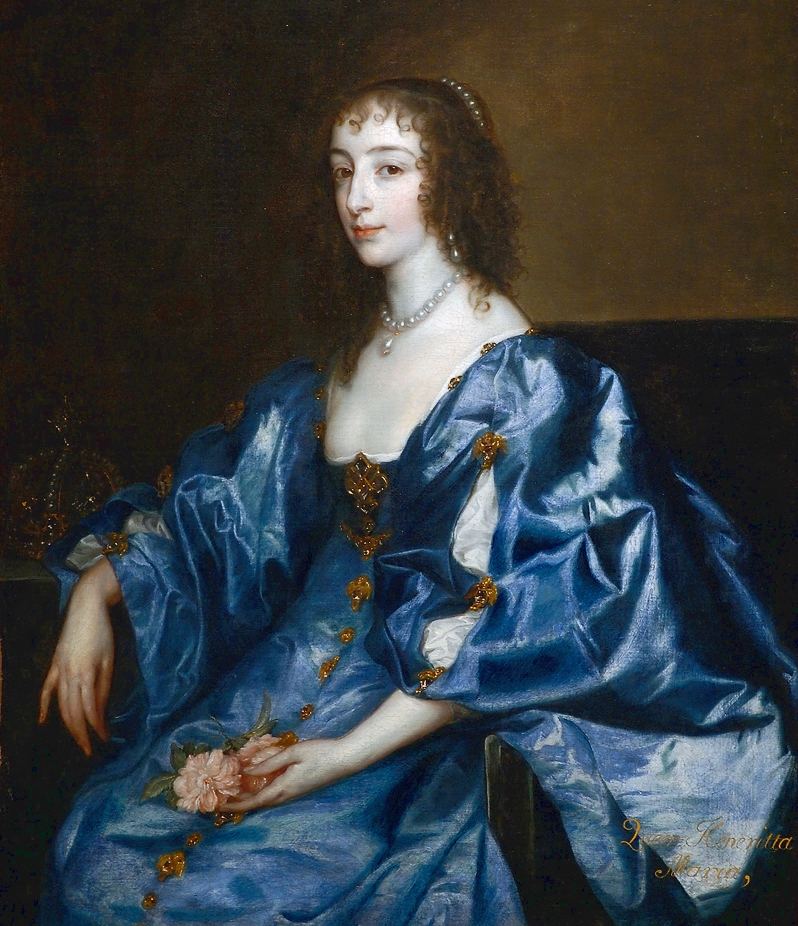
Henrietta Maria, Queen Consort to Charles I, 1609 – 1669

Mourning Dress, Ladies’ Home Journal, August, 1891

The layered capelet makes for an interesting piece of coordinating outerwear. Capes/caplets/mantles were popular during the 1890s and came in different lengths. A wide variety of materials were used ranging from wool to lac. Shorter versions were especially popular and we have included a few examples:

Capelet or Mantle, c. 1890

Augusta Auctions, April 17, 2013 - NYC, Lot 209: "Battenburg Lace Capelet", 1890s Tape lace capelet, high stand collar, gold bullion trim, silk lining (damaged) very good.:

Lace Capelet With Gold Bullion Trim and Silk Lining, c. 1890s

1993.426_F

Cape, French, c. 1890s; Metropolitan Museum of Art (1993.426)

From the dresses illustrated in the above plate and ones looked at in previous posts, it should be pretty obvious that the outer-bodice/under-bodice/vest combination was a fairly prominent style and that a wide variety of materials and trims were used. One could easily get lost in all the variations and colors so one needs to keep in mind the idea of context. By context, we mean what was the dresses function and when and where was the dress worn? Needless to say, fashion plates focus on an ideal figure with everything optimized so we should always take things with a grain of salt. However, by the 1890s, photography had developed to the point where it was possible to get images that were exceedingly detailed so this can also be used for a guide.

We will be documenting further developments in 1890s fashion so stay tuned! 🙂