From The Atelier…It’s All About Couture

In recent months we have been working furiously to complete our orders while at the same time create new designs for the future which includes constructing gorgeous gowns for our Lily Absinthe line. Recently, we have been working on several bridal commissions and we have been documenting the results to share with our readers and clients, past and future.

Pose de garnitures dans l'atelier de Worth, grand couturier parisien. Paris, 1907.

Atelier Worth, Paris, 1907.

At this time, we want to take this moment to clearly state that we carry a full line of historically-based fashions of which bridal is only one element. If it appears that making bridal wear is all we do, nothing could be further from the truth. We look at 19th and early 20th Century fashion as a whole because it is all interrelated. Whether it’s corsetry and underpinnings, day dresses, evening wear, or bridals, we do it all and we do it with the finest workmanship and materials, based on our own designs and patterns. When we create a garment for you, it’s a one-of-a-kind that’s been constructed for you the individual based on your needs and requirements. In short, we turn dreams into reality and we do everything to ensure that the process is a pleasure.

Heart-clutching waterfalls of taffeta ruffles on our petticoats that make our gowns come to life. 🙂

We are not a mass-production operation nor do we ever intend to be one- we leave that to others. What we offer is one-on-one service: to put it another way, we are everything that couture is all about.

Ruffles2

Also, whether it’s just one person or a group, we have the resources and expertise and we have extensive experience in productions both big and small. We oversee all details from start to finish and nothing is left to chance.

Let us create something for you- bridal or otherwise. Be the Fashion Card on the Promenade in your Lily Absinthe Gown <3

A Brief Look At Wedding Dresses Of The 1870s

When we think of a wedding dress today, we usually envision a bright eggshell white dress trimmed with lace. However, this has not always been the case and this was especially true during the 19th Century; the concept of an all-white dress solely dedicated to being used on only the wedding day was relatively limited to the more wealthy women because of the expense. The reality was that wedding dresses came in a variety of colors and styles, often dictated by finances, availability of materials, and location. In many instances, the wedding dress was simply a woman’s “best dress” and was worn on formal occasions long after the wedding itself.

Wedding Dress1

The color white has not always been associated with weddings per se in Western culture although is has been associated with purity. For example, during the Middle Ages, white was actually considered the color of mourning. During the 19th Century, the association of white with weddings (e.g., white weddings) is said to have begun with Queen Victoria’s marriage to Prince Albert on February 10, 1840 when Victoria wore a white (or more properly a cream-colored) wedding gown. In regard to the dress, Queen Victoria wrote in her diary:

I wore a white satin dress, with a deep flounce of Honiton lace, an imitation of an old design. My jewels were my Turkish diamond necklace & earrings & dear Albert’s beautiful sapphire brooch.

With Queen Victoria’s choice of a white wedding gown, a trend was started (at least among the more wealth) which slowly developed over the remainder of the 19th Century. In regard to this trend, the August 1849 edition (page 440) of Godey’s Lady’s Book stated that:

Custom has decided, from the earliest ages, that white is the most fitting hue, whatever may be the material. It is an emblem of the purity and innocence of girlhood, and the unsullied heart she now yields to the chosen one.

We have now come to that subject which is said to engross the thoughts of a young lady from the time she comes out until she is married. The choice of a wedding dress!

Custom has decided, from the earliest ages, that white is the most fitting hue, whatever may be the material. It is an emblem of the purity and innocence of girlhood, and the unsullied heart she now yields to the chosen one. Now and then a fashion of light silks or satins comes in vogue, but is not generally adopted. White, then, let it be, if it is the simple muslin of the pretty country girl, who needs no foreign ornament, or the satin and Brussels lace, or the silver brocade of a Parisian countess. This, be it understood, if one is married at home. Of late, it has been quite common to be married in a traveling dress, and have the same tears shed for the ceremony among the bride’s friends, answer for the parting. A bridal tour being considered, by some ladies, quite as indispensable as a wedding ring.

Below are some examples of wedding dresses as depicted in fashion plates. Although the plates coloring depicts the dresses in pure white, in reality, the color chosen was often more of a cream or ivory.

The Englishwoman’s Domestic Magazine, November 1875.

Magasin Des Demoiselles, 1876

Turning to the dresses themselves, here is one example of a late 1870s wedding dress:

Wedding Dress, c. 1878; Los Angeles County Museum of Art (M.83.231.20a-b)

Wedding Dress, c. 1878; Los Angeles County Museum of Art (M.83.231.20a-b)

Allowing for age and museum lighting, the color of the dress is of a shade of off-white, especially when compared to the accompanying veil.

Below is an interesting wedding dress dated from 1874 that done in a polonaise style in a silk gauze:

2010EE5537_jpg_l

Wedding Dress, English, 1874; Victoria & Albert Museum ( T.68 to E-1962)

2010EE5609_jpg_l

2010EE5536_jpg_l

The above dress belongs to the collection of the Victoria and Albert Museum and according to the Museum website, the bride that originally wore this dress was Lucretia Crouch, who married Benjamin Seebohm at the Friend’s Meeting House in Clevedon, 10 September 1874.  Both the bride and groom were Quakers who, as a rule, favored mainstream styles of clothing at this time.

The dress itself was made of a cream-colored silk gauze with narrow narrow opaque stripes and trimmed with cream silk embroidered net lace. A three-quarters length bodice with flared sleeves and attached draped polonaise overskirt bordered with lace. The bodice fastens with hooks and eyes in the centre front and with a ‘V’ neck. The underskirt is full-length and is constructed from the same silk gauze edged with three flounces of lace with edges of lace attachment to the bodice and skirt of silk satin rouleaux, and an additional row of rouleaux on the sleeve edges. The bodice front and polonaise overskirt are trimmed with silk satin ribbon bows. There is also a belt sash of silk satin lined with cream silk which has a fastener in the center front that is camouflaged with a satin bow. Finally, a large silk gauze and net lace bow supported with a stiff cotton gauze interlining and is attached to the back of the belt.

Now on the flip side, consider this:

Chicago1

Wedding Dress, 1874; Chicago History Museum (1946.31a-d)

Chicago2

Chicago3

Chicago4

This dress is constructed of a green silk taffeta and was worn by  by Mrs. Robert S. Elder, née Harriet Newell Dewey, mother of the donors of the dress, to her wedding in 1874. What is nice about the above example is that the provenance of the dress is firm and as such, it does demonstrate that other colors were used, even while the trend towards white was gaining momentum.

Here is another example of a wedding dress from 1879:

Wedding Dress, 1879; from antiquedress.com

bustlebluewhiteightsevtyupp  bustlebluewhiteightsevtysd

bustlebluewhiteightsevtytll

This dress style is in a princess line constructed of silk featuring two contrasting colors, blue and white. If you look closely at the pictures, the white portions appear to be of a silk damask (the detail shows up best on the sleeve). This style is characteristic of the late 1870s with a minimal bustle although it still has a train.

The provenance of this dress is excellent (I double-checked it on Ancestry.com), it was worn by a Hattie Ray (nee Pagin) at her wedding to Hugh G. Ray on June 5, 1879 in Frankville Township , Winneshiek County, Iowa. There is no doubt that this dress was a more practical style of wedding dress that was suitable for wear as a “best dress.”

Here is a dress from 1872 that is interesting in that while it’s a wedding dress, it’s a relatively simple one with somewhat minimal trim. Yes, it’s still pretty busy by today’s standards but by the standards of the 1870s, not so much. 🙂

35.78.1ab_F

Wedding Dress, 1872; Metropolitan Museum of Art (35.78.1a, b)

35.78.1ab_B

35.78.1ab_S (1)

35.78.1ab_S

The above dress is relatively restrained compared to regular day dresses of the early 1870s and the train is fairly simple. Probably the greatest extravagance is the fringe running along the mid-front of the dress and flowers.

Below are two more examples, one from 1878 – 1879 and the other from 1880. Both of them are interesting in the use of asymmetrical trim and especially the 1880 dress.

Wedding Dress, c. 1878 – 1879; Metropolitan Museum of Art (1979.339.2)

Close-Up of the hem/guard.

34.95.1_F

Wedding Dress, 1880; Metropolitan Museum of Art (34.95.1)

34.95.1_B

34.95.1_d

Close-Up

While an all-white wedding dress was considered to be the ideal, it’s evident that wedding dresses of other colors were used, either by themselves or combined with white. However, it as a trend, the all-white wedding dress was gaining ground and especially since it was a status symbol. Weddings have traditionally been more than just a ceremony to mark the start of a formal relationship, it was also an occasion for families to display their status and respectability, concepts which were of the utmost importance to Victorians. The wedding ceremony, and the wedding dress by extension, were essential to the family and the bride demonstrating that they were respectable elements of society. Granted, this was the ideal but it was a major driver of social behaviors.

Finally, the development of the wedding dress is a prime example of how fashions have been traditionally transmitted, starting with those of higher social stature (such as Queen Victoria) and then slow spreading downward in society. In the case of America, while it often stated that it was a less structured society with much social mobility, when it came to fashion the same situation applied only with industrialists and businessmen taking the places of aristocrats (ok, that’s a broad oversimplification but it works here).

Wedding Dress_1875_1

Wedding Dress, 1875

So, on a more practical level, if one is searching for recreating a wedding dress from the late 19th Century, there are a wide variety of choices that are available and one does not have to settle for some shade of white. Also, in terms of style, one has choices in that a day dress, evening dress, or even ball gown style can be adapted for use.

Wedding Dress_1871_1

Wedding Dress, 1871; The rug certainly adds an interesting ambience to the picture.

We hope you have enjoyed this brief overview and stay tuned for further installments taking wedding gowns into the the 1880s and 1890s.


Update From The Atelier

FB_IMG_1446676745536

Mac, our creative consultant.

It’s been another busy and creative week here at Lily Absinthe and I am excited to say we moving forward with developing a series of new designs that include both historically-based as well as more contemporary designs. Also, we are in the process of developing some new sources of fabric that will give our new designs that added “punch”. Stay tuned for more developments in this department. 🙂

We are also proud to announce that we will be attending Costume College 2016, on July 28 – July 31, 2016 and we look forward to meeting many of our blog followers in person.

So it’s full speed ahead on into 2016!

Lily Absinthe Takes A Look At India During The British Raj

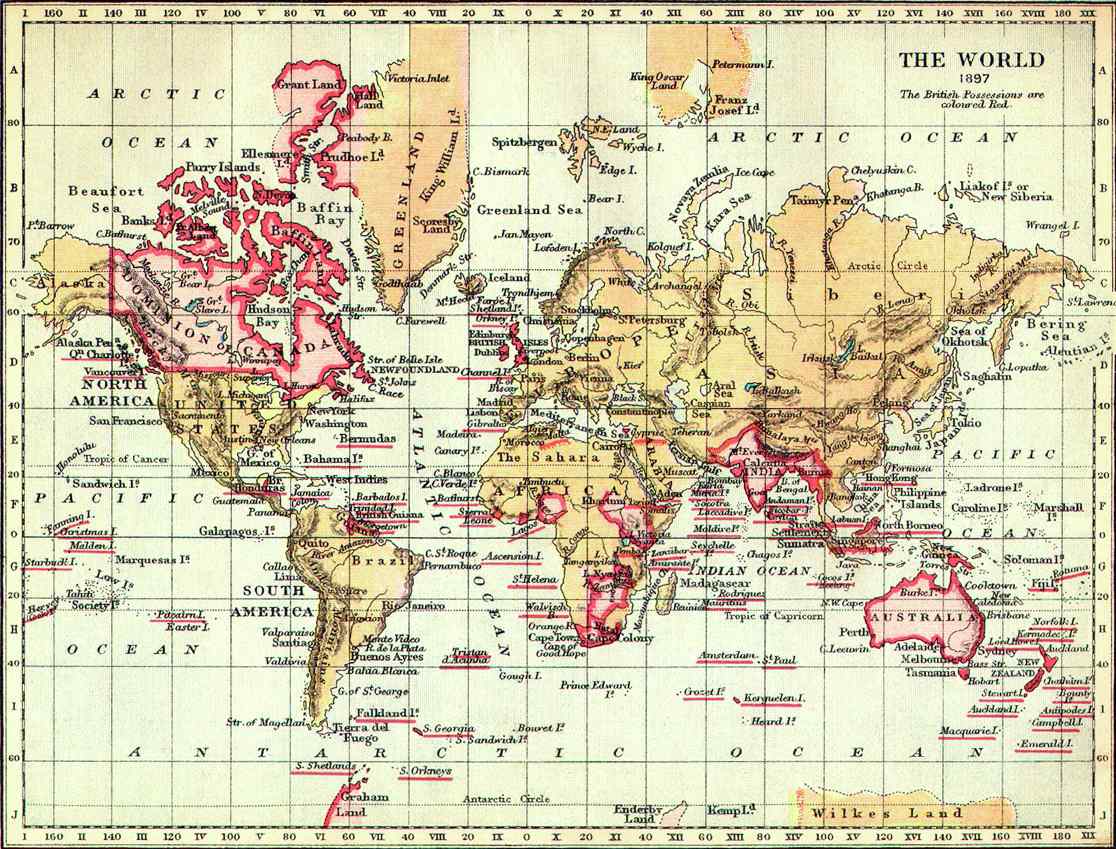
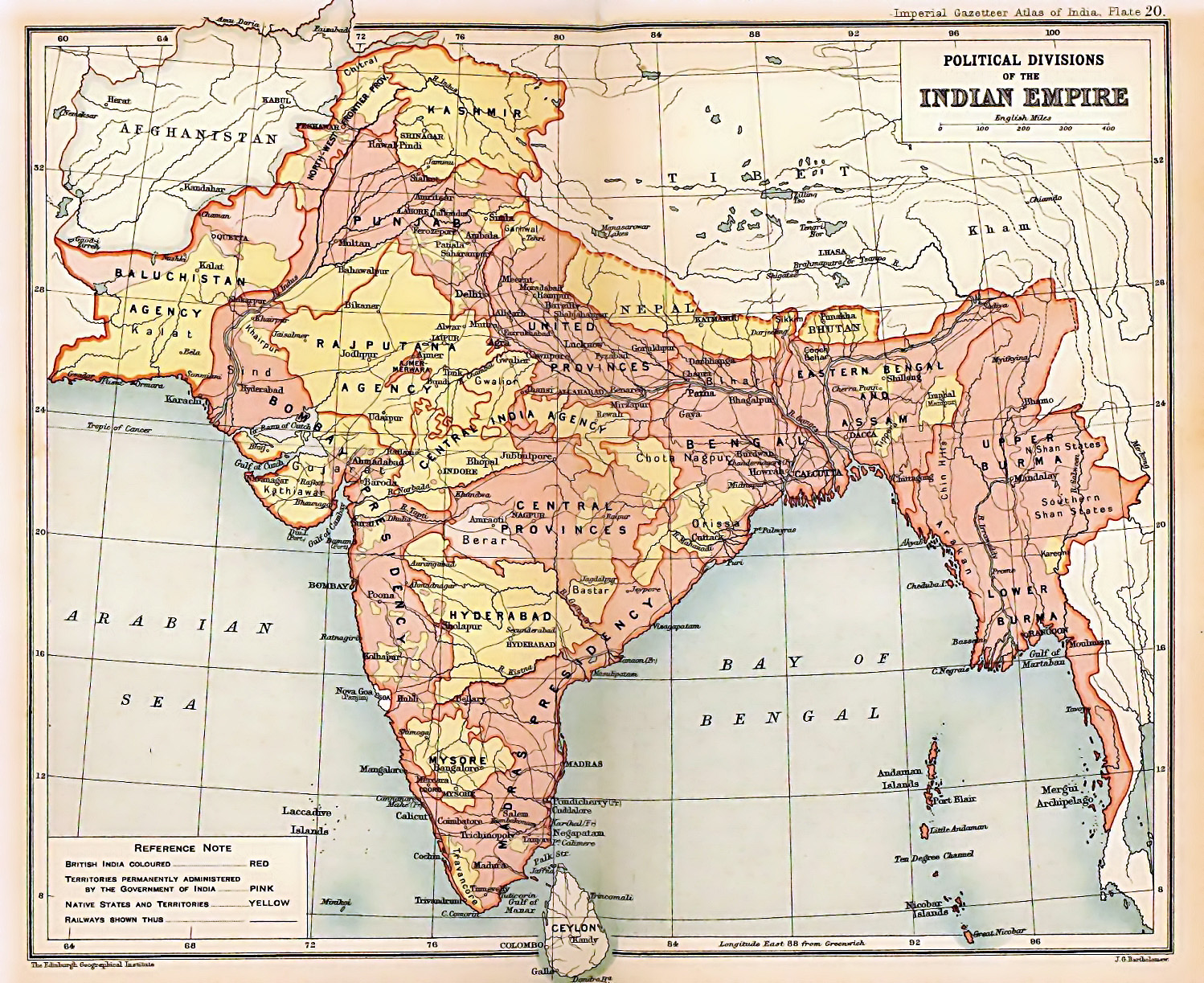
With the recent series Indian Summers on Masterpiece, our thoughts have turned towards the subcontinent of India and in particular that period of British rule commonly referred to as the British Raj or just Raj. In particular, we have been exploring the relationship between India and fashion during the  late 19th and early 20th Centuries. Composed of the present-day nations of India, Pakistan, and Bangladesh (and some other areas such as Oman and Sri Lanka at various times), British India was enormous in comparison with the United Kingdom itself: India had a land mass of approximately 1,893,179 square miles and a population of approximately 225 million (according to the first census taken in 1881). In comparison, the United Kingdom had a land mass of 120,832 square miles and a population of approximately 35 million (including Ireland).

Map of the British Empire, 1897.

Political Map Of British India, 1909.

But numbers alone do not tell the story. Culturally, “India” was a collection of various small states and territories populated by a variety of ethnic and racial groups following a variety of religions and  speaking many different languages. British India was the centerpiece of the British Empire and the effects of that relationship are still felt to this day and especially in the areas of food and fashion. However, during the period of British rule, the relationship between Indian and Britain was a complex one and had both positive and negative aspects. While the British were more than happy to make money trading for various Indian products, they were less enthusiastic about cross-cultural contacts.

c.1890's PHOTO INDIA TAJ MAHAL AGRA

Taj Mahal, Agra, c. 1890s

Basically, British racial attitudes of the time conditioned the relationship between ruler and ruled and this meant that while they ruled India, they did so in a distant manner, taking measures to maintain a distance, both culturally, socially, and even physically on occasion. These racial attitudes became especially hardened in the wake of the Sepoy Mutiny in 1857 – 1858 (or First War of Independence as it’s referred to in India) and the British ruled with the attitude they were were essential to India- without them the country would dissolve into anarchy that many characterized as a “bloodbath.”

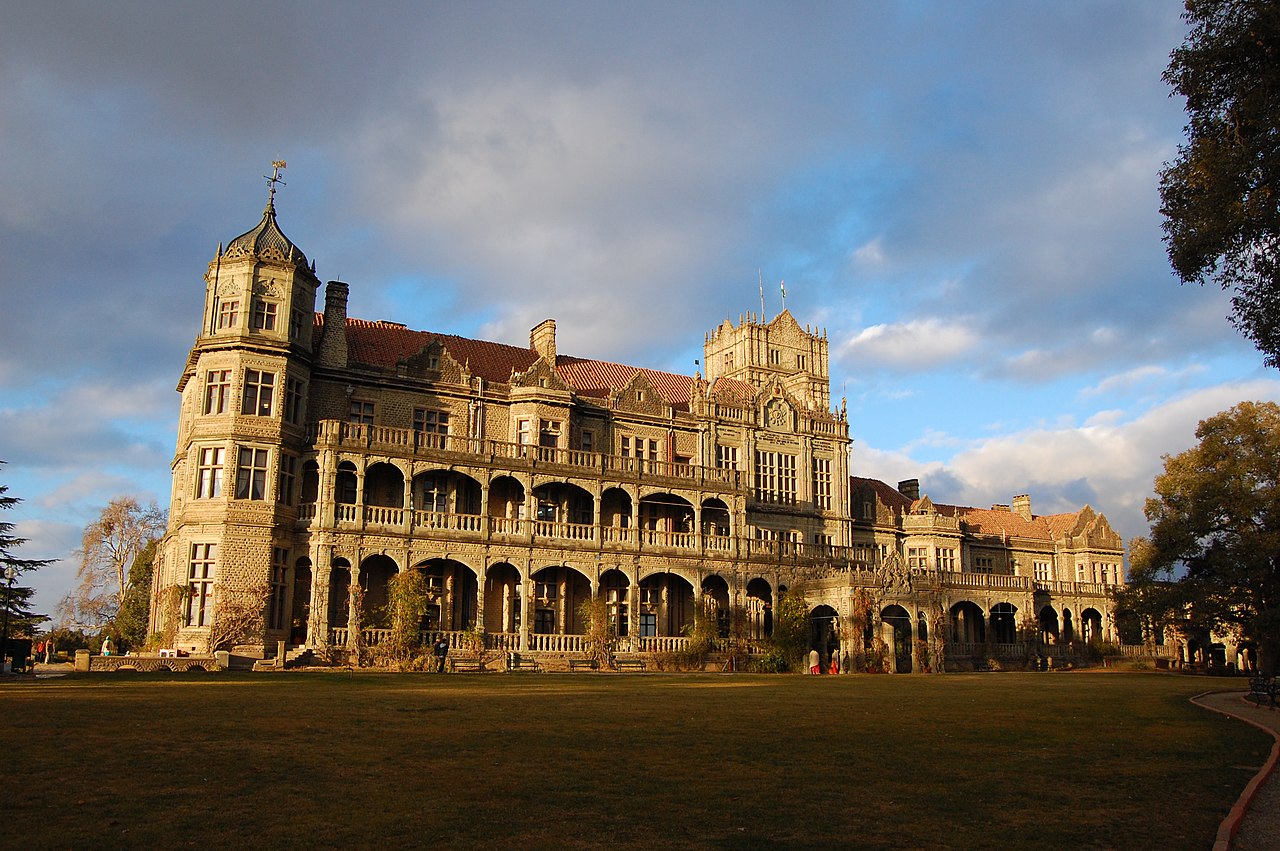
Culturally, this cultural and social distance was reflected in the manner of British settlement. Great efforts were made to recreate a slice of Britain and this was especially true in the case of Simla, a town located in the hills of northern India. The climate in Simla (referred to as Shimla today) was similar to that of England  and it was here in 1863 that the British decided to make it the summer capital of British India; twice yearly the entire government would move from Calcutta (Kolkata), over 1,000 miles away to escape the heat.

Viceregal Lodge, built in 1888. This was the summer residence of the Viceroy of India.

Viceregal Lodge, 1909

The Mall, Simla, c. 1880s

Turning to fashion during the Raj, here are a few views:

0dc0173d1357ac5296c43998f7dbdc7e

Judging by the sleeves on the women’s dresses, the above family picture appears to date from the early 1890s. This appears to be more of a formal portrait (except for the woman in the back who has an injured arm in a sling).

d0487d4a1fca1461c31a15c18af1ec10

The above picture appears to date from the 1890s and we see a light dress being worn by the woman on the left while a more full outfit is being worn by her companion.

Two British Women In Rickshaws - Ceylon (Sri Lanka) c1870's

The above picture also appears to date from the early 1890s. While it’s hard to arrive at any definite conclusions in regard to fabric or construction, it’s fair to say that the women’s outfits were probably lighter than what would be found at home in terms of fabrics. Interestingly enough, we see a variety of looks. On the right in the above picture, we see a shirtwaist/skirt combination being worn with her late 80’s flowerpot hat. The woman to the left is wearing a more fashionable 1890s gown.

696299449d402115899d536b5b5ec9f2

Couple and household servants.

The above picture is most likely from the early 1900s and here we see a shirtwaist/skirt combination.

1905_1

April, 1905

In the above picture we see the English mother in what appears to be a wrapper, a practical garment both for the climate and dealing with children. This would not be worn outside of the immediate household.

india_0001

in-india-rust

In the two above portraits, the subjects are unidentified but judging from the clothes, it appears that these two portraits were taken sometime in the late 1890s. These two women are fashionably dressed

What is interesting and not unexpected is that there does not appear to be any sort of a cultural crossover in terms of clothing, at least from Indian to British. This is an area that bears more study because it poses some interesting questions regarding the transfer of fashion between cultures. Compared to other places and times the social/cultural walls dividing ruler from ruled were high.

Some insight can be found by considering the nature of the Raj itself. Unlike more traditional empires, the Raj was not the result of an organized process of military conquest but rather a series of disjointed actions that occurred over a hundred years. Initially, the British came to trade in the guise of the East India Company. However, at the time they first arrived, there was a growing political vacuum as a result of the decline of the Mughal Empire during the 18th Century and gradually the British acquired increasing political power as they sought to reinforce their economic position.

The British were well aware that due to inferior numbers, they could not rule solely through military force, but rather they used a combination of political manipulation, economic power, and selective military action. As part of this, there was the idea of prestige, maintaining a superior position based on the idea of belonging to a superior race. As part of this process of maintaining prestige, women were viewed as an essential element and not only were they expected to be good wives and mothers, they were expected to personify all those traits that made the British a superior race. This also meant that wherever the British resided in India, it would be a transplanted piece of Great Britain (as much as possible) and this was reflected in places such as Simla.

And naturally, as fashion reflects society and culture, it followed that fashion worn by the British in India would replicate what was worn back home although the materials used were no doubt lighter and more suited to the warmer climate found in India. Also, many Indians connected with the Raj began to adopt Western dress.

The above is just a cursory, extremely simplified view of the Raj and there is naturally a lot more to it. However, what is striking to the casual viewed is that for the most part, the British in India existed in their own world, mostly apart from the Indians and interaction was severely limited except for a few “proper” channels, a situation that largely remained unchanged until 1948 when Indian and Pakistan became independent nations. However, it must be noted that the social situation was a lot more fluid in the early days during the 17th and 19th Centuries and the 1920s and 1930s.

rider-in-india

The Raj is long gone now and the world has moved on. We look upon the past with its riches in fascination but at the same time we know that there were aspects that are best left behind. However, at the same time, there is much that is worthwhile and for us, that serves as a driving force for what we do.

Sarah Bernhardt – A Different Look…Maybe…

On of the most famous actresses of the 19th Century was Sarah Bernhardt. Her career spanned the years from 1862 through 1922 and she performed both in Europe and America.

Sarah_Bernhardt(1844-1923)

Sarah_Bernhardt_as_Cleopatra_1891

Sarah Bernhardt as Cleopatra, 1891.

As with other major celebrities of the day, she lived a good part of her life in the public eye and people took note of what she wore both on and off stage. Designers made it a point to design clothes for actresses as a means of promoting their work and Sarah Bernhardt was no exception- Jacques Doucet and Paul Poiret designed various outfits for her.

But sometimes there are images that simply make one wonder. Below are two images from the Library of Congress that are allegedly of her:

Sarah Bernhardt2

Sarah Bernhardt (alleged) as the “Ocean Empress,” c. 1880Library of Congress.

Above is a portrait of Sarah Bernhardt, supposedly, in a diving suit entitled “The Ocean Empress”. Below is another portrait from what appears to be the same event:

Sarah Bernhardt1

Sarah Bernhardt (alleged) with unknown person, c. 1880 Library of Congress.

No doubt they were probably some sort of promotional pictures of some sort but beyond that we know little, at least in English. A curiosity, to be sure! And no, we are going to start making diving suits. 😉