Heading Back To LA…

sunset landscapes nature arizona national burning Wallpaper

Well, it’s been a crazy week in Tombstone for us but for the most part, we achieved what we set out to do. We weren’t able to get some of the shots we wanted but nevertheless, we have amassed quite a collection- the only thing left to do is edit them and when we do, you will be the first to see them. Now it’s time to load up the SUV and head back to LA where other work awaits us. It seems that we’re always on the move. 🙂

So what’s on for the future? Well, we’re working on another bridal design but the specifics will have to wait for the moment… We’re also refining our “Camille”, “Lily”, and “Tatiana” dress designs, refining them further and adding new exciting fabrics and colors- stay tuned, we’ll have more in the near future on this. There’s more happening but it will have to wait for future posts.

See you down the trail!

Lilie Absinthe On The Road In Pearce, Arizona

wp-1467577721233.jpg

Under sparkling Arizona skies…

Today finds us on the road to Pearce, Arizona to get some pictures of our dress designs in what are, admittedly, probably some of the most lonely places in Arizona today but rich in Western history going to back the mid-19th Century when Americans came to this country in search of silver and gold and to raise cattle. For openers, below is our signature “Camille” day dress in shades of lavender which made its debut at Clockwork Alchemy a few short months ago:

wp-1467574089527.jpg

And here’s a better view from the front porch at No. 11:

wp-1467574117117.jpg

And naturally, there were a few friends to help us out: 🙂

wp-1467575621498.jpg

And in the middle of nowhere, I found myself! 🙂

wp-1467576174409.jpg

And finally, it was time to head home:

wp-1467576360156.jpg

Stay tuned for the fashion pictures themselves! <3

At The Dressmaker’s Cottage At No. 11…

Day Three of a working trip out West (technically east for me) in “guess where,” Arizona at our No. 11. Yesterday was location scouting, today involved some of our elaborate signature gowns and trying not to curse the monsoon rain which chased us all back indoors. I’ve got a staging room full of gowns to organize and saying goodbye to today’s haircolor- today I was a redhead, tomorrow will be platinum. I can’t wait to take this wig and hairpiece off and scrub off these red eyebrows…variety is always fun, but I’m happiest as brunette.

Below are just a few pictures…does the dress look familiar? It should, this is the “Lucy” dress that made its first appearance at Clockwork Alchemy back in May. 🙂

wp-1467354299910.jpg

Our Lily Absinthe Corsetry & Couture’s “Lucy” gown, worn at “The Dressmaker’s Cottage” at No. 11, Old West Tombstone…note the JR Terrier at the bottom left… 🙂

wp-1467354299908.jpg

Our “Lucy” gown, in the front parlor bedroom…

wp-1467354299977.jpg

And another view of the “Lucy” dress…don’t mind the whirling JR Terrier in the front… 😉

wp-1467385957345.jpg

And the joyful sight of all of today’s gowns, which get to be pressed and hung up for next week…a designer’s work is never done. 🙂

Dressing The Lawman

Recently someone asked me the question: “What did lawmen wear in the Old West?” The easy answer is: “the same clothes that everyone else wore.” OK, I’ll admit that that answer is a bit snarky and it is a legitimate question. Our perceptions of what lawmen wore have been to a great degree shaped by what we’ve seen in film and television with all its inherent inaccuracies.

Tombstone-Val-Kilmer-Sam-Elliott-Bill-Paxton-Kurt-Russell

Wyatt Earp Movie1

When considering the question of fashion and lawman, one’s head is filled with images from such iconic movies as Tombstone or from television shows such as Gunsmoke. In reality, “lawmen” in the American West during the late 19th Century took several forms to include town and county sheriffs/marshals, state rangers such as the Texas or Arizona Rangers, and federal marshals. Also, there could be a variety of semi-private “lawmen” such as Pinkerton detectives (who often functioned as a law unto themselves).

TEXAS RANGERS — (Standing from left) Jim King, Bass Outlaw, Riley Boston, Charley Fusselman, Tink Durbin, Ernest Rogers, Charles Barton and Walter Jones. (Seated, from left) Bob Bell, Cal Aten, Captain Frank Jones, J. Walter Durbin, Jim Robinson and Frank L. Schmid. – Courtesy Texas Ranger Research Center; Texas Ranger Hall of Fame & Museum —:

Texas Rangers, c. 1888

This photograph was made in about 1880, and shows three agents from the Pinkerton Detective Agency. The man in the middle is William Pinkerton, son of the group's founder, Allan Pinkerton. Allan Pinkerton was a personal friend of Abraham Lincoln, and provided protection for the president while he was in office.:

Pinkerton Detectives c. 1880. The man sitting in the middle is purported to be Allan Pinkerton, the company’s founder.

Also, it must be noted that for many jurisdictions throughout the American West, the position of “Sheriff” at the country or municipal level was typically an elected one with all its inherent flaws and they had a variety of job duties of which apprehending criminals was only a part. Other duties could include serving warrants and summonses, supervising executions, jailing prisoners, investigating crimes, collecting stray dogs, and collecting taxes. Collecting taxes was one of the most important parts of the job since it was taxes that paid for the sheriff’s deputies and the costs of running the government.

While the popular conception of the Old West lawman is that one of a steely-eyed gunfighter staring down one or several desperados, all intent on murder and mayhem. The reality was that it more about dealing with drunks and generally keeping public order, specially in the newly-formed cow towns such as Wichita and Dodge City.

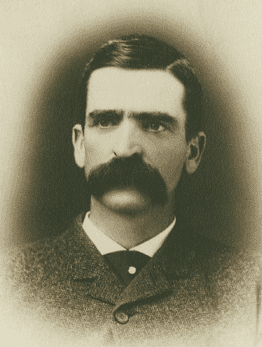
That said, let’s move to the clothes- here are just a few pictures of real Western lawmen:

John Slaughter, Sheriff of Cochise County, Arizona 1887 – 1890

Bass Reeves Lawman the Original Lone Ranger ✔️:

Bass Reeves, Deputy US Marshal, 1876 – 1907

Old West lawman | old-west-lawman_edward-johnson.jpg:

Henry Andrew "Heck" Thomas born January 3, 1850 was an lawman on the American frontier most notably Oklahoma. He was appointed US Deputy Marshal out of Fort Smith, Arkansas working under Judge Isaac Parker.:

Looking at the above pictures, it’s easy to discern that their clothing pretty much mirrored what was generally worn. For the most part, it mostly consisted of trousers, shirt, vest, and a sack coat. In warmer weather, a jacket was not worn and sometimes just the shirt was worn. Allowing for the “dressing up for the camera” effect, it’s still obvious from the more informal portraits that it wasn’t an affected style. In many instances, there was little difference between what a lawman wore and what others wore except for the badge and perhaps more guns.

Lawmen as seen on film.

For anyone desiring to recreate the look of a Western lawman, probably one of the best places to start is with either a sack suit or for something more “out on the trail,” a pair of trousers, shirt, and vest but that’s only a suggestion. There are a lot of original pictures that one can use to base their research on and they can adjust their look depending on what sort of an impression. One thing I do want to note is that except during times when lawmen were in active pursuit of a criminal or otherwise expecting trouble, they were not walking arsenals with multiple pistols and a rifle or shotgun. In town, lawmen frequently simply carried a small caliber pistol in a trouser or coat pocket (often reinforced because of the weapon’s weight).

And another…

Finally, it should be noted that as an elected public official, a county or town sheriff or marshal was expected to project an image of respectability (although the definition of “respectable” could be somewhat elastic) and as such, they tended to dress the part. For many, the position was viewed as more of a means to a political career than anything else and they acted accordingly. One good example of this was with Johnny Behan, the Sheriff of Cochise County. For the most part, he was more concerned with collecting taxes and keeping up appearances; for the actual work of enforcing the law, deputies were hired. Pictures of Behan show him dressed in a sack suit, looking like any middle class small town businessman (which he basically was). Like today, image and respectability were important during the Victorian Era and dressing correctly played a key role.

Johnny Behan, c. 1871

Reality is often pretty dull when compared to what is portrayed in film and television and that especially applied to the lawman of the American West and we hope that you have found this post to be informative. 🙂  


Lily Absinthe & That Old West Magic

It’s going to be a busy week here at No. 11. This is where we make the real old west magic. So many projects, my head is spinning! 🙂

wp-1467071947136.jpg

wp-1467071932877.jpg