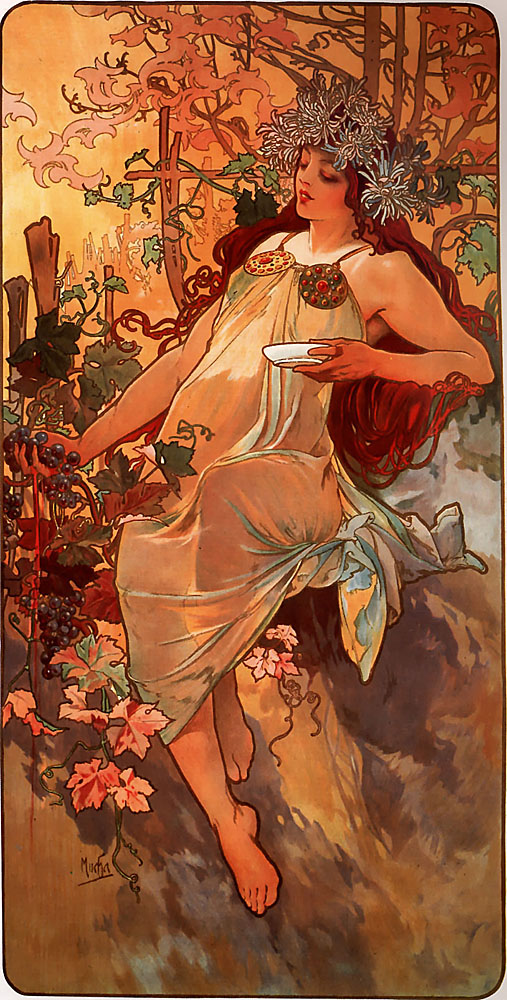
And It Was Showtime…

Today we were planning on heading south to San Diego to take part in the fashion show at the Gaslight Gathering Convention. Unfortunately, due to events beyond our control, we had to cancel our appearance but we still want to promote the event. However, we still want to put a spotlight on the show’s theme which is based on Alphonse Mucha’s Seasons, a series of prints he created in 1896 depicting the seasons as personified:

Spring

Summer

Autumn

Winter

The Seasons was so popular that a second set was subsequently released in 1897. These are simply exquisite and an excellent example of Art Nouveau.

We sincerely apologize for having to cancel our engagement but hope there will be frther opportunities in the future.

1890s Style- Day Wear, Part 3

By 1895, the 1890s “look” for day wear had fully defined itself. In contrast with the relatively static 1880s, styles gave emphasis to a more flowing silhouette that suggested mobility and constant movement. More significantly, in response to the rise of the “New Woman,” we begin to see a proliferation of day styles intended for various specific activities, many of them occurring outside of the home. One of the most profound fashion trends of the 1890s was the development of day wear that was suitable for the workplace. More and more women were taking up newly emerging opportunities to work outside the home and thus there was a need for practical day which was answered by the waist/jacket/skirt combination. Women were also now participating in sporting activities in increasingly numbers to include tennis and golf. And finally, one cannot overlook the radical (for the time) styles that emerged in response to the growth of bicycling- both for sport and as a practical method of transportation.

Image result for 1890s silhouette

The “X” Silhouette

In terms of style elements, no matter the outfit was, they all tended to follow, more or less, the X-silhouette (or hourglass figure) characterized by a combination of the wasp-waist created by corsetry along with A-line skirts and bodices that widen out towards the top with large gigot sleeves. In short, big on the top and bottom and narrow in the middle.

1895-dinner-dresses-harpers-bazar

The Ideal

  Below are a few examples of the variety of day wear that was extant:

5_1895 tweed

Day Dress, c. 1895; Daughters of the American Revolution Collection

In the above picture we see an extremely LARGE set of gigot sleeves, each one almost as large as the bodice front. While the waist is not a severe wasp-shape, it still is structured and defined by the corset underneath and as such, measures 21 1/2 inches. The skirt has clean lines, simply flaring outwards and the bodice features a front with shirring. The basic fashion fabric is a wool tweed combined with shirred silk crepe and velvet trim.

 Below is another example only this time, the bodice is a solid piece that matches the rest of the dress:

1cdee7c7b2e30cbb3e7de0db4b6afa5f

Day Dress, c. 1895; August Auctions

Once again, a basic day dress style only with the bodice being completely made of the same fabric as the skirt. The striped cotton fabric makes for an interesting visual effect combined with the collar, cuffs, and waist belt in a black velvet.

Walking Suit

However, this was not the entire picture…with the New Woman going off to work outside of the house, there was a need for more practical day wear and this was reflected in such styles as the “walking suit” or “tailormades”:

Doucet

Walking Suit, Jacques Doucet, 1895; Victoria & Albert Museum (T.15&A-1979)


6100eb128f5dcbc31f2f04638d2d629f

Waking Suit, 1892; Metropolitan Museum of Art (1982.82.6a, b)

1982-82-6ab_s

Side Profile

1982-82-6ab_b

Rear View

For the top, women’s suits either consisted of a separate jacket and waist or a a faux waist/jacket that were actually one unit. This idea can be seen first seen during the 1880s but it wasn’t until the 1890s that one sees this style pushed further as can be seen with this example:

Walking Suit 1892

Walking Suit, 1892; Metropolitan Museum of Art (C.I.53.72.9a–c)

Walking Suit 1892

Front Close-Up

Walking Suit 1892

Side Profile

Walking Suit 1892

Rear View

The lines on this suit are very clean and the overall effect is very plain except for the soutache on the front and back of the jacket and cuffs as well as running all the way around the skirt hem. The jacket is cut so that it’s mostly open with wide lapels accentuating the top along with the puffed sleeves- the sleeves are relatively undeveloped but this example was made in 1892 before the gigot sleeve trend had set in. What is especially striking about this example is that one can also view the waist separately from the suit:

Finally, we come to the most extreme example of the women’s suit: the bicycling suit:

Cycling Suit 1896

Cycling Suit, 1896; Metropolitan Museum of Art (2009.300.547a, b)

Cycling Suit 1896

Rear View

Cycling Suit 1896

Skirt Top Detail

1980-110-1a-d

Cycling Suit, c. 1896; Philadelphia Museum of Art (1980-110-1a–d)

This is a relatively tame example of the cycling suit in that while the skirt was shorter (essential for clearing the bike chain while riding), it was still a skirt. Later, this style would also feature bloomers, an even more practical garment for riding. Below are some more examples:

e80ef318d90b6fb530904b24d859277e

C. 1897- The individual in the picture does not appear to be happy.

Besides “suits”, bicycling clothes could also consist of separate skirts and jackets or simply waists and skirts.

4f7a81125a6d852abe8bb5889afdb89a

The Delineator, September 1896

Black broadcloth cape and bicycling outfit in 'The Ladies Home Journal', March 1896.:

The same basic outfit worn for bicycling was also practical for other activities such as golf:

e2b70edd495d31878c45dffe96eb35e5

Vasser Students Playing Golf, c. 1895

Besides suits, skirts, and jackets, sporting activities also had an effect on other items of women’s clothing such as sweaters:

10-college-sweater

Women’s College Sweater, c. 1895; DAR Collection

38.93 0002

Women’s Sweater, c. 1895; Metropolitan Museum of Art (2009.300.1111)

Yes, you see that right- sweaters with gigot sleeves! In some circles, this would be considered scandalous- no bodice whatsoever. 🙂 And of course, the logical combination was for the sweater to be worn with a skirt…

2009-300-1111_aw

Sweater & Skirt Combination; Metropolitan Museum of Art

In terms of fashion, the 1890s spawned a wide variety of styles intended for various activities outside the traditional home and while this may seem somewhat tame by today’s standards, it marked the beginning of a major shift in the roles of women in society and we begin to see an increasing number of women pursuing public life, whether through desire , necessity, or a combination of both and it’s a process that’s still playing itself out to this day.

In future installments, we’ll be taking a closer look at day styles of the mid to later 1890s where we see the gigot sleeve grow to sometimes absurd proportions and the subsequent reaction. Stay tuned! 🙂


Lily Absinthe Goes To A Wedding…

This is a bit belated but here’s our wrap-up of the wedding we attended at Heritage Square Museum. First, there’s the venue and what can we say? It’s a wonderful collection of fully restored Victorian Era houses that have been relocated from various parts of Los Angeles to Heritage Square Park and then restored to their former glory. It’s a lovely setting for any sort of a historically-themed event and weddings are no exception. 🙂

wp-1475599975987.jpg

All Set Up For The Wedding

The wedding itself was a marvelously planned affair with the ceremony taking place in front of one of one of the houses. The ceremony itself was relatively simple but very beautiful and was well-attended by family and friends. The reception afterwards was simply amazing and included a complete sit-down meal to include wine and champagne- unlike a lot of weddings, the meal was exquisite and much of it was cooked fresh on-site (before leaving, I discretely asked one one of the servers for a business card 🙂 ). Afterwards, the traditional wedding cake was served up along with an array of pastries and cookies. There was more than enough food for everyone and they even urged people to take home the leftovers- a complete class act and simply beyond amazing.

Adam Heritage Square

Sporting My New Boater…

And then the bride…we had re-worked a vintage Edwardian dress that the bride wore for her wedding gown and it was simply amazing to see in the outdoors- while all our work looks marvelous back at the Atelier, much of it doesn’t really “come alive” until viewed outdoors in natural light and this was no exception:

wp-1475599201567.jpg

The Bride And Groom

wp-1475599242158.jpg

wp-1475599184242.jpg

The flowers along with the backdrop of the green lawn and the brightly-colored houses, it really set off the dress, making it stand out (as it should since she’s the bride). The bride was extremely pleased with the result and she thanked us profusely and that made it all worth it. 🙂

Naturally, the event gave us an opportunity to wear some of our best and we took advantage of the period backdrop to get a few pictures of ourselves… 🙂

wp-1475599453336.jpg

Right Out Of An Impressionist Painting… 

Adam Heritage Square

One More…I’m a bit more serious here…


More On No. 11 On Film…

It’s been a crazy-busy week here at No. 11 in Tombstone so the blog posts have gotten a tad behind…but here’s some more about the TV production that was partially shot at No. 11. It’s for a production by Fox Latino called Run Coyote, Run which is due to air in 2017. According to one website, the series is about “two unlikely friends join forces to create a business in getting people through the US border” and No. 11 in Tombstone would be filling for Naco.

wp-1475512788150.jpg

Getting Set Up

While we’ve worked on our share of film and television projects, this one is the first time we’ve been involved as a filming location. Horror stories abound of location shoots that have gone bad but what we experienced was quite the opposite and it was overall a pleasant experience. The entire crew was very professional and easy to work with and it event turned out that some of the crew members and ourselves had mutual friends- small world. Interestingly enough, the crew had a mix of Mexicans and Americans but everything seemed to work just fine.

wp-1475512822908.jpg

Rigging The Lighting- The door to the right was replaced with a “stunt door.” 

Most of the filming involved exterior shots of the house, mostly at night, and while this presented no problem, we did have to work around a succession of rainstorms passing through Tombstone (great timing, that). The one major element was that one of the characters would be breaking the windows in a door in a drunken rage so the production crew replaced one of the front doors with a new one purchased at Lowe’s (everything was set right at the end to include clean-up). As things turned out, because of the delays caused by the rainstorms, they had to film part of a second evening so everything actually took two days from start to finish.

wp-1475512803305.jpg

The “Stunt Door” from the outside.

While this experience was somewhat outside of our normal realm of fashion and history, it was still an interesting experience and we met some amazing people who we hope we can work work with in the future.

wp-1475512772905.jpg

Another view of the bedroom and the “stunt door”…

wp-1475512752094.jpg

Molly was not happy having her space invaded…

wp-1475512724631.jpg

Equipment Everywhere…

1890s Style- Day Wear, Part 2

With few major exceptions, the process of fashion evolution tends to be gradual and it doesn’t always happen evenly or in a straight-forward manner. In fact, much of the dating used in fashion history tends to be arbitrary and represented more of an approximation than a precise moment when a fashion changed. During the late 19th century, fashion change came at a much slower pace than what we’re used to today in an era of fast fashion and social media and sometimes it defies neat categorization.

In our last installment, we attempted to identify some signs that the shift from the bustle silhouette to something different was happening in the years from 1889 through 1890 but our conclusions are by no means the only ones possible. Our goal is to shine a light on some of the more obscure aspects of late 19th Century fashion and provide a starting point for further study. With that, let’s proceed… 🙂


wp-1474052003382.jpg

As the 1890s moved on, the bustle had almost disappeared except for perhaps a small pad in some instances. Essentially, the basic silhouette was taking on a more upright appearance with an emphasis on a less structured flowing skirt ending in a narrow waistband. Moreover, as the 1890s progressed, we being to see the emergence of the “wasp waist” silhouette where the skirt and the bodice were emphasized while the waist was minimized, an effect achieved through corseting; the iconic leg of mutton sleeves contributed to this by emphasizing the upper torso.

This style began to manifest itself by 1892 and here are a few examples or at least the idealized version:

journal-des-demoiseles_jan-1892

Journal Des Demoiselles, 1892

journal-des-demoiseles_aug-1893

Journal Des Demoiselles, August 1893

delineator-1894

The Delineator, 1894


1894-la-mode-illustree

Le Mode Illustree, 1894

journal-des-demoiseles_aug-1894

Journal Des Demoiselles, August 1894

The above fashion plates pretty much capture the shift in styles during the early to mid 1890s characterized by a narrow waist and exaggerated fullness to the skirt and bodice. The full upper sleeves (often termed gigot or leg of mutton sleeves) also served to emphasize the bodice size and these came in a variety of shapes and configurations. Compared to the 1880s, 1890s style seemed to be relative unstructured with flowing skirts and seeming emphasis on a free-flowing “natural form.”

The fashion plate below provides an excellent visual summary of the early to mid 1890s silhouette where we see a narrow “wasp waist” combined with a voluminous skirt and bodice: broadly speaking, the silhouette was now of an “X” shape.

1894

When viewing these fashion plates, it would seem that dresses had become more loose (i.e. natural) with much less of the sculpted structure that characterized the 1880s. However, 1890s style was just as structured but in a different way. Whereas the 1880s skirts were characterized by draping and bustled trains, 1890s skirts were characterized by gored skirts that were wide at the bottom and culminated in a narrow waist, emphasizing free movement. To balance the wide skirts, bodices were also cut full. Of course, there was a variety in the individual details but the ultimate silhouette was still there.

Fashion plates can be informative but only go so far in helping to understand style. As with the 1870s and 80s, there were several basic styles that could be worked in a seemingly infinite combination of fabrics and trims. As with all late 19th Century styles, while the overall silhouette tended to remain the same, choices in fabrics, cut, and trim often varied, ranging from the very plain and utilitarian to the elaborate on a scale suitable for the most formal of day affairs.

Below are a few different examples:

Day Dress 1894

Day Dress, c. 1894; Metropolitan Museum of Art (35.134.13a, b)

Day Dress 1894

Close-Up Of Bodice Front

Day Dress 1894

Side Profile

Day Dress 1894

Rear View

Day Dress 1894

Detail Of Sleeve And Cuff

Naturally, the one is first attracted by the striking effects of the silk overskirt with its pattern of waving stripes in light and dark gray (or light and dark silver, depending on your interpretation); it’s an incredible weave. What is also interesting is the juxtaposition of velvet sleeves and collar and bodice trim, all in brown- you have the cold grays combined with a warm brown. The center is the bodice is a bit busy with a lace front but is framed by more light gray silk that matches the light gray stripes. Finally, the bullion soutache adds further embellishment that further adds to the dress’s overall effect. The use of fabrics and trim all combine to create a three-dimensional effect of various textures.

In terms of silhouette perspective, the use of the over and under skirt combination would seem to be a throw-back to the 1880s (it wasn’t for the the sleeves and bodice which are definitely characteristic of the 1890s). It’s an interesting anomaly and one can see a few examples in fashion plates- perhaps this is more of a transitional style but definitely not the norm.

Now for a something more plain:

eb91709075c220165b4c75b81aaae768

Day Dress, c. 1893 – 1894; Metropolitan Museum of Art (C.I.58.2a, b)

1890s style for day dresses was often relatively simple with little trim and often monochromatic. Here we see a more developed set of gigot or leg-of-mutton sleeves, narrow waist and full, untrained skirt with multiple gores. The bodice is designed to mimic the waist and jacket combination only all in one color.

Finally, here’s another common style based on the jacket/waist combination:

1893 Walking Dress

Walking Dress, c. 1893; Metropolitan Museum of Art (1979.163a, b)

1893 Walking Dress

Close-Up Of The Bodice

1893 Walking Dress

Side Profile

1893 Walking Dress

Rear View

 Here are a few more views:

The walking suit was a popular style and features a wool check pattern skirt and outer jacket combined with a navy blue waist complemented with wide lapels in the same color. Often, the jacket featured wide lapels which carried over in to the early 1900s, the lapels growing even more extravagant in size.

From the above examples and those in the previous post, we can see the emergence of the classic wasp waist or “X” silhouette of the Mid-1890s. In the next installment, we’ll take a closer look of this classic 1890s style and especially the “leg-of-mutton” sleeve style so stay tuned. 🙂